
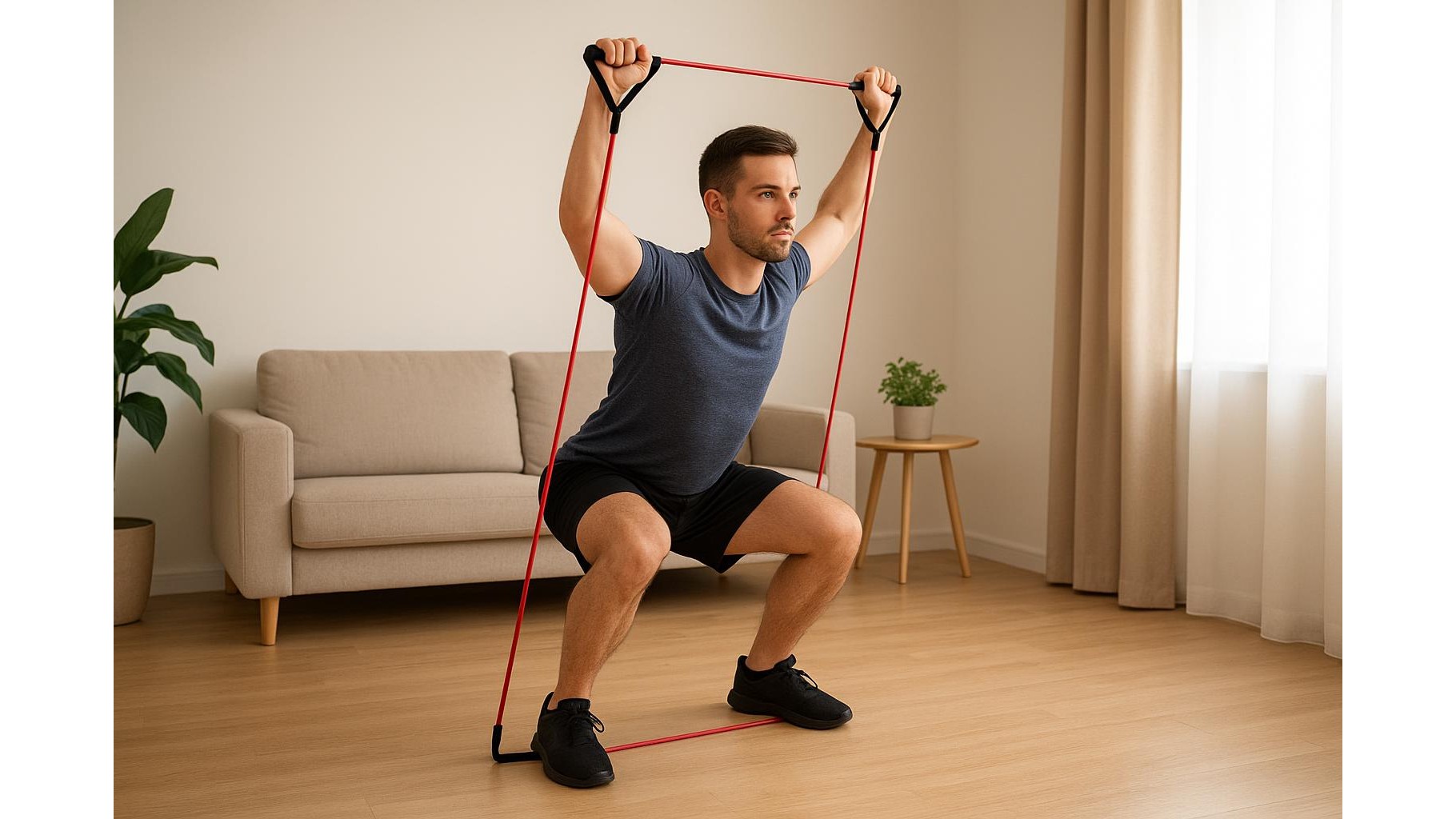
Training at home does not have to mean owning a full rack of weights. With a single resistance tube with handles you can build a safe, effective full body strength workout in just 30 minutes, even in a very small space. This routine offers three intensity options so both beginners and intermediates can progress using the same simple piece of equipment, without complicated setups.
Why train with a single resistance tube at home
A quality resistance tube lets you train your chest, back, legs, core and shoulders with one lightweight tool that fits in a drawer or suitcase. Elastic resistance challenges your muscles throughout the entire range of motion and is gentler on the joints than many free weights. Because the tube can be anchored under your feet or around a sturdy object, you can easily adjust tension by stepping wider or moving further from the anchor. This makes the workout highly scalable without needing different dumbbell sizes. For home gym beginners, it is also less intimidating and safer to handle than heavy iron.
Essential setup and safety cues before you start
Before each session, check your tube and handles for cracks or fraying and avoid using it on sharp or abrasive surfaces. Stand with a light bend in the knees, engage your core and keep your chest open to protect your lower back. When you set resistance by stepping on the tube, make sure it is centered under your feet and that both sides are even to avoid imbalances. Move in a slow, controlled tempo: around two seconds to lift, two seconds to lower. Never let the band snap back. Breathe out on the effort (when pulling or pressing) and in on the easier phase. If you feel joint pain, reduce the stretch or switch to the lighter intensity option described below.
30-minute full body structure and intensity options
This 30-minute routine uses six compound moves: squats with a shoulder press, bent-over rows, chest press, Romanian deadlifts, standing chest-openers and core anti-rotation holds. Perform each exercise for 40 seconds, followed by 20 seconds of rest, cycling through the six moves for three total rounds. Beginners should use a shorter range of motion, stand closer to the anchor and keep the tube with slight slack at the start of each move. Intermediates can increase intensity by stepping wider, moving further from the anchor and adding a brief pause at the point of maximum tension. Advanced home athletes can shorten rest periods to 10–15 seconds and focus on deep, full ranges of motion while maintaining perfect form.
Upper body moves: pull, push and posture work
For the upper body, anchor the tube in a doorway or around a sturdy post for rowing and chest movements, or stand on it for overhead work. In the bent-over row, hinge at the hips with a flat back, hold the handles and pull your elbows toward your ribs, squeezing the shoulder blades together to target the upper back and lats. For the chest press, face away from the anchor, handles at chest height, and press straight forward, keeping wrists neutral and elbows slightly down, not flared, to protect your shoulders. Finish the circuit with standing chest-openers or band pull-aparts to strengthen the postural muscles, focusing on drawing shoulders away from the ears and maintaining a long neck throughout the movement.
Lower body and core: squats, hinges and anti-rotation
To train the lower body, stand on the middle of the tube, feet about hip to shoulder width. For squats with a press, hold the handles at shoulder height, sit your hips back and down as if to a chair, then drive through the heels to stand and press the handles overhead in one fluid motion, working legs, glutes and shoulders together. Romanian deadlifts target the hamstrings and glutes: keep a soft knee bend, push the hips back and lower your torso until you feel a stretch in the back of your legs, then return to standing by driving the hips forward. For the core, use the tube anchored at chest height, stand side-on, hold the handles close to your sternum and resist the band’s pull as you slowly press your arms straight out, training anti-rotation strength and a stable midsection.
Progression, recovery and long-term consistency
Repeat this full body resistance tube workout two to four times per week, leaving at least one rest day between strength sessions. As you adapt, progress by increasing band tension, adding an extra round, or extending work intervals to 45–50 seconds. Always prioritise smooth technique over resistance: when your form breaks down, you are done for that set. Combine this workout with light walks or low-impact cardio on alternate days to support recovery and cardiovascular health. With just one simple tool and a consistent 30-minute routine, you can build strength, improve posture and maintain long-term fitness without leaving your living room.









