
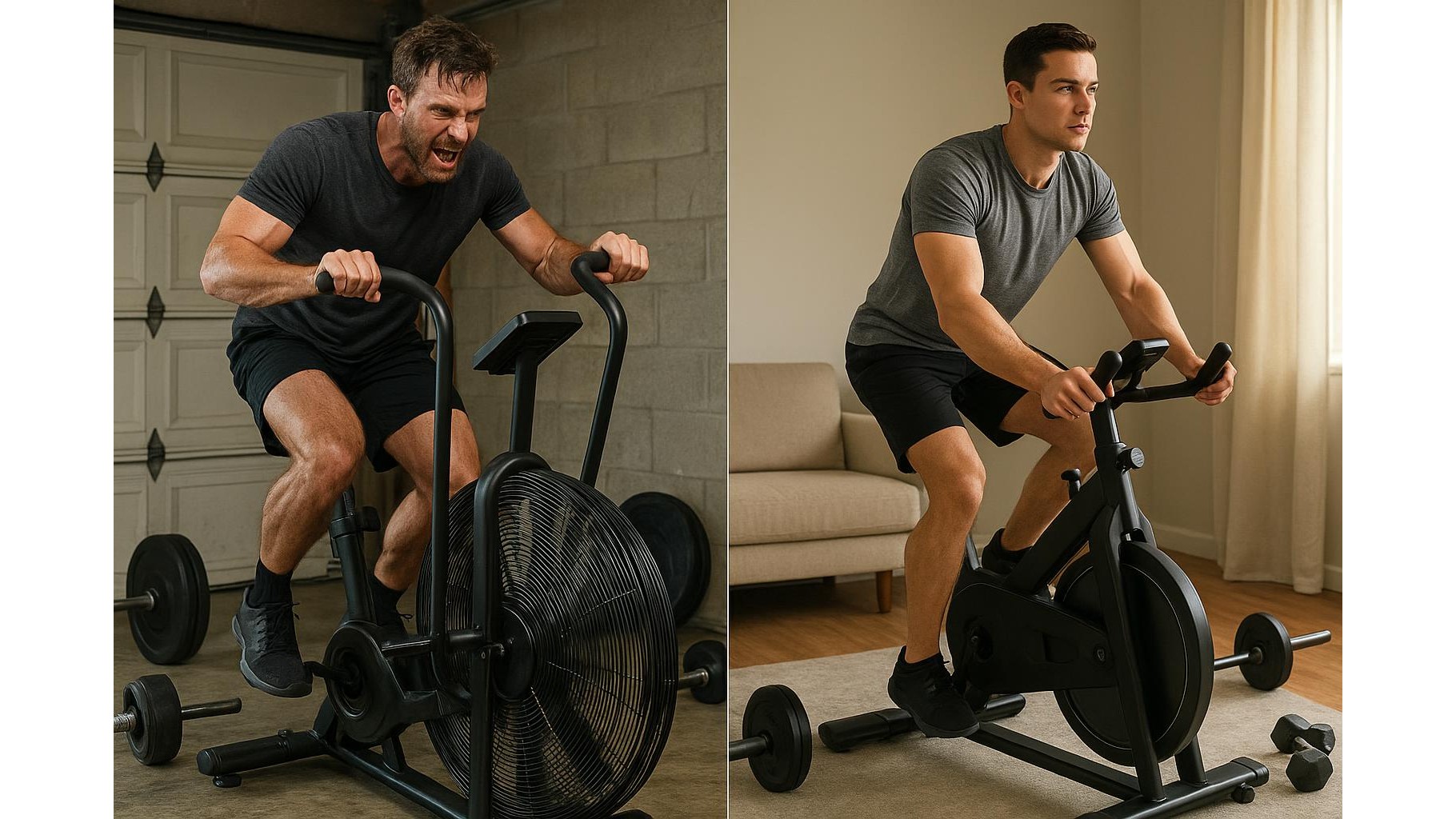
When your weekly routine is built around heavy strength training, your choice of home cardio matters. You need a machine that supports recovery, builds conditioning, and doesn’t wreck your joints or your sleep with excessive noise. Two of the most popular options are the air-resistance fan bike and the magnetic spin bike. Although they both live in the “bike” category, they behave very differently when paired with squats, deadlifts and pressing days.
How fan bikes and magnetic spin bikes generate resistance
An air-resistance fan bike uses a large fan that pushes against the air: the harder you pedal (and push/pull the arms), the more resistance you create, with no real upper limit. This makes fan bikes ideal for brutal, short intervals that spike heart rate fast. A magnetic spin bike, on the other hand, uses magnets and a flywheel: resistance is set via a dial or console and stays consistent until you change it. That gives you very smooth, predictable resistance, perfect for longer, steady rides or structured intervals where you want tight control over power and cadence.
Interval training and conditioning on strength days
On days when your legs are already toasted from heavy squats or deadlifts, the type of interval training you choose can make or break recovery. Fan bikes shine for short, all-out efforts like 10–20 second sprints with long rest periods, mimicking the demand of intense sets in the weight room. Because resistance auto-adjusts to your effort, they’re fantastic for high-intensity intervals (HIIT) and mixed upper-lower conditioning. Magnetic spin bikes are better suited to controlled intervals such as 1–3 minute efforts at a fixed resistance and cadence. This makes them friendlier for strength-focused lifters who want to build their aerobic base without adding too much neuromuscular fatigue from repeated all-out sprints.
Joint stress, posture and recovery impact
Both fan bikes and magnetic spin bikes are low-impact, but they load your body differently. Fan bikes require a strong push-pull with the arms and heavy leg drive, creating a very full-body pattern that can stress already tired shoulders or hips if technique breaks down. The constant acceleration and deceleration in all-out fan sprints can feel harsh on knees if you are not warmed up properly. Magnetic spin bikes encourage a more classic cycling posture with steady pedalling; resistance is smoother, so joints experience less abrupt force changes. For lifters dealing with cranky knees or lower backs, a spin bike with a well-adjusted saddle height and handlebar position often provides a more joint-friendly recovery ride, especially on the day after a heavy lower-body session.
Noise, home environment and training schedule
Noise is a major factor in a home gym, particularly if you train early or late. Fan bikes are inherently loud because the fan has to move a lot of air to create resistance: during hard intervals you will hear a strong whooshing sound that can easily carry through walls. That can be an issue in flats, shared spaces or when training near bedrooms. Magnetic spin bikes operate almost silently: the magnetic resistance system and belt drive make only a soft hum, so they are more compatible with apartment living, watching TV, or training while others sleep. If your schedule forces you to train at noise-sensitive times, the magnetic option usually wins for practicality.
Fitting each bike into a strength-focused weekly plan
For a lifter whose priority is strength and muscle, cardio needs to support performance, not sabotage it. A good structure is to use a fan bike for one weekly high-intensity conditioning session on an upper-body day or after a lighter lower-body workout. This session can focus on short, powerful intervals to build work capacity without overdoing volume. The magnetic spin bike can then handle two to three low- to moderate-intensity rides per week, placed either on rest days or after sessions where you want active recovery and improved blood flow with minimal fatigue. In this way, the fan bike becomes your “strength of the lungs” tool, while the magnetic spin bike serves as your quiet, reliable base-building and recovery machine.
Both the fan bike and the magnetic spin bike can integrate well into a heavy lifting routine, but they serve slightly different roles. Fan bikes excel at brutal, short HIIT sessions that mirror the intensity of heavy strength work and rapidly improve conditioning, at the cost of higher noise and potential fatigue if overused. Magnetic spin bikes provide controlled resistance, minimal joint stress and near-silent operation, making them ideal for frequent, recovery-oriented rides and aerobic base building. Choose the fan bike if you crave all-out intervals and don’t mind noise; choose the magnetic spin bike if you need quiet, predictable cardio that keeps your strength training at the centre of your weekly plan.









