
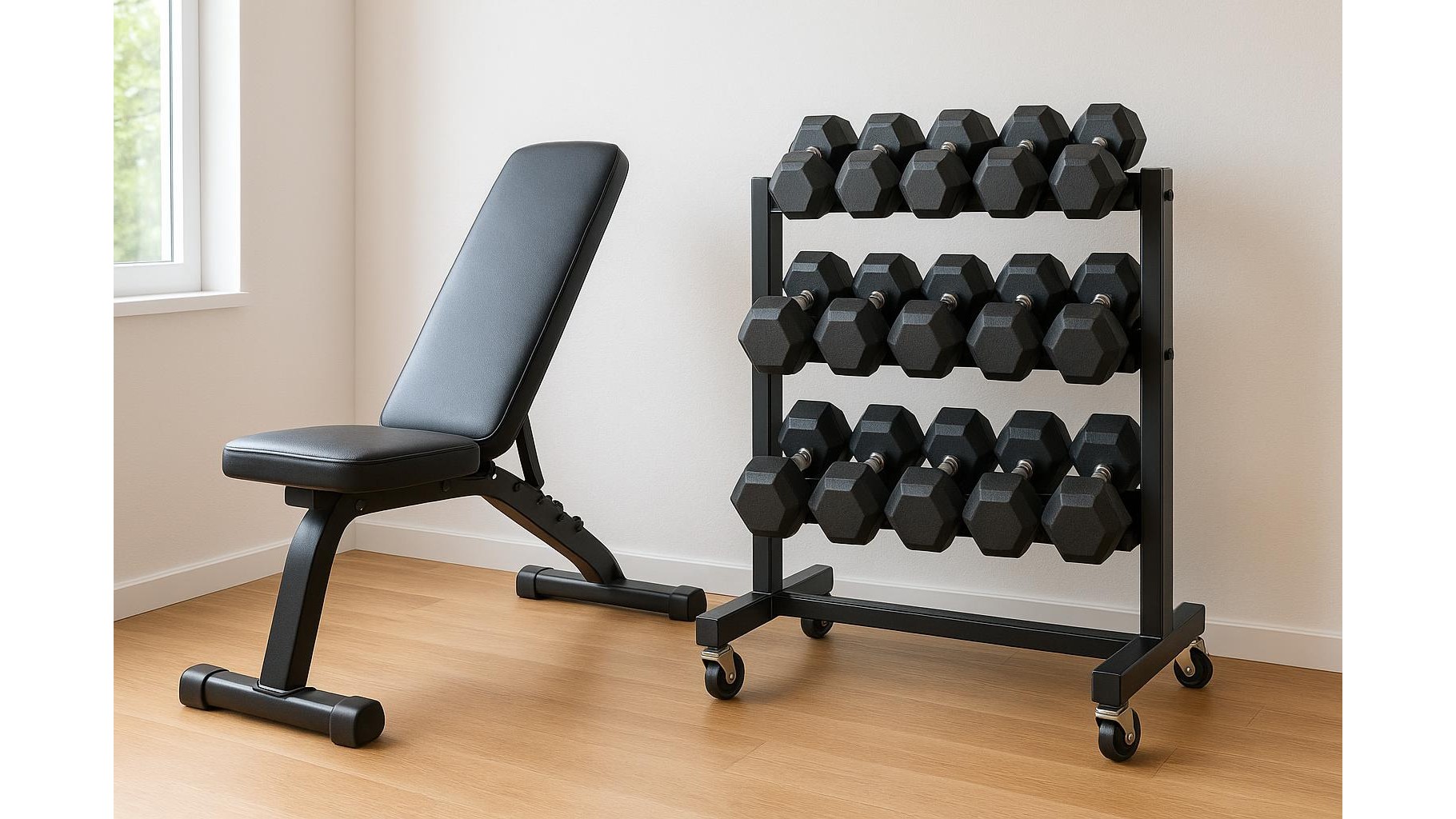
Rolling dumbbell racks can completely change how your home gym feels and functions. Instead of a heavy, fixed stand that blocks walkways or eats up floor space, a mobile dumbbell rack lets you bring the weight you need to your training zone and roll it away when you are done. In a small flat, garage gym or multi‑use room, choosing the right wheeled storage is the difference between a tidy, motivating workout corner and a cluttered hazard.
Why a rolling dumbbell rack makes sense in small home gyms
A dumbbell rack on wheels is ideal when your training area also serves as a living room, office or kids’ playroom. You can store multiple pairs of free weights vertically instead of lining them up on the floor, and then move the whole unit against a wall when you need open space for yoga, stretching or mobility work. Unlike fixed shelving, a rolling rack lets you reconfigure your layout as your training changes: pull it next to your bench for heavy presses, roll it near a mirror for form checks, or park it under a window to free up the centre of the room.
Capacity and compatibility with your current (and future) weights
When choosing a mobile dumbbell rack, start with capacity. Count your current pairs and add at least 30–50% extra space for future upgrades. Many compact wheeled racks hold between 6 and 10 pairs of dumbbells, which is perfect for a small home gym that uses light to moderate weights for HIIT, circuits and accessory work. Check that the tiers or cradles can accept the shape of your dumbbells: some racks are optimised for hex rubber dumbbells, while round or neoprene styles may need flat shelves rather than individual saddles. A smart layout is to keep heavier pairs on the bottom tier and lighter ones on top to improve stability and make quick weight changes feel more intuitive.
Stability, safety and frame design
A rolling rack still needs to feel rock solid when parked. Look for a steel frame with welded joints, a wide base and a published maximum load that comfortably exceeds your full set of dumbbells. Lower, V‑shaped or A‑frame designs tend to be more stable than tall, narrow towers, especially on uneven garage floors. Anti‑tip features matter in homes with children or pets: heavier weights stored low, rubber feet at the front and lockable casters all reduce the chance of the rack shifting or wobbling. Also consider the height of the top tier so you are not repeatedly lifting heavy weights above shoulder level just to rack them, which can be both inefficient and risky.
Wheel quality, maneuverability and floor protection
The wheels are what separate a great rolling dumbbell rack from a frustrating one. Choose models with large rubber or polyurethane casters that roll smoothly over hard floors and low‑pile carpet without digging in. At least two, ideally all four, wheels should have reliable locking brakes so the rack does not move while you are racking or unracking heavy dumbbells. Soft, non‑marking wheels will protect wooden or vinyl floors from scuffs, while 360‑degree swivel casters make it easy to turn the rack in tight spaces. In very small rooms, being able to angle the rack sideways into a corner can reclaim valuable square footage you would otherwise waste.
Layout ideas: keeping weights close but never in the way
To actually save space, plan where your wheeled rack will live when not in use and how it will move during workouts. One effective layout is to park the rack along the shortest wall, then roll it next to your adjustable bench or squat stand only when needed. In a living room gym, tuck the rack behind a sofa or near a TV stand so it reads more like furniture than equipment. If you combine strength and cardio, keep the rack positioned between your power rack and a compact cardio machine so you can flow between lifts and intervals without crossing the room. The goal is to have dumbbells always within arm’s reach of your main training zone, yet instantly movable when you need a clear, open floor.
Choosing the right rolling dumbbell rack for your home gym means balancing capacity, stability, wheel quality and smart layout. A compact, sturdy rack with good casters turns scattered weights into a single, mobile station that follows your workout instead of dictating it. By thinking ahead about how you store and move your dumbbells, you can keep your training tools close, your floors clear and your home gym feeling spacious, organised and ready for serious sessions.









