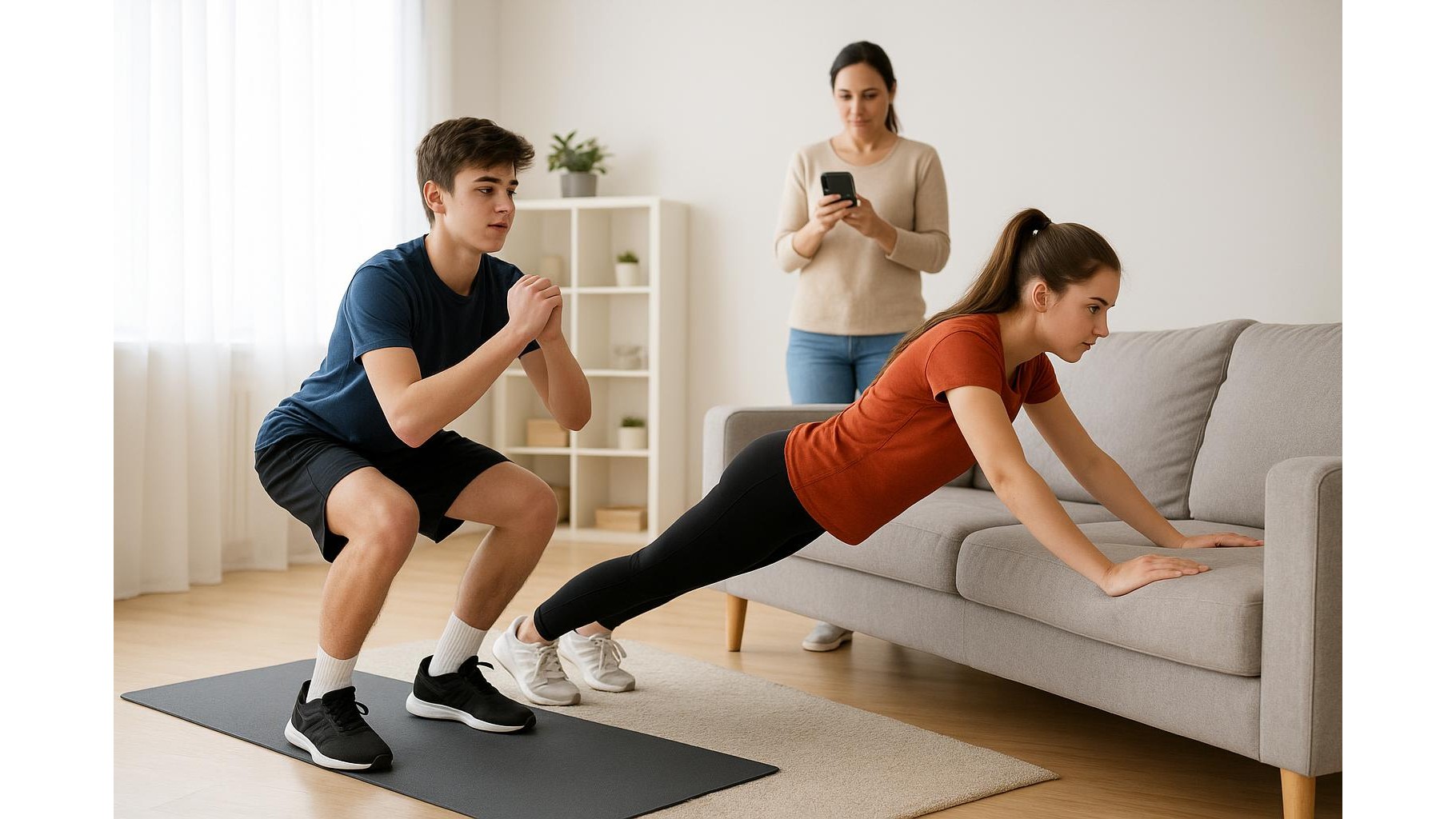
Building strength at home for teens does not have to mean heavy weights or complicated machines. With the right structure, a simple 30-minute bodyweight workout can improve posture, coordination, and confidence, while staying joint-friendly and age-appropriate. This routine is designed for teenagers aged 13–17 and can be followed together with a parent or guardian to keep training safe, effective, and fun.
Safety first: rules for teens and parents
Before starting, agree on some basic home workout safety rules. Train on a non-slip surface with enough space to move arms and legs freely. Warm up for 5 minutes with gentle marching, arm circles, and easy bodyweight squats. Teens should stop immediately if they feel sharp pain, dizziness, or shortness of breath. Parents can watch for technique and breathing: no holding the breath, and no racing through reps. The focus is on control and form, not on how many reps can be done. Two or three sessions per week with at least one rest day in between is enough for progress.
The 30-minute structure: sets, reps and rest
This teen bodyweight workout follows a clear structure: 5-minute warm-up, 20-minute strength circuit, and 5-minute cool-down. The strength block uses 6 exercises done in a circuit. Perform each exercise for 30–40 seconds, then rest for 20–30 seconds. After all 6 moves, rest 1–2 minutes and repeat the circuit 2–3 times depending on fitness level. Beginners can start with 2 rounds, while more active teens can complete 3. Parents can keep time with a phone timer and gently cue posture, reminding teens to move smoothly and to stay within a comfortable effort level of around 6–7 out of 10.
The joint-friendly full-body circuit
The routine balances upper body, lower body, and core while protecting growing joints. Try this 6-exercise circuit:
- Incline push-ups on a sturdy table or wall for shoulders and chest
- Bodyweight squats to a chair to guide depth and protect knees
- Dead bug core exercise on the floor for spine stability
- Hip bridge for glutes and lower back support
- Half-plank from knees to train core without overloading
- Reverse lunges with bodyweight only, holding onto a chair if needed
All movements should be slow and controlled. Teens should keep a neutral spine, knees tracking over toes, and shoulders relaxed away from the ears.
Technique tips and common mistakes
Good technique for teen strength training starts with body awareness. For squats, think about sitting back into a chair, keeping heels on the floor and chest gently lifted. In push-ups, keep the body in a straight line from shoulders to knees or ankles, without letting hips sag. For core moves like dead bugs and planks, brace the abdominals as if preparing for a light poke, and avoid arching the lower back. Common mistakes include rushing reps, using momentum, and holding the breath. Parents can coach simple cues like “slow and steady”, “breathe out as you push”, and “quality over quantity”.
Cool-down, recovery and when to progress
Finish with 5 minutes of cool-down and stretching. Focus on thighs, calves, hips, chest, and shoulders with gentle holds of 15–20 seconds each, without bouncing. Hydrate after the session and encourage a balanced snack with protein and carbs if the workout is performed before a meal. Teens can progress gradually by adding 5 seconds to each work interval, increasing to a third circuit round, or moving from incline push-ups to floor push-ups when form is solid. If soreness is mild, it is normal and should ease in 24–48 hours; strong or lingering pain is a sign to reduce intensity or rest. Over time, this simple plan builds a foundation of strength, stability, and confidence for more advanced training.
With a clear structure, joint-friendly exercises, and support from parents, a 30-minute teen home workout can safely improve strength, posture, and athleticism. Sticking to good form, sensible progressions, and regular rest days helps teenagers develop lifelong fitness habits and prepares them for any sport or future gym training.