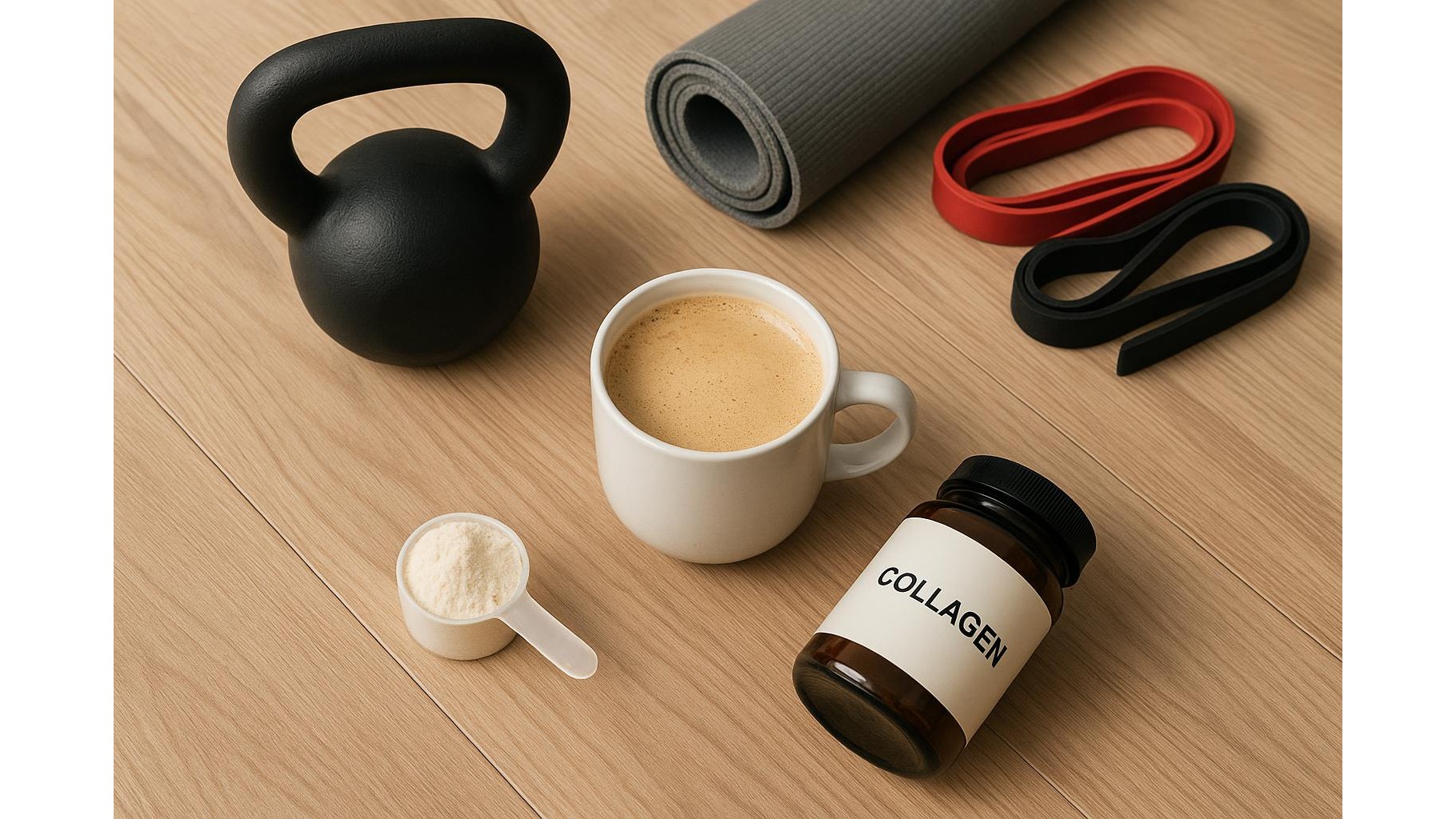
For home athletes trying to get the most out of limited training time, small nutrition choices can make a big difference. Two trends dominate social feeds and kitchen cupboards right now: flavoured collagen coffee creamers that promise better joints, hair and skin, and classic protein powders aimed at building and maintaining muscle. They are often marketed as interchangeable, but from a sports nutrition perspective they do very different jobs. Understanding how they differ in protein quality, joint support, dosing and convenience will help you decide what really supports your home workouts.
Protein quality: why collagen and whey are not the same
When you’re training at home with dumbbells, a barbell or just bodyweight, your first nutrition priority is meeting your daily complete protein target. Collagen-based creamers are made from collagen peptides, which are very low in the essential amino acid tryptophan and relatively low in leucine. That means they score poorly on indices like PDCAAS and DIAAS and are not considered a complete protein source. In contrast, typical whey protein powders provide all essential amino acids and around 2–3 g leucine per 25–30 g serving, enough to trigger robust muscle protein synthesis after training. For building or preserving lean mass, especially when you train in a caloric deficit, a standard protein powder clearly outperforms collagen coffee creamers.
Joint health and recovery: where collagen can shine
Collagen coffee creamers are popular because of their claimed benefits for joint health, tendons and even skin. Mechanistically, collagen peptides supply high levels of glycine, proline and hydroxyproline, amino acids that are abundant in connective tissues but relatively scarce in typical high-protein gym diets focused on chicken, eggs and whey. Emerging research suggests that taking 10–15 g of collagen peptides, ideally with some vitamin C, 30–60 minutes before loading the joints (for example, a skipping, running or lower-body strength session) may support collagen synthesis in cartilage and tendons over time. For home trainees with a history of knee or shoulder discomfort, adding a collagen product to coffee can be a convenient way to reach those connective-tissue–supporting doses, but it should be viewed as complementary to, not a replacement for, complete protein.
Dosing, timing and realistic expectations for home athletes
To maximise performance and recovery while training at home, aim for roughly 1.6–2.2 g of protein per kg of bodyweight per day, split into 3–5 meals containing 20–40 g of high-quality protein. A scoop of typical protein powder easily fits that framework and can be used post-workout, as a snack or to top up a low-protein meal. Collagen coffee creamers are usually dosed much lower per serving—often 5–10 g of collagen with additional fats and flavourings—and many blends do not provide enough total collagen to match research protocols unless you double up. For joint support, you’ll likely need to follow label guidance and ensure you actually hit those 10–15 g per day. In terms of expectations, collagen is a slow-burn supplement: any joint or skin benefits tend to emerge after weeks or months, while the impact of whey or other complete proteins on muscle recovery is felt much sooner.
Convenience, calories and daily routine in a home gym lifestyle
From a lifestyle perspective, collagen coffee creamers win on habit stacking: many home athletes already drink coffee every morning, so adding a scoop is frictionless. However, these creamers can include extra sugars, MCT oils or other fats that raise the drink’s calorie content without delivering proportionate protein. If fat loss or weight maintenance is a priority, those hidden calories matter. A simple whey protein powder mixed with water or low-fat milk delivers far more protein per calorie, and an unflavoured powder can even be stirred into oats, yoghurt or smoothies without changing your coffee routine. For busy home workers who train between meetings, a ready-to-shake protein serving is often more predictable and easier to track than a flavoured creamer whose macros vary widely between brands.
When to choose collagen creamers and when to choose protein powders
For a typical home trainee focused on strength, hypertrophy or body recomposition, a complete protein powder should form the backbone of your supplementation, ensuring you reliably hit your daily protein target. Collagen coffee creamers make more sense as a targeted add-on if you want to experiment with joint or connective tissue support, particularly during higher-impact blocks of training or when you increase volume on skipping, running or plyometric work. You could, for example, keep your usual whey shake post-workout and add a collagen creamer to your pre-workout coffee on heavy leg or HIIT days. Framed this way, the question isn’t collagen versus protein, but how to combine a complete protein base with optional collagen to support both muscles and joints in a realistic, sustainable home gym routine.
In summary, collagen coffee creamers and traditional protein powders serve distinct roles. Protein powders offer superior muscle-building support thanks to their complete amino acid profile and higher leucine content, making them essential for most home athletes’ recovery and performance. Collagen products, including creamers, are better viewed as niche tools aimed at joint and connective tissue support when dosed appropriately and used consistently. Choose a high-quality protein powder as your foundation, consider collagen as a strategic supplement if joint health is a concern, and always prioritise total daily protein and calorie balance over marketing claims.