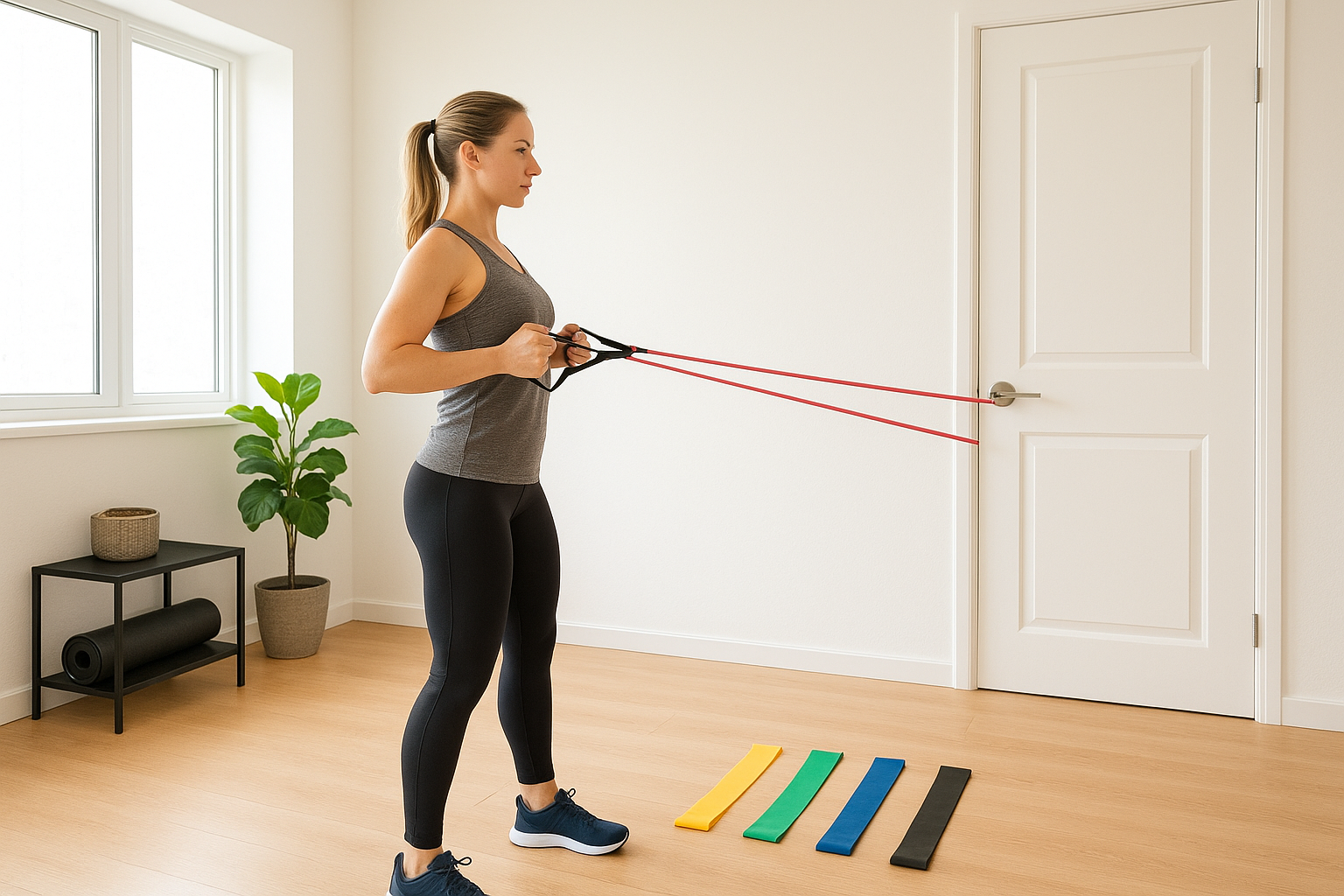
Building strength at home does not require bulky machines or a gym membership. With a simple set of resistance bands, you can follow a structured, beginner-friendly 4-week plan that gradually increases in difficulty while staying joint-friendly and time-efficient. This guide walks you through clear sessions, how often to train, and how to progress safely using only bands in your living room.
Why choose resistance bands for home strength?
Resistance bands are ideal for beginners because they offer adjustable resistance, smooth tension, and are gentle on the joints compared to free weights. They take up almost no space and are perfect for a small home gym. By choosing a set that includes multiple bands, handles, and a door anchor, you can perform full-body workouts without extra equipment. The constant tension helps improve muscular strength and control, and you can easily scale exercises up or down by switching bands or adjusting your stance, making them perfect for a 4-week progressive plan at home.
Essential band setup and safety at home
Before starting, set up your home workout space. Use a non-slip surface and ensure your resistance bands are free from cracks or frays. When using a door anchor, always secure it on a solid, closing door and pull gently first to test stability. Stand tall with a neutral spine, engage your core, and avoid locking your joints at the end of movements. Move with control in both directions, focusing on slow returns to build strength safely. Begin each session with 5 minutes of light marching, arm circles, and band pull-aparts using the lightest band to warm up your muscles and protect your shoulders and lower back.
Week 1: learning movement patterns
In Week 1, the goal is to learn correct technique and get used to time under tension. Train three non-consecutive days per week (for example, Monday, Wednesday, Friday). Perform 2 sets of 10–12 reps for each exercise, resting 60 seconds between sets. A simple full-body circuit could include banded squats, standing chest press with the band anchored at chest height, seated rows with the band looped around your feet, standing overhead press, and glute bridges with the band around your thighs. Use a light band so you can complete every rep with good form. Focus on smooth breathing and posture rather than pushing heavy resistance in this first stage.
Weeks 2–3: building strength and volume
From Week 2, increase the challenge while still keeping the program beginner-friendly. Maintain three sessions per week but move to 3 sets of 10–15 reps. If the last three reps feel easy, step slightly farther from the anchor point or move up to a medium band. Add variations like banded split squats, single-arm rows, and standing rotations to engage your core stability. In Week 3, you can introduce simple progressive overload by shortening rest periods to 45 seconds or adding one extra exercise for each major muscle group. Always prioritise controlled movement and full range of motion over band thickness.
Week 4: progression and mini-challenges
Week 4 is about consolidating strength and testing your progress with safe, manageable challenges. Keep three main sessions, but turn them into circuits: perform 5–6 exercises back-to-back with 30–45 seconds rest, then rest 2 minutes and repeat the circuit 2–3 times. Mix upper, lower, and core moves to keep your heart rate elevated: for example, banded squats, rows, chest press, hip hinges, overhead press, and anti-rotation holds. If you can perform more than 15 reps with perfect form, increase tension by switching bands or adjusting your stance. Finish each workout with a few minutes of light stretching using the band to improve flexibility and recovery.
Maintaining results beyond 4 weeks
After completing this 4-week home strength plan, you will have built a foundation of strength, better posture, and improved body awareness using only resistance bands. To maintain progress, continue training at least two to three times per week and gradually add variations, such as banded deadlifts, lateral walks, and push-up progressions. You can also increase volume by adding sets or a fourth weekly session focused on weaker muscle groups. Because bands are portable, this programme can travel with you, keeping your home fitness routine consistent over time. With structured progression and mindful technique, resistance band training can remain a safe, effective cornerstone of your strength journey.
In summary, a beginner-friendly 4-week home strength plan using only resistance bands offers an accessible way to build muscle, boost stability, and train your entire body without leaving home. By starting light, focusing on form, and gradually increasing resistance and volume, you can make steady, noticeable gains in strength and confidence with minimal equipment.