Training your entire body at home does not require a full rack of machines. With a simple pair of dumbbells, a clear wall and a smart tri-set workout structure, you can build strength, improve conditioning and stay consistent in a small space. This 40‑minute session focuses on three fundamental patterns – legs, push and pull – and shows beginners and intermediates how to adjust load, tempo and rest to match their level.
Table of contents
Why a tri-set full body workout works at home
A tri-set means you perform three exercises back to back with minimal rest, then rest at the end of the block. For a home full body strength workout, this format is ideal: you hit more muscle groups in less time, keep your heart rate elevated and make the most of limited equipment. In this plan, each tri-set includes a leg movement, a push movement and a pull movement, ensuring balanced training for the whole body. Working in tri-sets also makes it easier to manage time: set a timer for 40 minutes, complete as many quality tri-set rounds as you can, and you have a simple, repeatable structure that fits busy schedules and small living rooms.
[h ol_placeholder type=”cta” id=”telegram”/]
Essential gear: two dumbbells and a wall
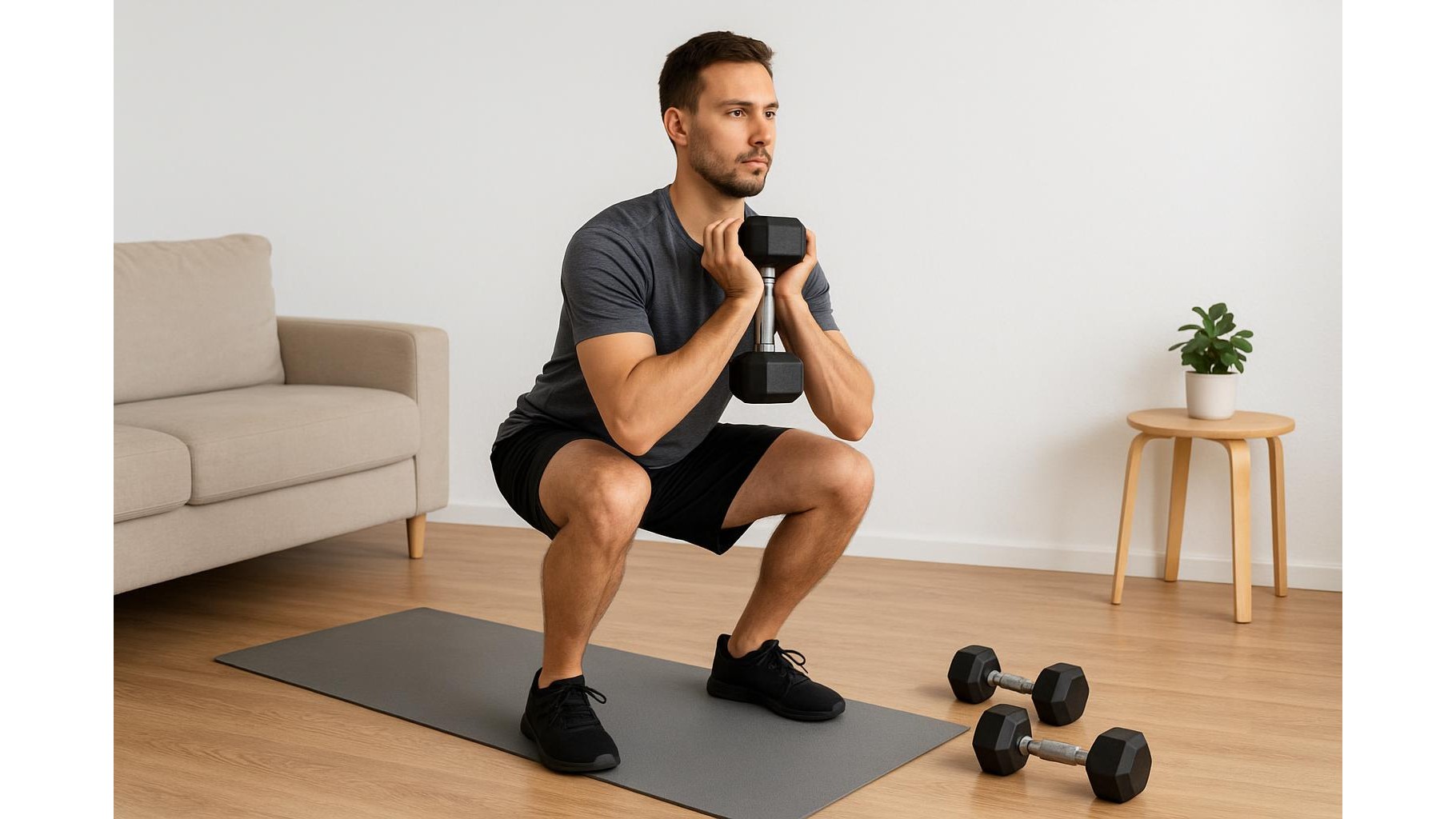
The only things you need are a stable wall and a pair of dumbbells heavy enough to challenge you in the 8–15 rep range. Fixed-weight hex or rubber dumbbells are perfect because they are compact, don’t roll away and are gentle on floors and walls. Choose a weight that feels moderately hard by the last 2–3 reps of each set without breaking your form. If you have more than one pair, select a lighter pair for shoulder and arm work and a heavier pair for legs, but this plan is fully doable with just one pair. Clear a patch of wall where you can safely lean your back for wall sits and wall presses, and make sure the floor is not slippery to keep each movement safe and controlled.
Tri-set A: legs, vertical push and core
Start with Tri-set A focusing on lower body strength, overhead pressing and core stability. Perform 10–15 reps of dumbbell goblet squats, holding one or both dumbbells at your chest, sitting your hips back and keeping your knees tracking over your toes. Move directly into 8–12 reps of dumbbell wall presses: stand with your back against the wall, press your mid and lower back into it, and press the dumbbells overhead, avoiding arching your spine. Finish with a 20–40 second wall sit hold with the dumbbells resting on your thighs if possible. Rest 60–90 seconds, then repeat the tri-set 3–4 times. Beginners can reduce load, shorten the wall sit and focus on smooth technique; intermediates can slow the lowering phase to increase time under tension.
Tri-set B: hinge, horizontal push and pull
Tri-set B targets the posterior chain, chest and back. Begin with 8–12 reps of dumbbell Romanian deadlifts, sliding the dumbbells down the front of your legs with a soft knee bend, hinging at the hips to load your hamstrings and glutes while keeping your back flat. Transition into 8–12 reps of floor dumbbell presses by lying on your back, pressing the dumbbells from chest to straight arms with elbows stopping just off the floor. Finish with 10–15 reps of bent-over dumbbell rows, hip-hinged with a neutral spine, pulling the weights towards your lower ribs. Rest 60–90 seconds after the three moves, then repeat for 3–4 rounds. If your dumbbells are light, extend the rep range up to 15–20 and minimise rest; if they are heavy, stay at the low end of the reps and rest closer to 90 seconds.
Managing rest, progression and small-space setup
To keep this 40-minute home workout efficient, use a timer: allow 12–18 minutes for each tri-set block, including rest. Between exercises in a tri-set, keep transitions to 10–20 seconds – just enough to adjust your grip or position. Beginners can rest a little longer after each full tri-set, while intermediates can use a steady 60 seconds and focus on consistent breathing. Progress week by week by adding a rep or two per set, slowing the eccentric (lowering) phase to 3 seconds, or tightening rest periods. In a small space, store your dumbbells close to the wall, set up your floor area perpendicular to the wall for quick shifts between standing and floor moves, and always prioritise clean, controlled form over chasing more rounds.
Finishing touches: cool-down and consistency
After you complete your tri-sets, spend 3–5 minutes cooling down with gentle hamstring, quad, chest and upper-back stretches, using the wall for balance and support. Consistency is where this minimalist setup shines: with just two dumbbells and a wall, you can repeat this full body strength tri-set workout two or three times per week, tracking your loads, reps and rest. Over time, you will notice stronger legs, a more powerful push and pull and better overall work capacity. Keep the structure the same, tweak the details as you get fitter, and your small home space can deliver big, long-term strength results.