A well-structured full body home workout with a single kettlebell can deliver strength, cardio and mobility in just 35 minutes, with minimal space and equipment. This routine is designed for all levels and breaks your session into a smooth flow: warm-up, main strength circuits, conditioning finisher and cool-down. All you need is one sturdy kettlebell, some floor space, and the willingness to move with focus and control.
Choosing the right kettlebell for this routine
To get the most from a 35-minute kettlebell workout, pick a bell that challenges you while still allowing clean technique. Beginners often do well with a 6–8 kg bell, while intermediate users may choose 10–16 kg depending on the exercise. A quality cast iron kettlebell with a smooth handle and flat base will feel better in the hand and sit safely on the floor. Look for a bell with a durable coating and a handle wide enough for two hands, as this routine includes swings, goblet squats and presses. Investing in a solid kettlebell turns a corner of your living room into a highly effective home gym.
5-minute warm-up to prepare your whole body
Before you touch the weight, spend 5 minutes on a focused warm-up. Start with 60 seconds of gentle marching or jogging in place, followed by arm circles and hip circles to open your joints. Then perform 2 rounds of 30 seconds each of bodyweight squats, walkouts to a high plank and glute bridges. Finish with light, unloaded hip hinge repetitions to pattern the movement you will use for kettlebell swings. The goal is to increase blood flow, wake up your core and prime the shoulders and hips so that each kettlebell exercise in the main block feels smoother and safer.
Main strength block: lower body and core focus
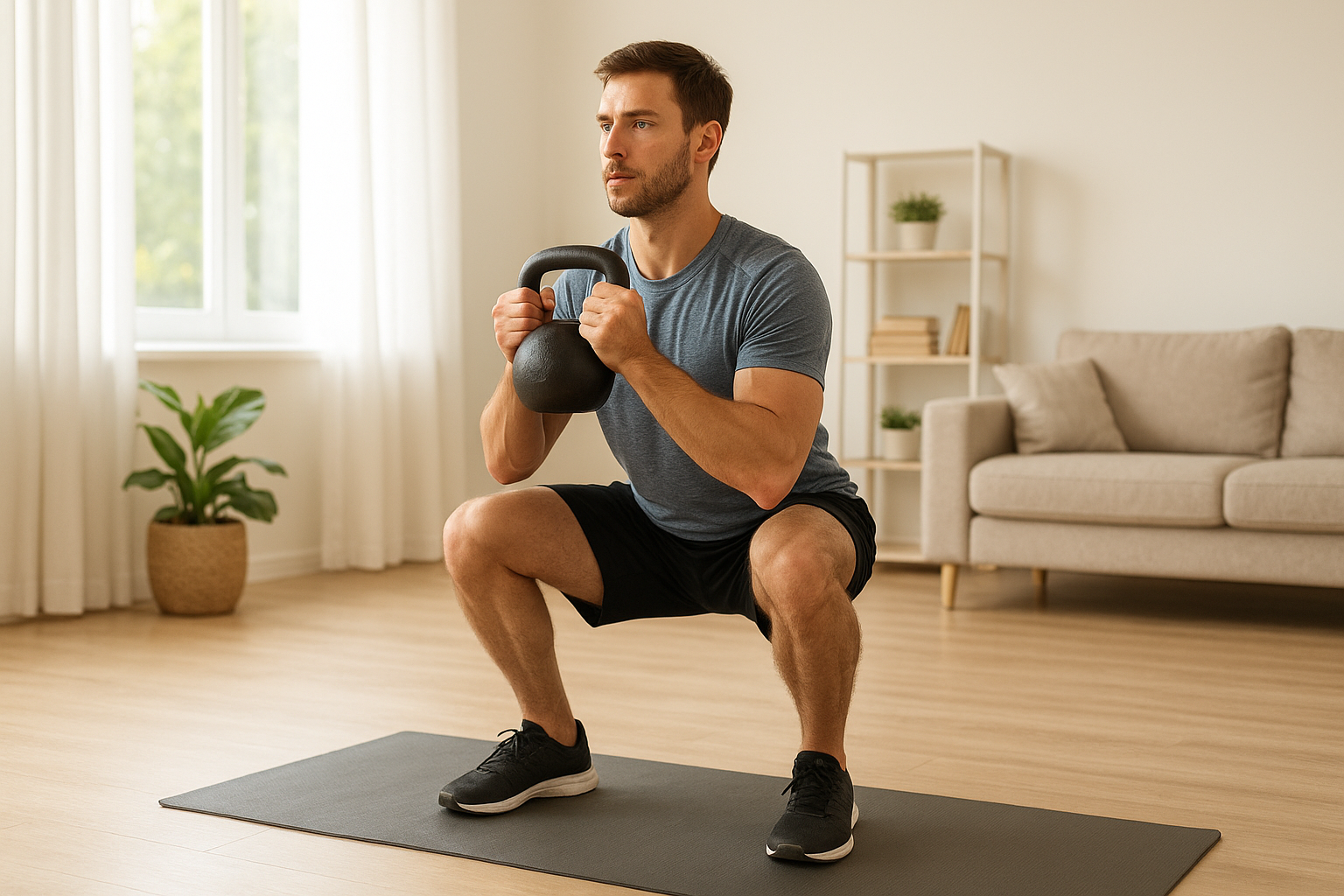
The first 12-minute block targets legs and core with three key moves. Perform 3 rounds of 40 seconds work and 20 seconds rest for each exercise: kettlebell goblet squats, Romanian deadlifts holding the bell in both hands, and half-kneeling kettlebell halos around the head. Keep the bell close to your chest on squats, push hips back on deadlifts, and move slowly and controlled on halos to challenge shoulder stability and core strength. Beginners can shorten the work periods to 30 seconds and focus on shallower squat depth, while advanced users can add a pause at the bottom of each squat or slow the negative phase of the deadlift.
Upper body press and pull complex
The second 12-minute block trains the upper body with pressing and pulling patterns. Alternate sides every set. Perform 3 rounds of 40 seconds work and 20 seconds rest per move: single-arm floor presses, bent-over single-arm rows and kettlebell rack carries walking around your training space. On presses, keep your elbow at about 45 degrees from your torso and drive the bell up with a stable shoulder. For rows, hinge at the hips with a flat back and pull the bell towards your hip. Rack carries, with the bell resting between forearm and biceps, train anti-rotation core strength and posture. Beginners can keep their free hand on a chair or wall for balance, while advanced lifters can slow each rep and minimise rest for more intensity.
Explosive conditioning finisher
To close the session, a short but intense conditioning finisher boosts your heart rate and calorie burn. Perform 6 minutes of alternating kettlebell swings and kettlebell thrusters in a 30 seconds on, 30 seconds off pattern. Focus on powerful hip drive for swings, snapping hips forward to float the bell to chest height while keeping your back neutral. Thrusters combine a front squat and overhead press in one fluid motion, demanding full body coordination. If you are new to swings, start with dead-stop swings or hip hinge drills without weight, and if thrusters feel too demanding, switch to goblet squats or push presses, always prioritising form over speed.
Cooldown, recovery and progression tips
Finish your single kettlebell full body workout with a 4–5 minute cool-down. Include static stretches for hamstrings, hip flexors, chest and shoulders, plus deep breathing to bring your heart rate down. Aim to perform this 35-minute routine two to three times per week, leaving at least one rest or light activity day in between. As you progress, you can increase the kettlebell weight, add an extra round to each block or extend work intervals while keeping rest the same. Track how many quality reps you complete in each set and focus on gradual, consistent improvement rather than rushing. Over time, this simple structure will build strength, endurance and confidence in your home training.
This 35-minute kettlebell session shows how a single piece of equipment can deliver a complete home workout that is efficient, scalable and engaging. With a thoughtful warm-up, targeted strength blocks, an effective conditioning finisher and a short cool-down, you cover mobility, strength and cardio without leaving your living room. Adjust the load, tempo and volume to your level, prioritise technique on every rep, and this minimalist routine can become a cornerstone of your long-term fitness plan.