
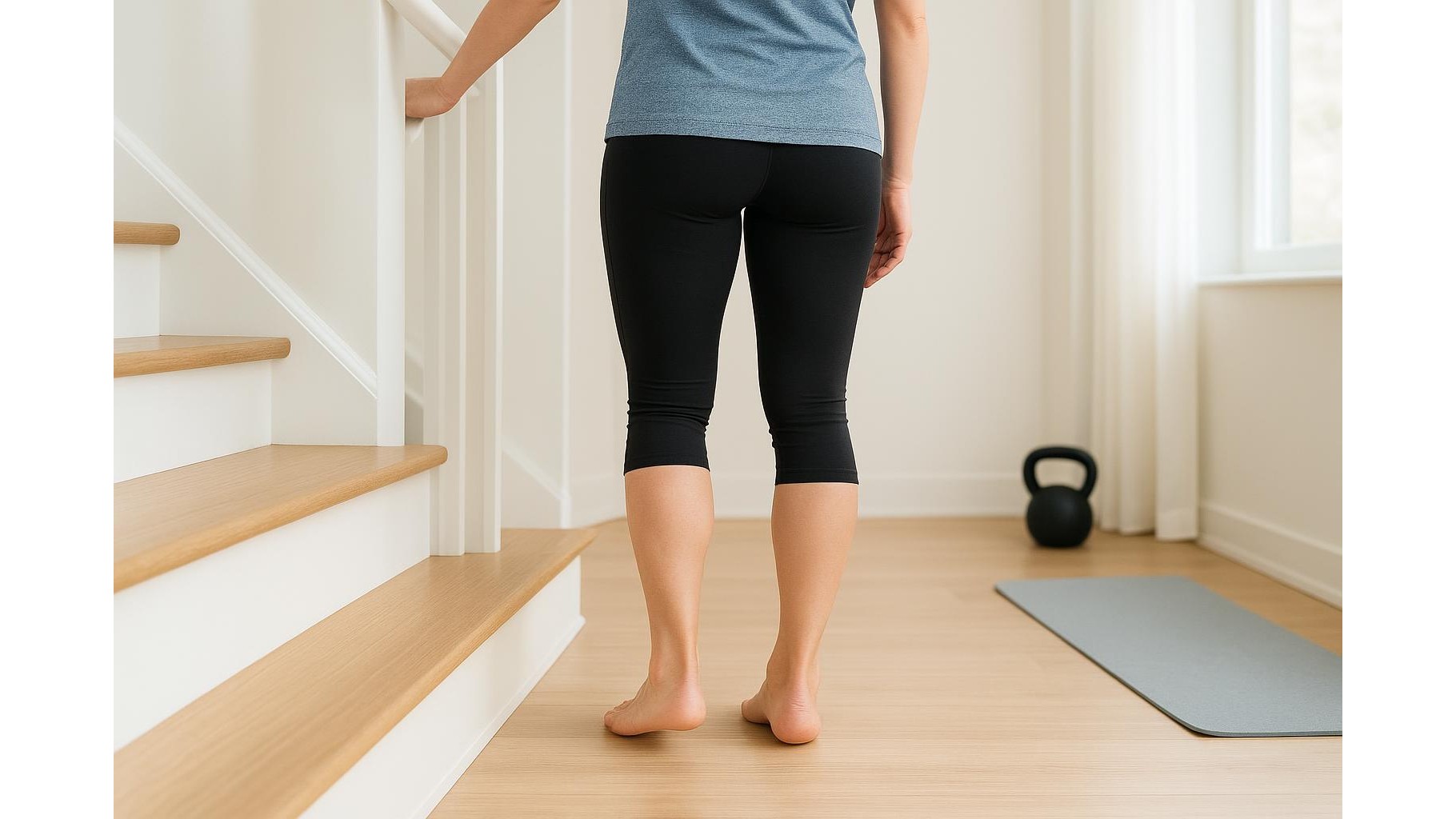
After a hard home workout, it’s common to feel your lower legs tighten up, making every step – and every squat – feel heavier. A simple stair-based routine can act as a quick calf and ankle reset at home, helping you restore mobility, ease post-training stiffness and keep your squat and jump mechanics sharp for the next session.
Why your calves and ankles get tight after training
Whenever you run, jump or squat, your calf muscles and ankle joints take a big share of the load. Over time, repeated impact and deep knee bend patterns create micro-tension in the gastrocnemius, soleus and the tissues around the Achilles tendon. If you go straight from workout to sofa, that tension can ‘set’, limiting dorsiflexion (the ability to drive the knee over the toes). Limited dorsiflexion forces compensations in your knees, hips and lower back. A short, structured stair sequence helps pump fresh blood through the lower legs, lengthen tight tissue and restore the glide around the ankle so your next session feels lighter and more reactive.
Step 1: Supported stair calf stretch for global length
Start with a classic stair calf stretch to open the entire back line of the lower leg. Stand on the bottom step with the balls of your feet on the edge and your heels hanging off. Hold the railing or wall for balance. Gently drop both heels down until you feel a firm but comfortable stretch through the calves, keeping your knees straight and your chest tall. Breathe slowly and stay for 30–45 seconds, then rise onto your toes and repeat for 2–3 rounds. This global stretch targets the larger gastrocnemius muscle and begins your post-workout recovery, encouraging circulation and reducing that stiff, wooden feeling when you walk downstairs after heavy squats or lunges.
Step 2: Bent-knee soleus focus to unlock ankle dorsiflexion
Next, shift the emphasis to the deeper soleus muscle, which plays a key role in ankle mobility for squats and jumps. Stay on the same step with the balls of your feet supported and heels hanging free. This time, bend your knees slightly as you drop your heels below the step. You should feel the stretch lower down towards the Achilles and just above the ankle. Keep your weight evenly balanced and avoid bouncing. Hold for 30–45 seconds, then come up and reset. Perform 2–3 rounds. By opening the soleus, you create more usable dorsiflexion, helping your knees travel forward safely in deep squats while reducing strain on the heels and lower back.
Step 3: Dynamic stair pulses to improve circulation
Once the tissues are warm and lengthened, add gentle movement to boost blood flow and flush metabolites from tough sessions. Stand tall on the step and perform slow heel raises: push up onto your toes, pause for one second at the top, then lower the heels just below step level in a controlled way. Aim for 10–15 repetitions, focusing on a smooth tempo and balanced weight across the forefoot. This dynamic work turns your stretch into an active mobility drill, reinforcing strength at end range while using the calf muscles as a pump for venous return. It’s especially helpful after high-rep jumping, skipping or sprint intervals, when the lower legs feel congested or ‘pumped’ long after the workout ends.
Step 4: Ankle circles and step-edge mobilisations
To fine-tune ankle mobility, move beyond straight-line stretches. Stand side-on to the stairs and place one foot on the bottom step, heel planted and knee slightly bent. Gently drive your knee forward over the toes, then trace small circles with the knee to explore the edges of your range without pain. Do 8–10 circles clockwise and anticlockwise, then switch sides. You can also stand on one leg with the other foot hovering and draw slow circles with the toes, keeping the movement coming from the ankle rather than the hip. These patterns free up the joint capsule, improve proprioception and teach your body to control the new range you unlocked with the earlier stretches, supporting smoother, more stable landings in jumps.
Step 5: Finishing reset and breathing for lasting relief
Finish your calf and ankle reset with a brief relaxation phase so the body ‘accepts’ the work you’ve done. Stand flat on the floor at the base of the stairs with feet hip-width apart. Gently rock your weight from heels to toes and side to side, noticing how the floor feels under your feet. Take 5–8 slow breaths, in through the nose and out through the mouth, letting your shoulders drop and your calves relax. If you like, add a final 20–30 second light stair calf stretch. This calm, low-intensity finish down-regulates your nervous system, which can help reduce lingering tension and make your improved mobility and range of motion stick for your next home gym session.
Used consistently, this quick, stair-based lower leg routine becomes a powerful tool in your home gym recovery toolkit. By regularly resetting your calves and ankles after training, you support better squat depth, cleaner jump mechanics and more comfortable daily movement, all with nothing more than a simple staircase.









