When you only have 15–20 minutes for a home HIIT workout, choosing the right cardio machine really matters. Two of the most popular options for ultra-intense intervals are the air bike and the rowing machine. Both can torch calories, challenge your lungs and build serious conditioning, but they feel very different in practice, place different demands on your joints, and suit different homes and fitness goals. This guide compares them side by side so you can decide which one truly fits your short, hard sessions.
Table of contents
How air bikes and rowing machines work
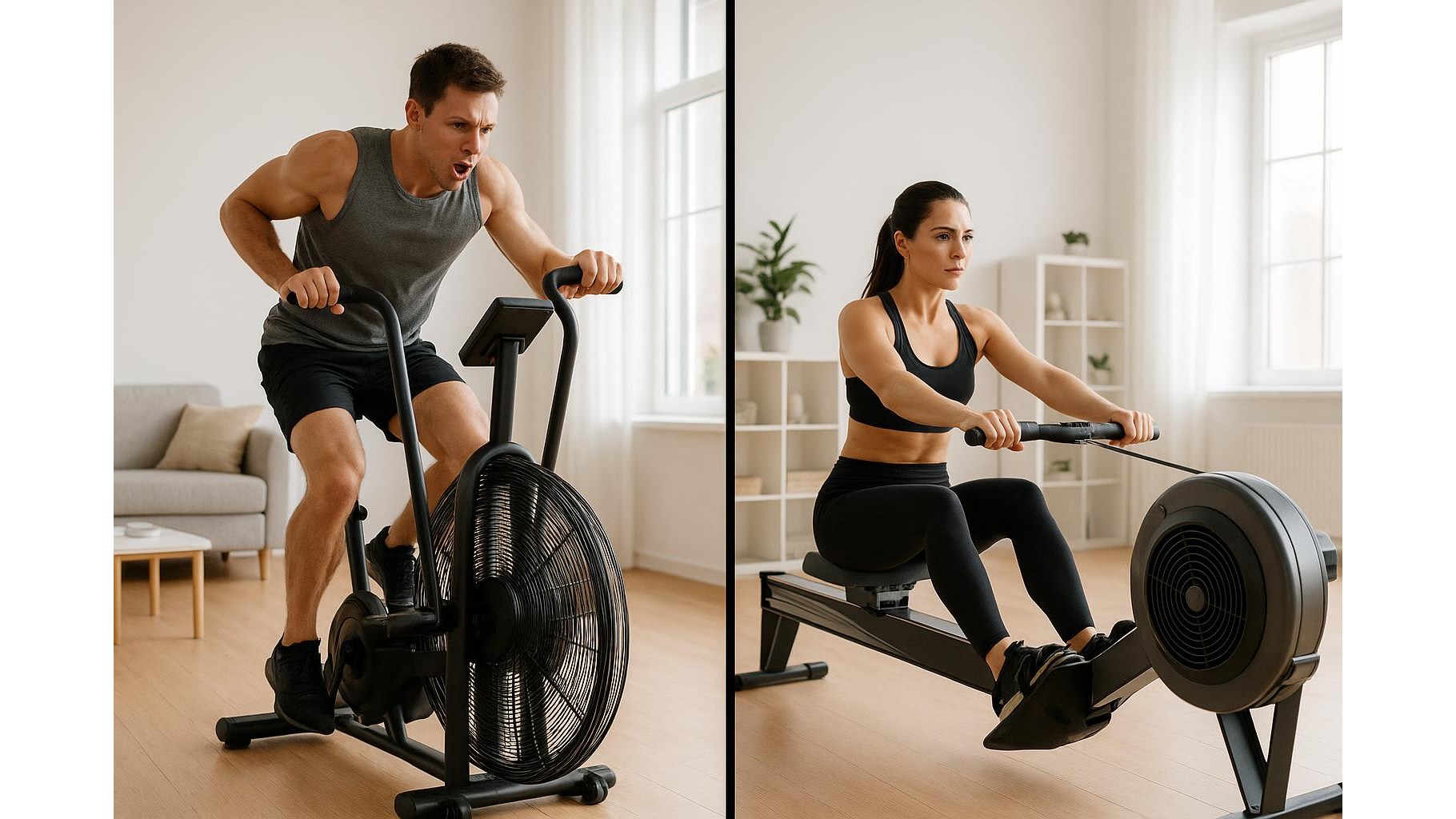
Air bikes use a large fan wheel that increases resistance the harder you pedal and push–pull the handles. The classic design is similar to models like the Assault-style fan bike, where resistance is entirely air-based and infinitely scalable: sprint harder and the bike instantly bites back. A rowing machine (often nicknamed an erg) typically uses air or magnetic resistance through a flywheel. You sit low, strap in your feet, and drive with your legs while pulling the handle to your chest. Both tools deliver full‑body cardio, but the bike emphasizes continuous circular motion, while the rower has a powerful drive phase and a brief recovery on each stroke, which can change how your intervals feel.
Joint impact and comfort during HIIT
For short, intense HIIT sessions, joint comfort is crucial. The air bike is fully low‑impact for the lower body: your feet stay planted on the pedals and there is no impact like running. However, long sprints can stress the shoulders and elbows if you over‑grip the handles or use poor posture. The rowing machine is also low‑impact, but it demands more from your hips, lower back and knees. A strong hip hinge and neutral spine are essential; otherwise, repeated hard strokes can irritate the lumbar area. If you have a history of knee or back issues and don’t want to learn much technique, the air bike is usually more forgiving. If you’re willing to refine your form, rowing offers a smooth, joint‑friendly pull that many people find very comfortable once they’ve learned it.
Muscle groups, intensity and calorie burn
Both tools can drive your heart rate to the red zone in under a minute. The air bike heavily recruits the quads, glutes and hamstrings, while the pushing and pulling action of the arms hits the chest, shoulders and upper back. Because you can keep constant tension by pedalling and pumping the handles, it’s easy to maintain brutal intensities in classic protocols like 10 rounds of 20 seconds on / 40 seconds off. The rowing machine is more posterior‑chain dominant: powerful leg drive plus strong engagement of the glutes, lats and mid‑back. Each stroke has a built‑in rhythm – explode, then glide – which some people find more sustainable for slightly longer intervals, such as 30–60 seconds of hard effort. In practice, both deliver high calorie burn per minute, but rowing often feels more muscular in the mid‑back, while the bike feels more like a full‑body sprint.
Noise, footprint and suitability for apartments
For apartment living, noise and footprint are decisive. Air bikes with large fans are inevitably noisy at high speed; the whooshing fan and chain drive can be heard through thin walls, which may be a deal‑breaker for late‑night intervals. They also tend to have a relatively compact footprint but are visually bulky due to the big fan cage, and most don’t fold. Rowing machines – especially modern magnetic or hybrid models – are often quieter, with a consistent hum rather than a roar when you sprint. Many can be stored vertically, taking up little floor space between sessions. If you’re training in a small flat with neighbours, the rower usually wins on both sound and stowability, whereas the air bike is better suited to a spare room or garage gym where noise is less of an issue.
Which is better for your goals and short HIIT sessions?
If your priority is maximum intensity in minimum time with almost no learning curve, the air bike is hard to beat. You can jump on, set a timer for 8–15 minutes and alternate all‑out sprints with easy pedalling; it naturally supports brutal Tabata‑style intervals. It’s ideal for people who like to “switch off the brain” and just go. The rowing machine shines if you want a mix of cardio and technique. It rewards good posture and timing, and it can double as a steady‑state cardio tool more comfortably than the bike for many users. It’s also especially good if you want to spare your shoulders and focus the workload more on the legs, glutes and back. In both cases, adding short warm‑ups and cool‑downs will help you get the most from your home HIIT without overloading your joints.
Ultimately, the best choice for short home HIIT workouts depends on your body, your space and your preferences. Choose an air bike if you want a brutally simple, high‑intensity tool that’s always ready for fast intervals and you don’t mind more noise. Choose a rowing machine if you prefer a quieter, more technical full‑body workout that folds away easily and feels smoother on the back once your form is dialled in. Either way, committing to consistent, intense but time‑efficient sessions will do far more for your fitness than endlessly debating the “perfect” machine.