If you spend hours in front of a screen, your neck, shoulders and lower back eventually let you know. The good news: you don’t need a full gym or long sessions to feel better. This 20-minute mobility and core workout for gamers is built for small living rooms, zero equipment, and quick breaks between matches. It focuses on spine-friendly mobility, opening tight hips and shoulders, and anti-slouch core work to support your posture while you play.
Table of contents
Warm up your spine and reset your posture
Start with 3–4 minutes to wake up your joints and undo the classic gamer hunch. Begin on all fours with cat–cow: round your back up toward the ceiling, then gently arch it while lifting your chest. Move slowly for 8–10 reps, focusing on smooth breathing and pain-free range of motion. Next, sit tall on the edge of a chair and perform seated spinal rotations: cross your arms over your chest and rotate your upper body to the right, then to the left, for 8–10 reps per side. Finish with chin tucks against a wall—gently slide the back of your head into the wall to create a double-chin feeling, hold 5 seconds, repeat 8–10 times. These drills “reset” your posture before you hit the more demanding work.
Open tight hips and ankles from long sitting
Hours in a chair lock your hips and ankles, which can lead to lower back stiffness and sluggish movement. Spend 5 minutes on hip and ankle mobility. From a half-kneeling position (one knee down, the other foot in front), gently drive your front knee over your toes while keeping the heel down for 10–12 reps per side to free up the ankle. Then move into a world’s greatest stretch: from a push-up position, step your right foot outside your right hand, drop the back knee if needed, and rotate your chest toward the front knee, reaching the arm up. Take 5 deep breaths, switch sides. If kneeling is uncomfortable on hard floors, you can place a folded towel under your knee, or use a thick home workout surface like a standard non-slip yoga mat to protect your joints and make the routine more comfortable.
Shoulder openers to fight the gamer hunch
Your shoulders and chest bear the brunt of hours with a controller or keyboard. Dedicate 4 minutes to shoulder mobility and upper-back activation. Stand facing a wall, forearms on the wall, elbows at 90 degrees. Slowly slide your arms up while gently pressing your forearms into the wall, then slide back down, for 10–12 reps—this targets the mid-back muscles that help keep your shoulders from collapsing forward. Follow with thread-the-needle on all fours: slide one arm under your body, dropping your shoulder and head toward the floor, hold a breath, then return; 8–10 reps per side. To finish, do 2 sets of 10–15 prone Y-raises lying face down, lifting your arms in a Y shape with thumbs up; this strengthens the postural muscles that resist the classic slouch.
Core work that supports your spine, not your ego
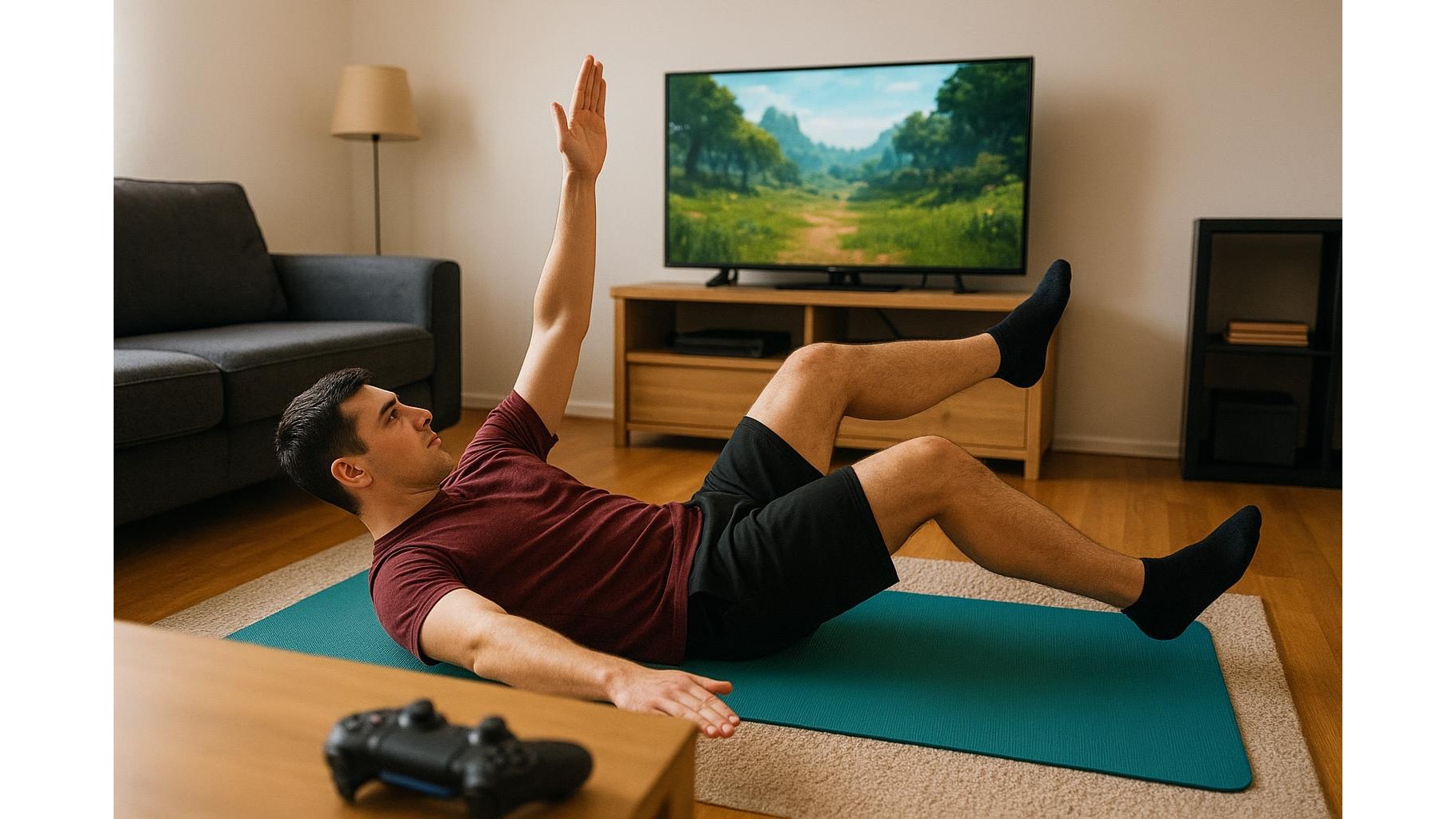
Instead of endless crunches, this routine uses anti-rotation and anti-extension core exercises that protect your spine and improve sitting posture. Perform 3 rounds of the following circuit: dead bug for 30 seconds (lying on your back with arms up and knees at 90 degrees, slowly extending opposite arm and leg while keeping your lower back gently pressed into the floor), followed by a side plank for 20–30 seconds per side. Rest 30–40 seconds between rounds. Focus on controlled breathing and keeping your ribs down, not on how high you can lift. This type of core training builds endurance so your torso can stay stable during long gaming sessions, reducing stress on your neck and lower back.
Quick finisher you can repeat between matches
Wrap up with a 3–4 minute movement finisher that you can easily repeat as a micro-break during loading screens or queues. Set a timer for 3 minutes and rotate through these three moves without rushing: 8–10 bodyweight squats (sit back into your hips, keep your chest tall), 8–10 glute bridges (lying on your back, pressing through your heels to lift your hips), and 6–8 wall slides (back against a wall, arms in a goalpost position, sliding up and down). Rest as needed, but try to keep moving. This mini flow boosts circulation, wakes up sleepy glutes and upper back, and acts like a physical “reset button” so you feel fresher going into the next game.
Done consistently, this 20-minute mobility and core workout for gamers who train at home can transform how your body feels at the desk and on the couch. You don’t need gear, you don’t need much space, and you don’t have to sacrifice playtime. Aim to run through the full routine 3 times per week, and use the short finisher or a couple of the stretches on off days. In a few weeks, you should notice less stiffness, better posture, and more energy—both in and out of the game.