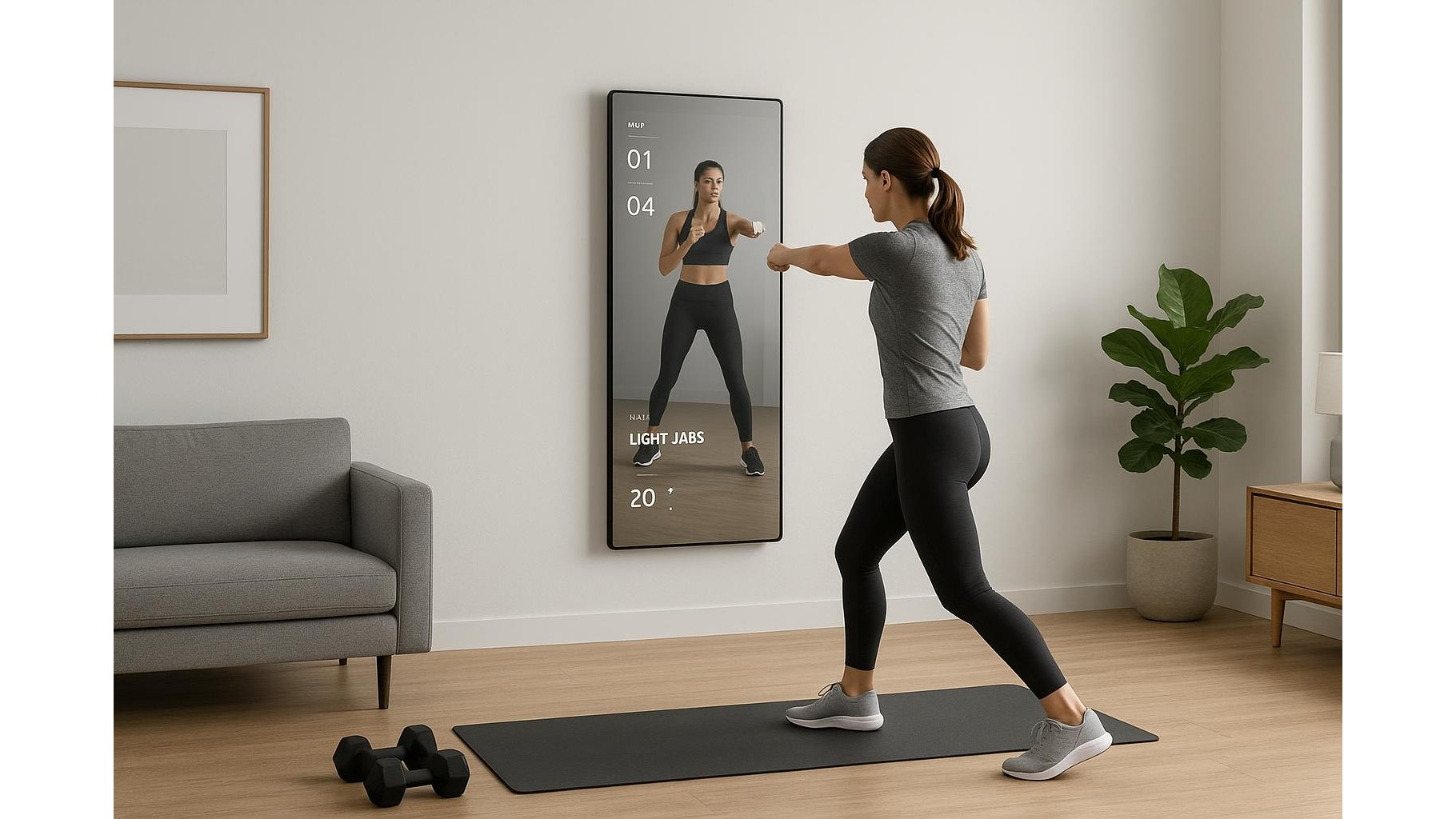
Smart fitness mirrors promise a sleek way to bring interactive workouts into your living room, bedroom or dedicated home gym. These wall-mounted or free-standing devices combine a full-length mirror with an integrated screen, speakers and connectivity, turning your reflection into a guided training session. Before you invest in what can be a costly piece of connected fitness equipment, it is crucial to understand how camera quality, workout libraries, privacy controls, space requirements and user profile affect whether a smart mirror will genuinely improve your training – or just become an expensive wall ornament.
Table of contents
Camera and display: seeing and being seen clearly
The heart of any smart fitness mirror is its camera and display. A good device should offer at least Full HD video so on-screen trainers and metrics remain crisp while you move. Many models rely on wide-angle cameras to capture your full body from a short distance, which is ideal for small rooms but makes optics and low-light performance even more important. If motion tracking or form feedback are advertised, check whether the manufacturer explains the technology behind it (simple silhouette tracking vs. advanced depth sensing) and whether lighting requirements are realistic for a typical UK home. The mirror coating also matters: higher-end products use glass that remains reflective even when the display is active, allowing you to check alignment on squats, lunges and yoga poses without losing contrast. Make sure the product you choose supports stable Wi‑Fi, offers Bluetooth for headphones and can be wall-mounted safely on your type of wall.
Workout libraries and subscriptions: what are you really paying for?
Beyond the hardware, the real value of a fitness mirror usually lies in its workout library. Most brands rely on subscription-based platforms, charging a monthly or yearly fee for access to live and on-demand classes. Before buying, study the catalogue: does it cover your interests – such as strength training, HIIT, yoga, Pilates, mobility or boxing – or is it focused mainly on general cardio? Look at how often new content is added and whether there are progressive programmes rather than only standalone classes. Check if multiple user profiles are included under one subscription, an important point for families or couples. Also verify language options, music licensing (can you use your own playlists?) and whether you can download sessions for use during Wi‑Fi outages. If the subscription is cancelled, some mirrors become little more than a basic screen, so confirm what remains available: offline workouts, basic mirroring from your phone or only a demo mode.
Privacy and data: training under digital surveillance
Installing a large internet-connected mirror with a camera in your home raises legitimate privacy concerns. Look for products that feature clear, physical camera covers or shutters and allow you to disable the microphone in hardware, not just via software menus. Read the privacy policy: what data is collected, how long it is stored and whether it is shared with advertisers or partners. Many devices track heart rate (via connected wearables), rep counts and individual performance metrics; ideally, this data should be anonymised and exportable so you can keep your training history if you switch platforms. Parental controls are essential if children might appear in front of the camera. Finally, check whether the mirror supports local user accounts with PIN or password protection so guests or flatmates cannot accidentally access your personal profile, progress charts or payment details.
Space, installation and everyday usability
Smart mirrors are often promoted as perfect for small spaces, but real-world installation can be trickier. Wall-mounted models require solid fixing points; plasterboard walls may need special anchors or professional installation to handle the weight. Free-standing units offer more flexibility but demand a stable floor and enough clearance around them. As a rule of thumb, you should reserve at least two metres of clear floor in front of the mirror and enough ceiling height to safely perform overhead presses or jumping movements. Consider where the power socket and Wi‑Fi router are located; extension leads across walkways are unsafe for dynamic workouts. Usability also includes interface design: look for large, clear icons, responsive touch controls or companion apps, and the option to stream external content (such as YouTube tutorials or mobility routines) when you do not feel like following the built‑in classes. Simple, fast start-up is key to ensuring you actually use the mirror on busy days.
Who smart mirrors suit – and when another setup is better
Smart mirrors shine for users who are motivated by guided classes, value a clean aesthetic and want to combine strength, cardio and flexibility training in one system. Busy professionals, beginners who appreciate real-time form cues and people who dislike crowded gyms often benefit most. However, they may not be ideal for heavy lifters who require racks, barbells and high loads; in that case, traditional equipment plus a tablet or TV for programming offers better value. If you already own a smartwatch and like tracking metrics, make sure your chosen mirror integrates with your existing ecosystem to avoid duplicate data silos. Budget-conscious users might prefer pairing resistance bands and dumbbells with a lower-cost streaming service. Ultimately, a smart mirror is best suited to those who prioritise convenience and coaching over pure hardware, and who are comfortable committing to an ongoing subscription model.
In summary, transforming your wall into a digital coach can be a powerful upgrade for your home gym, but only if you match the device to your goals, space and privacy expectations. Evaluate camera and display quality, the depth and cost of the workout library, and how your data will be stored and protected. Think carefully about where the mirror will live, how you will move around it and whether your household’s training styles justify the investment. By approaching smart fitness mirrors with a critical eye, you can decide whether this sleek, connected solution is the right foundation for your long-term training or whether a simpler, more modular setup better fits your lifestyle.