
If your week is packed but you still want to train push, pull and legs, this simple 45‑minute full body dumbbell workout is for you. All you need is a sturdy pair of dumbbells and some floor space. Below you’ll find an efficient structure that moves from push, to pull, to legs, plus core, with clear rep schemes, rest times and beginner/intermediate tweaks so you can get in, work hard and get on with your day.
Equipment and workout structure
For this session you only need a pair of dumbbells heavy enough to challenge you in the 8–15 rep range. Look for a solid, grippy handle and flat ends so they won’t roll between sets. A typical 45‑minute layout looks like this: 5‑minute warm‑up, then 30–35 minutes of strength work, finishing with a short conditioning finisher. You’ll train in this order: push (chest, shoulders, triceps), pull (back, biceps), legs, then core. Use 60–90 seconds’ rest between sets. Beginners should start with 2 sets per exercise; intermediates can push to 3–4 sets while keeping at least 1–2 reps in reserve to avoid form breakdown.
Push block: chest, shoulders and triceps
Start with a dumbbell floor press: 3 sets of 8–12 reps. Lie on the floor, press the dumbbells above your chest, and pause briefly at the bottom so your upper arms lightly touch the floor. Follow with a standing dumbbell shoulder press for 3×8–10 reps, bracing your core and avoiding excessive lean‑back. Finish the push block with a dumbbell close‑grip floor press or overhead triceps extension for 2–3×10–15 reps to hit the triceps. Beginners can reduce the weight and cut one set from each move; intermediates can use slightly heavier loads and focus on controlled 2–3 second lowers to build more tension and muscle.
Pull block: back and biceps
The pull work starts with bent‑over dumbbell rows: 3×8–12 reps, hinging at the hips, keeping your back flat and pulling the weights towards your hip pockets instead of your shoulders. Next, hit your upper back and rear delts with a chest‑supported row on a bench or by lying prone on the floor and rowing from there, 2–3×10–12 reps. Finish the block with dumbbell curls for 2–3×10–15 reps, keeping your elbows close to your sides. Beginners can support themselves by bracing one hand on a chair during rows; intermediates may try unilateral rows (one arm at a time) to correct imbalances, keeping rest periods tight to stay within the 45‑minute window.
Leg block: quads, glutes and hamstrings
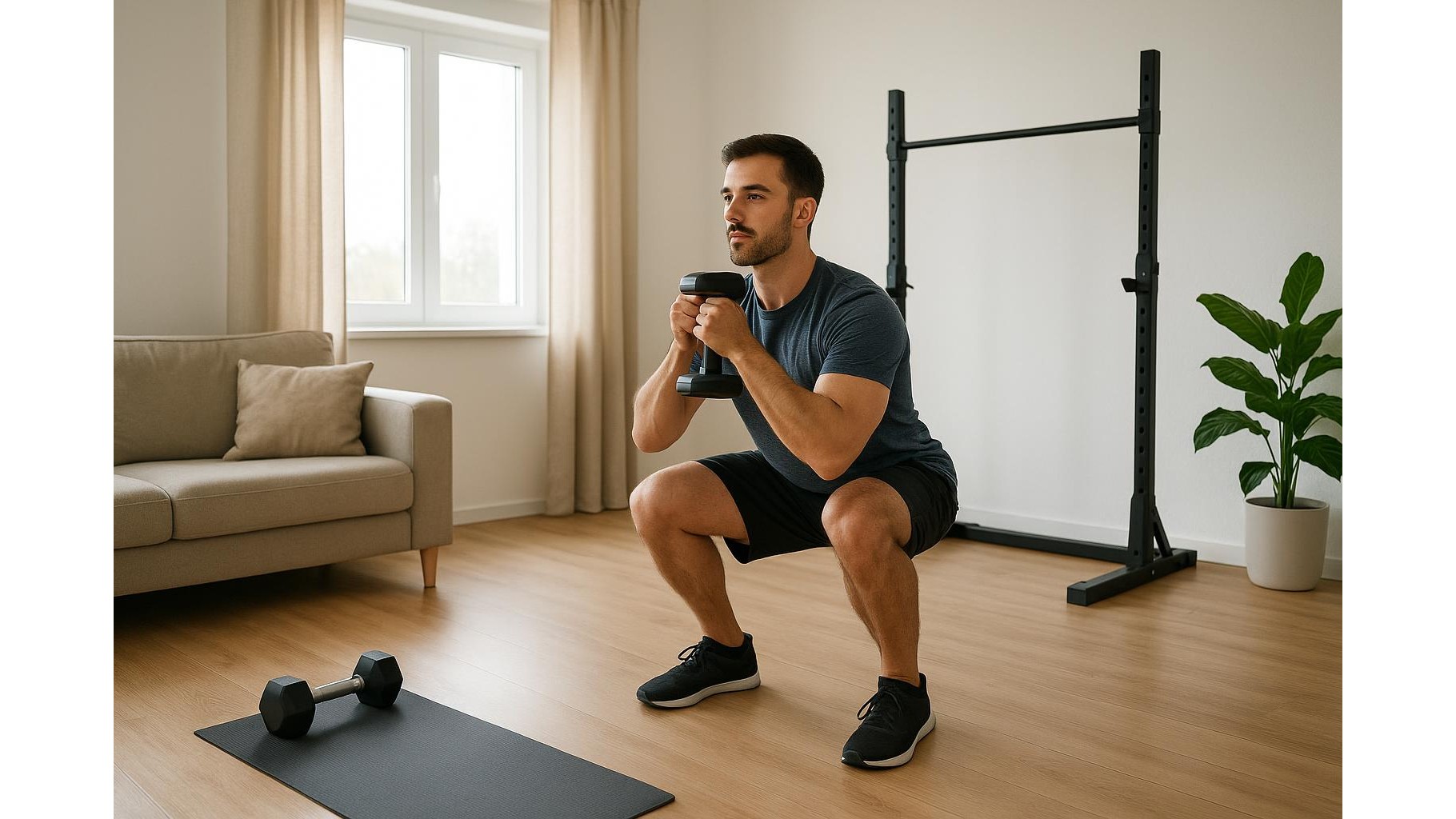
Move into lower body with goblet squats: 3×10–15 reps holding one dumbbell vertically at your chest. Sit your hips down between your knees, keep your chest tall and drive your knees out. Then switch to dumbbell Romanian deadlifts for 3×8–12 reps, focusing on a hip hinge pattern to load the hamstrings and glutes while keeping a neutral spine. Finish with a unilateral movement like reverse lunges or split squats for 2–3×8–12 reps per leg. If you’re a beginner, shorten your range of motion and use furniture for balance; intermediates can slow the eccentric (lowering) portion and limit rest to 45–60 seconds to increase the challenge without adding more weight.
Core and conditioning finisher
With roughly 5–8 minutes left, wrap up with a focused core and conditioning circuit. Try 3 rounds of: 30 seconds dumbbell dead bug (light weight, slow control), 30 seconds dumbbell Russian twists, and 30 seconds farmer’s carry pacing around your room with the dumbbells at your sides. Rest 30 seconds between rounds. This combination trains your abs, obliques and grip while elevating your heart rate for a short but effective conditioning hit. Beginners can drop the weight on the twists and shorten each work interval to 20 seconds; intermediates can extend to 40 seconds of work with 20 seconds of rest.
Progression tips for busy weeks
To keep progressing on a tight schedule, track your sets, reps and load. Aim to improve only one variable per week: add a rep or two, or increase the dumbbell weight slightly when you can complete all sets with good form. If time is extremely limited, you can turn the main blocks into supersets (for example, alternate floor presses with rows) to get the same volume in less time. When a week gets chaotic, run this single 45‑minute one‑session push pull legs at home workout instead of skipping training altogether. Over time, that consistency will matter more than chasing the perfect split.
This 45‑minute dumbbell workout gives you a balanced hit of push, pull, legs and core using just a pair of weights and some smart structure. By adjusting sets, reps and rest based on your level, you can make steady strength and muscle gains even in your busiest weeks, all without leaving home.









