Building a time‑efficient full body strength circuit at home is completely possible with minimal space and equipment. All you really need is a sturdy stool and a pair of light dumbbells to train legs, push, pull and core safely. This 35‑minute, three‑round routine is designed for small living rooms and beginners, with simple regressions that keep the focus on good form, controlled tempo and smooth breathing.
Essential gear: stool and light dumbbells
To set up your home circuit, pick a solid, stable stool that does not wobble and allows your knees to bend roughly to 90 degrees when you sit. This height works well for sit‑to‑stand squats, step‑ups and seated presses. Pair it with light dumbbells (typically 1–3 kg each for beginners) to add safe resistance for upper‑body and light lower‑body work. Light weights make it easier to learn technique without overloading your joints, especially in small spaces where you cannot drop or swing heavy loads. Place the stool against a wall if needed to prevent sliding, clear a 2×2 metre area, and keep a bottle of water and towel close so you can move smoothly between exercises.
Workout structure: 35 minutes, three rounds
This 35‑minute full body circuit is built around three rounds of five movements: a squat variation, a push, a pull, a hip‑dominated move and a core exercise. Aim for 40 seconds of work followed by 20 seconds of rest for each exercise. After one full round (all five moves), rest for 60–90 seconds before repeating. A sample circuit could be: stool sit‑to‑stand squats, inclined stool push‑ups, seated dumbbell rows, dumbbell Romanian deadlifts and seated knee raises on the stool. Total time comes from 3 rounds × (5 exercises × 1 minute) plus two longer breaks. Beginners can shorten work intervals to 30 seconds or skip the third round, while more experienced trainees can add a fourth round or slow the tempo for added challenge.
Lower‑body focus: squats and hip hinge
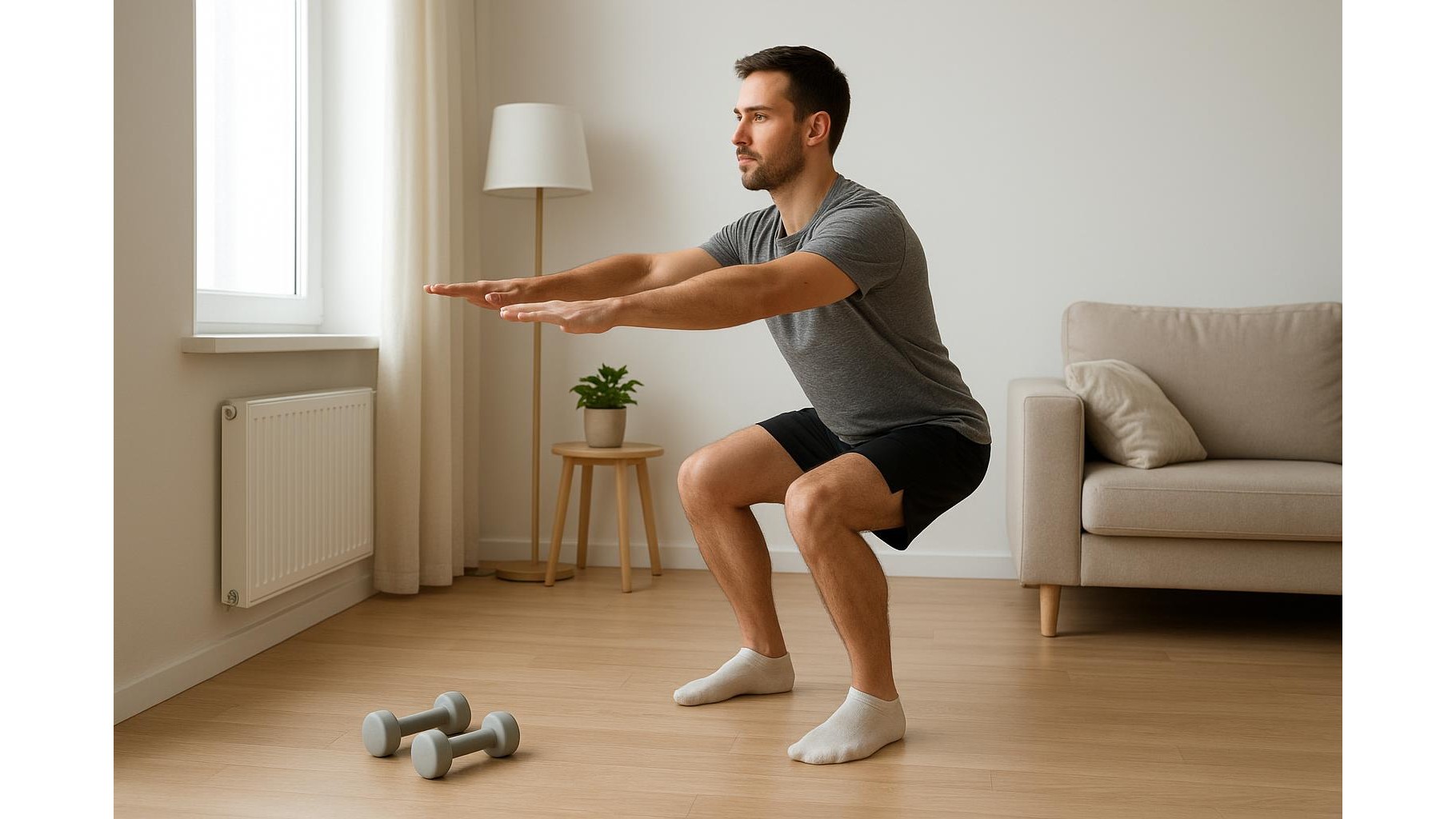
The stool makes lower‑body strength training accessible and safe in tight spaces. Start with sit‑to‑stand squats: sit tall on the stool, feet under knees, then drive through your heels to stand without using your hands, and control the descent back down. This teaches proper squat depth and alignment. For a hinge pattern, hold your light dumbbells at your sides, stand just in front of the stool and perform dumbbell Romanian deadlifts: push your hips back, keep a neutral spine and stop just before your hips touch the stool, then stand tall by squeezing your glutes. Beginners can perform these moves unloaded or reduce range of motion, while intermediate users can slow the lowering phase to increase time under tension without needing heavier weights.
Upper‑body push and pull in small spaces
With only a stool and dumbbells, you can still balance push and pull patterns effectively. For pushing, use inclined stool push‑ups: place your hands on the stool, step back into a straight plank and lower your chest toward the edge, keeping elbows at about 45 degrees. The incline reduces load on the shoulders and wrists compared to floor push‑ups. For pulling, sit on the stool, hinge slightly forward and perform seated dumbbell rows, drawing elbows toward your hips and squeezing your shoulder blades together. In very small spaces, these compact moves minimise movement around the room while still strengthening chest, shoulders, upper back and arms. If full push‑ups feel too demanding, regress by shortening the plank stance or keeping your knees bent.
Core stability and breathing
The stool also supports effective core training without needing to lie on the floor. Try seated knee raises: sit near the front edge, hold the sides of the stool lightly, lean back a little, then lift your knees toward your chest while bracing your midsection. You can alternate legs for an easier option. Add dumbbell hold dead bugs by lying on the floor with calves on the stool, holding one dumbbell above your chest; slowly lower the opposite arm and leg, then return to start, keeping your lower back gently pressed into the floor. Throughout every exercise, breathe steadily—exhale during the effort, inhale on the way back. A controlled breath pattern helps protect your spine, maintain balance on the stool and keep intensity sustainable for the full 35 minutes.
Progressions, safety and consistency
As you adapt to this home strength circuit, progress gradually. You can add challenge by increasing work intervals to 45 seconds, reducing rest to 15 seconds, or choosing slightly heavier dumbbells while maintaining impeccable form. Prioritise safety: check the stool for stability before every session, avoid jumping or explosive moves on it, and clear any obstacles around your training area. If any exercise causes sharp pain, regress the movement—use bodyweight only, reduce range of motion or swap for a simpler variation. Performed two to three times per week, this simple stool‑and‑dumbbell routine can steadily build strength, confidence and movement quality, proving that effective full body training does not require a gym membership or large home gym setup.
This full body strength circuit at home shows how much you can achieve with minimal equipment and floor space. By combining stool‑based lower‑body work, controlled push and pull patterns, and focused core stability, you train every major muscle group in just 35 minutes. Stick with the three‑round structure, use the regressions whenever needed, and gradually progress intensity as your technique improves. Over time, this compact workout can become a reliable foundation for your home fitness routine, helping you move better, feel stronger and stay consistent.