Living in a studio apartment does not mean giving up on strength training and mobility work. With a handful of carefully chosen tools, you can create a highly effective home gym starter kit that fits into a single box and slides under your bed or sofa. This guide focuses on compact, quiet equipment that lets you train full-body strength, stability and flexibility without compromising precious floor space.
Define your training goals and your space
Before buying anything, clarify what you want from your compact home gym. If your main goals are strength, mobility and joint-friendly training, you do not need big machines. Instead, prioritise tools that cover push, pull, squat, hinge and core patterns and that can be used in a floor area roughly the size of a yoga mat. Measure the height and width of your doors if you plan to use a door-anchored system, and decide where your “gym box” will live when not in use. This minimalist mindset keeps the kit focused and prevents clutter.
Resistance bands: the backbone of a minimalist kit
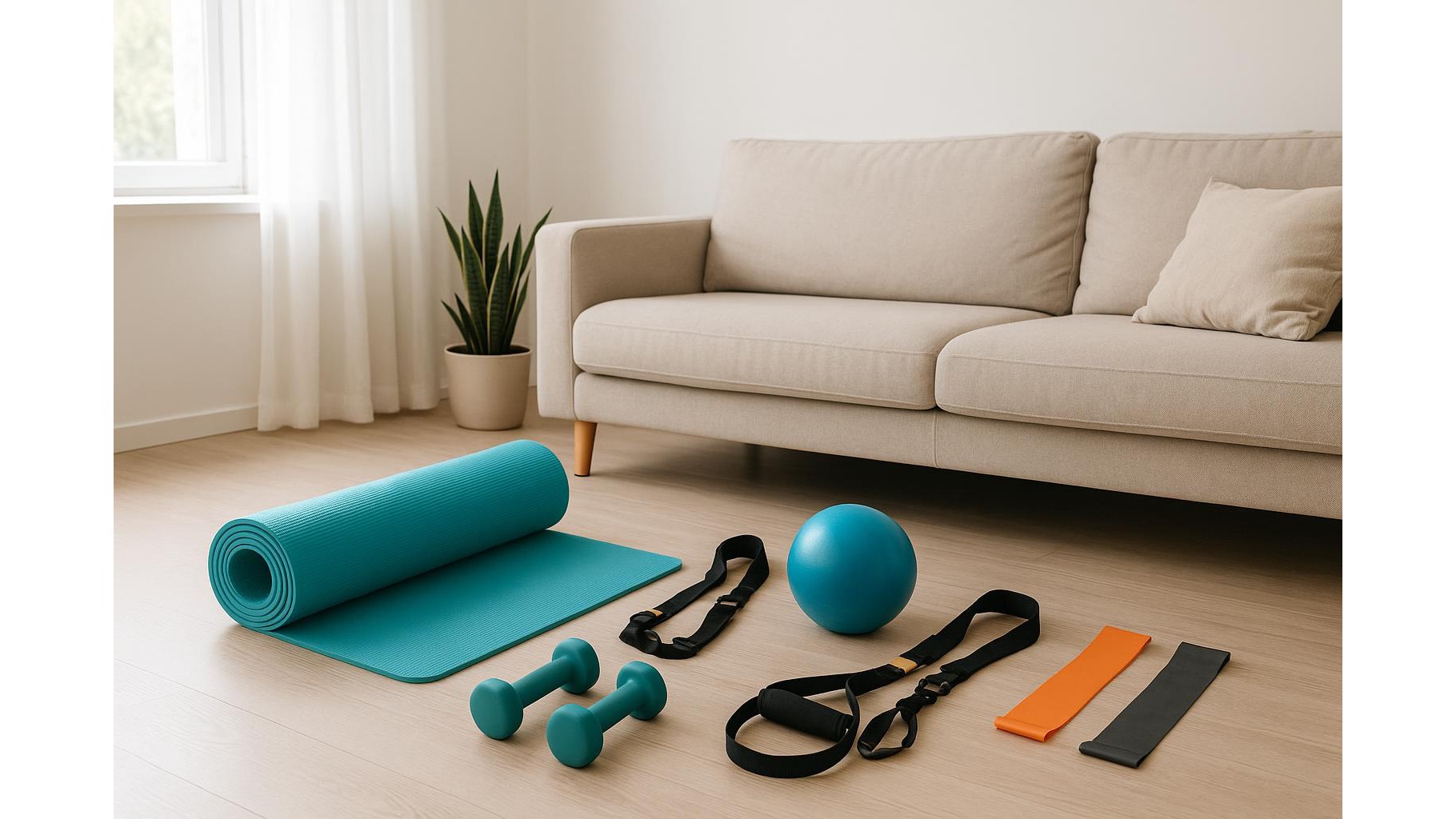
A good set of resistance bands covers most strength needs in tiny spaces. Look for a tube band set with handles, ankle straps and a door anchor so you can perform rows, presses, curls and leg work without bulky weights. Opt for multiple resistance levels so you can progress over time and adjust for different exercises. Bands are ultra-light, quiet, easy on the joints and take up almost no room in your apartment. Combine them with slow tempo and higher reps to build solid strength and muscular endurance, even if you are training in the corner of your living room.
Light dumbbells for loaded mobility and stability
While bands are versatile, a small pair of neoprene dumbbells adds a different kind of resistance that is perfect for shoulder stability, core control and loaded mobility drills. Compact dumbbells in the 1–3 kg range are enough for exercises such as overhead carries, arm bars, Turkish get-up progressions and slow shoulder rotations. Their textured coating protects your floor and reduces noise if you set them down quickly. Because they are short and stackable, they store easily in a box or basket, yet they significantly expand the range of movements you can do in a studio apartment setting.
A quality mat: your portable training floor
A durable exercise mat is non-negotiable in a small home gym. It defines your training zone, protects your joints and keeps you comfortable on hard floors. Choose a mat that is thick enough for kneeling and supine work but still foldable or rolls up tightly to fit behind a sofa or inside a wardrobe. Non-slip texture is important for standing moves like split squats and lateral lunges, while easy-to-clean surfaces matter if your “gym” is the same space where you cook or work. With a mat under you, floor-based mobility flows, core training and stretching sessions become much more inviting.
One or two specialty tools for extra versatility
To round out your compact kit, add one or two specialty tools that supercharge stability and mobility without taking up space. A small mini stability ball (around 20–25 cm) is excellent for core activation, adductor strengthening and spine-friendly mobility work; it deflates and stores in a drawer. A simple suspension trainer that anchors to a solid door gives you access to rows, supported single-leg squats and full-body stability drills using only bodyweight. Both tools are lightweight, packable and ideal for people who want a “gym in a bag” they can use at home or take when travelling.
When you combine resistance bands, light dumbbells, a supportive mat and one or two specialty stability tools, you get a complete mini-gym that fits inside a small box yet supports serious training. In a studio apartment, this compact starter kit lets you cover strength, mobility and balance work with minimal noise and no permanent equipment. Start with basic exercises, focus on good technique and gradually increase difficulty; you will discover that consistent, well-planned sessions matter far more than the size of your space or the amount of gear you own.