
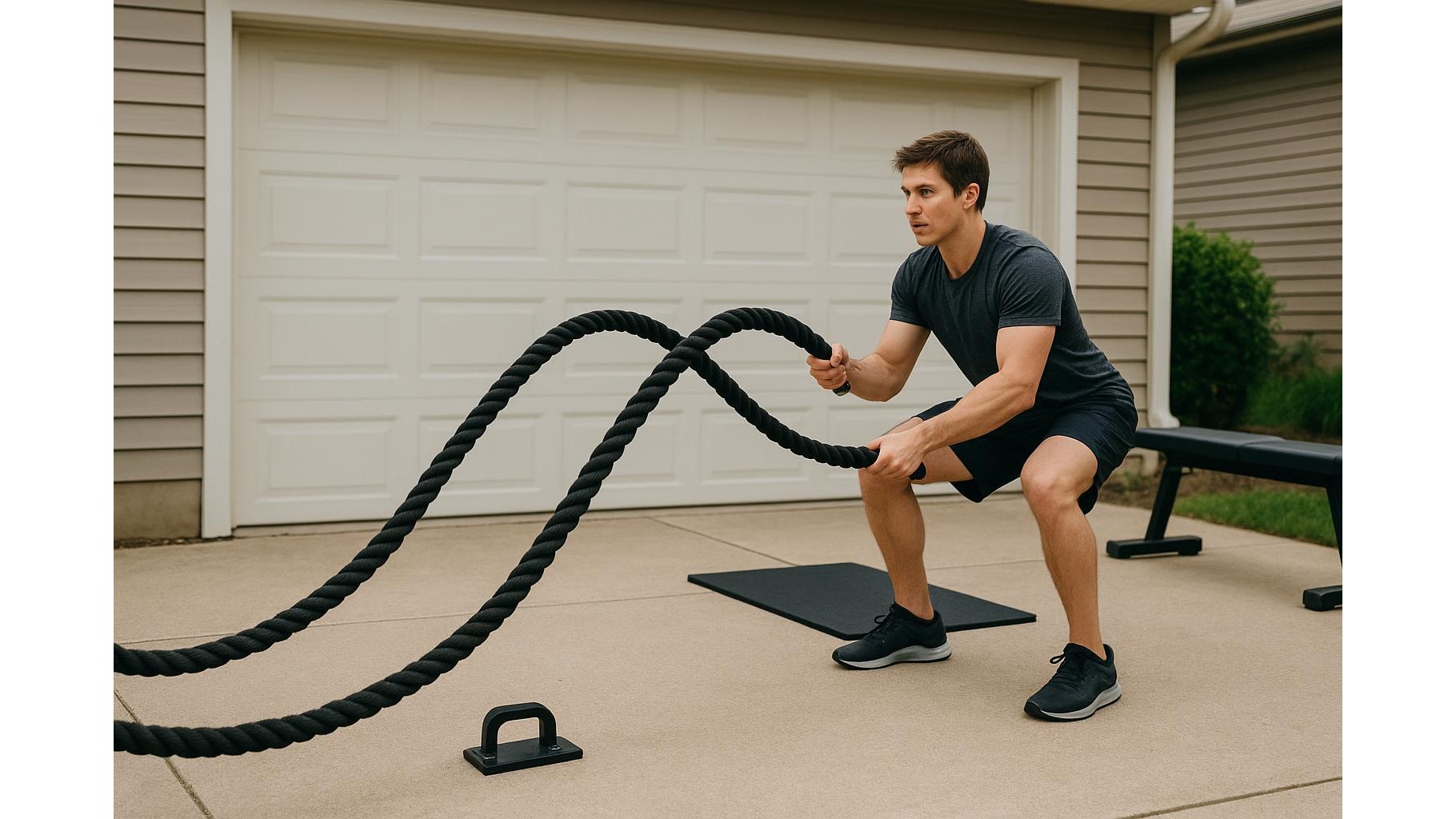
If you’ve got a small outdoor space or a corner in your garage, you’ve got everything you need for a powerful 30-minute battle rope and bodyweight workout. This routine is designed for driveways, gardens and garages, giving you a fast, scalable session that hits strength, conditioning and cardio with minimal equipment and maximum impact.
Why battle ropes belong in your home setup
Battle ropes are ideal for a compact home gym because they’re low-tech, brutally effective and easy to adapt to any fitness level. A quality 9–12 metre rope with a durable sleeve and solid grips lets you train power, endurance and core stability in one tool. Paired with simple bodyweight exercises like squats, lunges and push-ups, you can create a full-body circuit that fits neatly into a 30-minute block, perfect for busy evenings or weekends in the garden.
Safe anchoring and noise control in driveways, gardens and garages
Before you start, think about anchoring and noise control. Loop your rope around a solid post, tree, rack or heavy anchor point at ground level, making sure it can’t move or tip when you pull hard. In a garage, you can fix a dedicated wall or floor anchor into brick or concrete for extra security. To reduce impact noise on neighbours and protect your rope, place a rubber mat, old yoga mat or folded towel where the rope meets the ground. This also stops the rope from wearing out quickly on rough concrete or paving.
5-minute dynamic warm-up for battle rope sessions
Spend at least five minutes getting warm before you touch the rope. Start with 60 seconds each of marching or light jogging on the spot, then bodyweight squats and reverse lunges to loosen hips and knees. Add arm circles and shoulder rolls to prepare your upper body, followed by a set of plank walkouts to wake up your core. Finish with 20–30 seconds of very light rope waves to groove the pattern and check that your anchor is stable and the floor surface isn’t slippery.
The 30-minute battle rope and bodyweight circuit
Set a timer for three rounds of the following full body conditioning circuit. Work 30 seconds per exercise with 15 seconds rest, and take 60–90 seconds between rounds. Round structure: 1) Alternating battle rope waves for power and shoulder endurance. 2) Bodyweight squats or jump squats for legs and lungs. 3) Battle rope slams to hit the posterior chain and core. 4) Push-ups (from floor or elevated on a bench/wall). 5) Lateral battle rope waves or circles to challenge stability. 6) Forearm plank for core control. Adjust work/rest to 20/20 if you’re a beginner, or 40/20 if you’re more advanced.
Scaling, technique and safety tips
Focus on quality movement over speed. Keep a slight bend in your knees, brace your core and avoid shrugging your shoulders towards your ears while you work the ropes. To scale down, shorten the work intervals, step closer to the anchor to reduce rope tension, or replace jumps with low-impact versions. To make it harder, step further away, sink into a half-squat while waving, or add a lunge pattern to your upper-body moves. Always keep your training area clear of obstacles, wear shoes with good grip, and stop if you feel sharp pain rather than normal training fatigue.
Cool-down, recovery and making it a habit
Finish with a 3–5 minute cool-down. Walk slowly up and down your driveway or garden, then stretch your shoulders, forearms, hips and calves with gentle static holds. This helps bring your heart rate down and reduces post-workout stiffness. Aim to repeat this 30-minute battle rope and bodyweight workout two to three times per week, leaving at least one rest or light activity day in between. Over a few weeks you’ll notice better conditioning, stronger grip and more powerful upper- and lower-body strength, all built from the simple convenience of your driveway, garden or garage.









