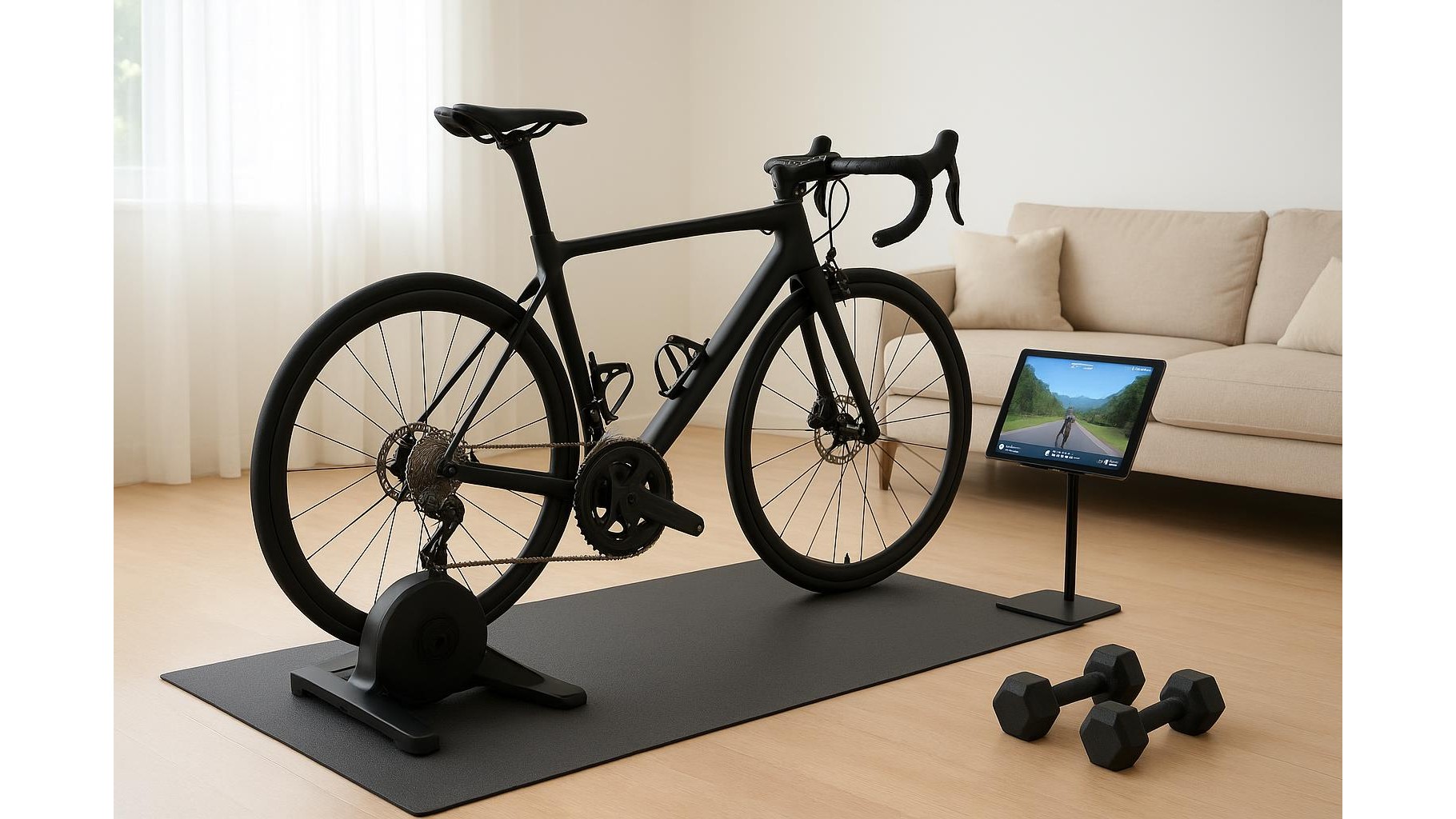
If you love your outdoor road or gravel bike but struggle with bad weather, dark evenings or limited space, a smart bike trainer can turn it into a compact, always‑ready home cardio machine. Modern trainers connect to apps, simulate hills and automatically adjust resistance so you can follow structured workouts without leaving your living room. Understanding the differences between direct‑drive and wheel‑on models, how noisy they are, and how much space they need will help you choose the right setup for your home gym.
Direct‑drive vs wheel‑on: how they work
Smart trainers fall into two main categories: direct‑drive and wheel‑on. Direct‑drive trainers replace your rear wheel: you remove the wheel and mount your bike directly onto a cassette fixed to the trainer. This design delivers more accurate power readings, a smoother ride feel and better stability for hard sprints. Wheel‑on trainers, by contrast, clamp your rear axle and press a roller against the tyre. They are usually cheaper and quicker to set up, but they tend to be slightly less accurate and can wear through tyres faster. For most riders who want realistic indoor cycling workouts and care about data, direct‑drive is the premium, future‑proof option, while wheel‑on suits occasional users or tight budgets.
Noise levels and home‑friendly performance
One of the biggest concerns for apartment dwellers is trainer noise. Direct‑drive smart trainers are typically much quieter, because the bike’s rear tyre is removed and the resistance unit is better isolated. At cruising speeds you will mostly hear your drivetrain and a low mechanical hum, which is often quieter than a washing machine and easy to mask with music. Wheel‑on trainers can be noticeably louder at higher speeds, where the tyre‑on‑roller contact produces a distinct whine. You can reduce this with a dedicated trainer tyre and by using a thick training mat to dampen vibration. If you plan to ride late at night, a quiet direct‑drive model on a mat is the neighbour‑friendly choice.
Space, storage and home gym integration
Even if you live in a small flat, a home cycling setup is easier to accommodate than most cardio machines. A smart trainer has a small footprint, roughly equivalent to a compact fan, and many models have foldable legs for easy storage in a cupboard or behind a sofa. You will need enough floor space for the trainer plus the length of your bike, and a bit of room to move when getting on and off. A training mat protects floors from sweat and stabilises the trainer, while a simple front wheel riser block or phone book levels your bike. If you already own a set of adjustable dumbbells or a foldable weight bench, your trainer can slot neatly into the same corner, turning a single room into a versatile home gym without permanent installations.
Connecting to apps for structured workouts
The real magic of a smart turbo trainer is its ability to connect to training apps over Bluetooth or ANT+. Platforms like Zwift, TrainerRoad, Wahoo SYSTM and Rouvy can control resistance in real time to follow workout intervals or virtual hills. In ERG mode, the trainer automatically adjusts resistance to hold your target power, so you simply pedal and follow the on‑screen prompts. This makes it incredibly easy to do structured interval training based on heart rate or power zones, even if you are not an experienced cyclist. Many apps also include training plans, fitness tests and social group rides, turning your living room into a connected cycling studio.
Choosing the right smart trainer for your goals
Before you buy, clarify how you intend to use your indoor bike trainer. If you want precise power‑based training and realistic road feel for frequent use, prioritise a mid‑range or high‑end direct‑drive smart trainer with good power accuracy, high maximum resistance and strong sprint stability. If you mainly need a reliable cardio option for winter or rainy days, a more affordable wheel‑on smart turbo trainer paired with your favourite app will still deliver great workouts. Consider compatibility with your bike’s axle standard and cassette, the maximum rider weight, and whether you need features like built‑in cadence measurement. Whatever you choose, pairing your existing bike with a smart trainer is one of the most space‑efficient and effective ways to bring serious cardio training into your home.
In summary, smart bike trainers transform your outdoor bike into a compact, quiet and data‑driven home cardio machine. Direct‑drive models excel in accuracy, realism and noise control, while wheel‑on trainers offer budget‑friendly flexibility. With only a small footprint, a training mat and a compatible app, you can enjoy year‑round, structured indoor cycling sessions without sacrificing living space, making them a powerful addition to any modern home gym.