Running a home gym for the whole family is convenient, but sharing a space also means sharing cupboards, shelves and fridges. When it comes to supplements, that can quickly become risky. Adult pre‑workouts, creatine, fat burners and high‑dose vitamins are never meant for children, and even many teen‑friendly products need careful supervision. Setting clear family supplement rules, organising storage and checking labels together keeps everyone safe while still supporting training goals for adults and older kids.
Why supplement rules matter in a shared home gym
In a shared home gym, it is easy for tubs and bottles to migrate from one shelf to another, or for younger kids to copy what they see adults doing. But adult products often contain stimulants such as high‑dose caffeine, concentrated herbal extracts or fat‑burner blends that are far too strong for teens and completely unsafe for children. Even seemingly harmless protein powders can hide sweeteners or added ingredients that are not appropriate for younger ages. As a baseline rule, no child should ever self‑serve supplements, and nothing marketed as a pre‑workout, fat burner, testosterone booster or similar should be used by anyone under 18 unless a doctor has clearly approved it. Treat supplements more like medicine than food: stored carefully, clearly labelled and only taken under adult supervision.
Label checks: how to quickly assess what’s safe for whom
Before any product comes into a family home gym, build a habit of doing a quick label check. Look first at the age recommendations or warnings section: if a product says “for adults only” or “not for use under 18”, keep it firmly in the adult zone. Scan the ingredients list for red flags like high caffeine, yohimbine, synephrine, strong fat‑burning blends or hormone‑related claims. For teens, focus on the most basic, evidence‑based options such as a simple whey protein or vitamin D, and even then, dose and timing should be agreed with a healthcare professional or sports nutritionist. For kids, prioritise regular food first; supplements, if needed, should be dedicated children’s formulas with clear dosing instructions, and never shared with adult products “just in a smaller scoop”.
Safe storage strategies in a home gym household
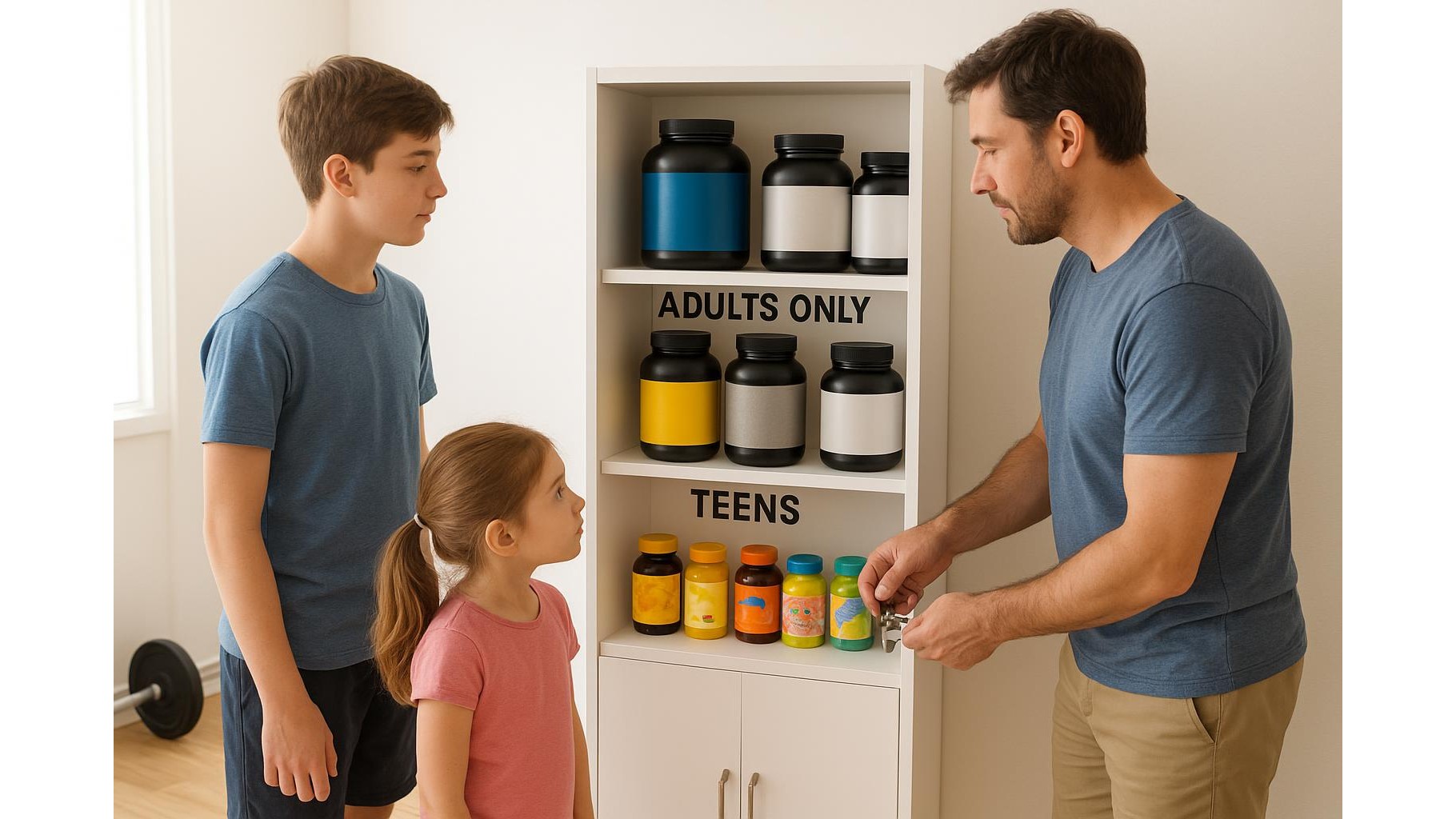
Organising storage is one of the most effective ways to keep adult, teen and kids’ supplements clearly separated. Keep all adult‑only products – especially pre‑workouts, creatine blends with stimulants and fat burners – on a high shelf, in a closed cupboard or in another room entirely, never on an open rack near the squat rack or treadmill. Create a separate, clearly marked area for anything teens are allowed to use, and another for children’s items such as multivitamins or vitamin D drops. Use labels like “Adults only”, “Teens with permission” and “Kids – only with parent” to reinforce the rules. Try to avoid leaving single scoops in shakers lying around; finish drinks promptly or pour leftovers away so there is no temptation for kids to “try a sip” of a pre‑workout or energy mix they find on the bench.
Child‑proofing: locks, routines and supervision
Beyond simple shelf separation, proper child‑proofing makes a big difference. Aim to store all strong supplements the same way you would store medicine: ideally in a lockable cupboard or box, with lids always screwed back on tightly. Build a family routine where kids are never in the home gym unsupervised, and where teens know they must ask before taking any supplement, even their usual protein or multivitamin. Parents should mix or measure serving sizes for younger kids and watch them take it, rather than leaving chewables or gummies out on the counter. Talk openly about why adult pre‑workout powders, creatine stacks and fat burners are off‑limits, explaining that “stronger” does not mean “better” for growing bodies. Clear communication plus practical barriers significantly reduce the chance of accidental misuse.
Why pre‑workouts, creatine and fat burners are not for kids
Many popular gym supplements are designed for fully grown adults, often engaged in intense training. Pre‑workout formulas can combine large doses of caffeine with stimulants and nitric‑oxide boosters that raise heart rate and blood pressure – not something you want for a child. Creatine itself is one of the better‑researched sports supplements for adults, but dosing, purity and long‑term effects in younger teens still require professional oversight; it should never be a casual, unsupervised choice. Fat burners are particularly unsuitable, mixing stimulants and metabolic enhancers that can cause jitteriness, sleep problems or more serious side‑effects even in adults. To keep things simple, adopt a strict household rule: children never use adult products, and teens only use the most basic, single‑ingredient supplements under adult and medical guidance, never multi‑ingredient “hardcore” stacks.
Establishing clear family supplement rules in a home gym keeps everyone safer while still supporting performance goals. By treating supplements more like medicine than snacks, separating adult, teen and kids’ products, checking labels together and using lockable storage, you reduce the risk of accidental misuse or copying behaviours. Adults can maintain their own routines with pre‑workouts, creatine or advanced formulas, while younger family members stick to age‑appropriate, supervised options when truly needed. A little planning and communication turns a shared training space into a safer, healthier environment for the whole household.