If you train in a cramped flat or a corner of your living room, you can still build serious strength and conditioning with the right structure. This 40‑minute full body routine uses just dumbbells, resistance bands and bodyweight exercises, so it fits in a tiny footprint and works with almost any budget. For each block you’ll find clear regressions if you’re newer to training and progressions if you’re more advanced, so the session can grow with you over time.
Gear check: what you need in a small home gym
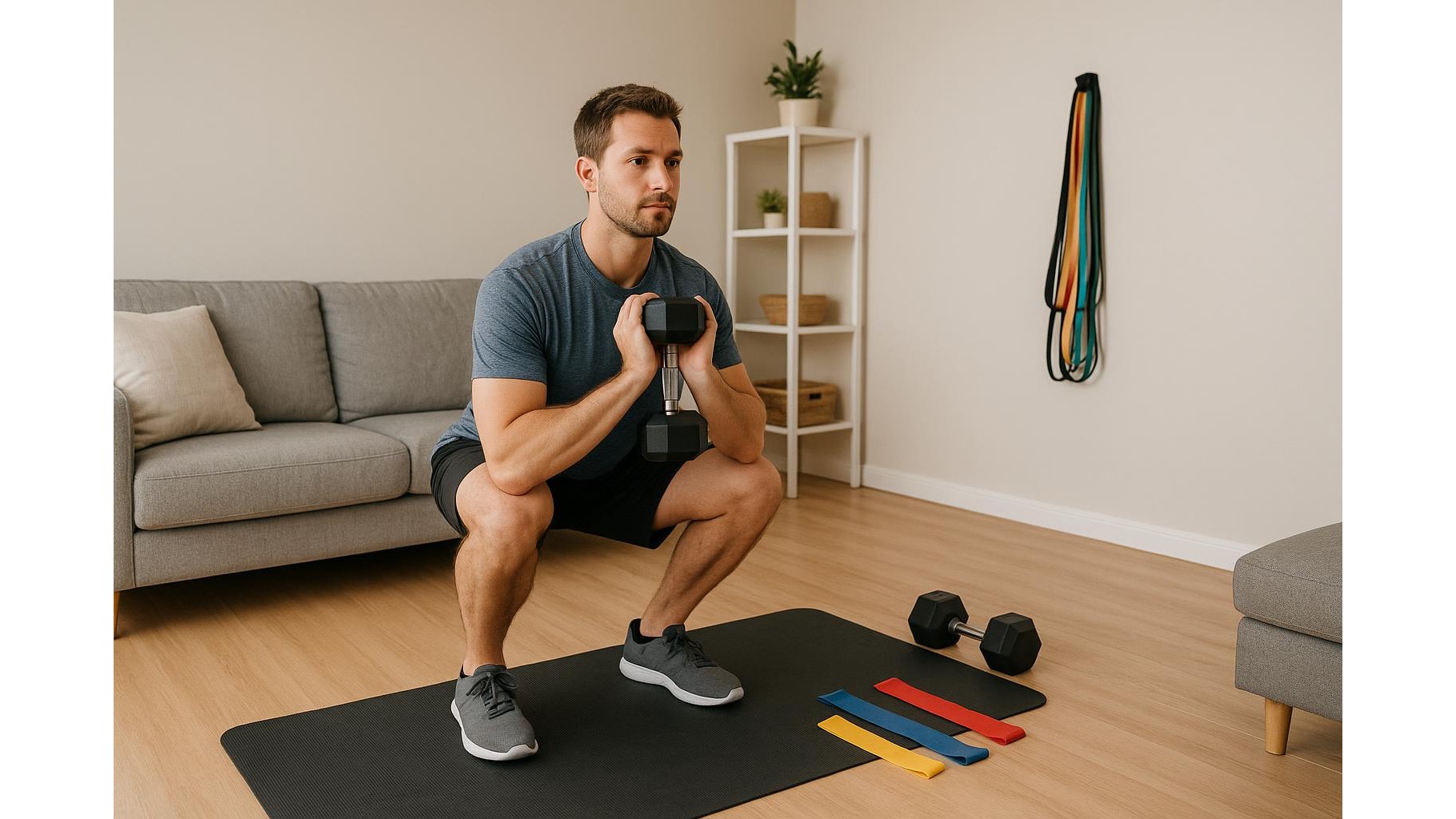
To get the most from this 40‑minute workout you only need three categories of tools: a pair of dumbbells, a set of resistance bands with handles and door anchor, and some floor space for bodyweight training. Ideally choose dumbbells that are moderately challenging for 8–12 reps of a squat or press; if you own adjustable dumbbells, even better, because you can scale load as you progress. For bands, a mixed set of light, medium and heavy tension lets you train both upper and lower body. Add a basic exercise or yoga mat if you’re on a hard floor to protect your joints and reduce noise. With this compact kit, you can hit every major muscle group without needing racks, benches or large machines.
Warm-up and movement prep (5 minutes)
Start with 5 minutes of dynamic movement to prime your joints and elevate your heart rate. Cycle through: 30 seconds of marching or jogging in place, 30 seconds of arm circles, 30 seconds of hip circles, and 30 seconds of bodyweight good mornings (hinge at the hips, soft knees, flat back). Repeat this mini‑circuit twice. Beginners can keep everything low‑impact and slower, focusing on smooth range of motion. More advanced athletes can add small hops, quicker transitions and deeper ranges to increase intensity. The goal is to feel warm and slightly out of breath, not exhausted, before you start the main strength work.
Strength circuit: lower body focus (12 minutes)
The first block targets your lower body strength, especially quads, glutes and hamstrings, using dumbbells and bands. Set a timer for 12 minutes and cycle continuously through:
- Goblet or suitcase squats with dumbbell(s) – 8–12 reps
- Resistance band deadlifts – 8–12 reps
- Glute bridges (bodyweight or banded) – 10–15 reps
Beginners can perform bodyweight squats instead of loaded goblet squats, and use the lightest band or no band for deadlifts. Advanced lifters can slow the lowering phase to 3–4 seconds, add pauses at the bottom, or use heavier dumbbells and stronger bands. Rest 30–40 seconds between exercises as needed, aiming for steady, controlled movement rather than rushing.
Strength circuit: upper body and core (12 minutes)
The second block shifts to upper body strength and core stability using bands, dumbbells and bodyweight. For 12 minutes, rotate through:
- Band or dumbbell row – 8–12 reps per side
- Push-ups (floor, hands on a bench, or with band assistance) – 6–12 reps
- Half‑kneeling band presses or dumbbell overhead presses – 8–10 reps per side
- Plank holds – 20–40 seconds
If you’re newer to training, elevate your hands for push‑ups and use lighter bands or one dumbbell for presses. Advanced trainees can add a band around the back for extra push‑up resistance, slow their tempo, or move to more challenging plank variations like shoulder‑tap planks. Keep your ribs down and core braced during all presses and rows to protect your lower back in a confined space.
Conditioning finisher (8–10 minutes)
To build conditioning without needing a treadmill or bike, you’ll use short, sharp bodyweight and banded intervals that work in a very small area. Choose three moves:
- Band thrusters or light dumbbell thrusters – 30 seconds
- Mountain climbers or step‑back lunges – 30 seconds
- High‑knee march or jog in place – 30 seconds
Rest 30–45 seconds, then repeat for 4–6 total rounds, adjusting to your fitness level. Beginners can shorten work intervals to 20 seconds and lengthen rest; advanced athletes can push to 40 seconds of work with minimal rest. Focus on snappy but controlled movement, breathing through the effort, and keeping a clear area around you to avoid hitting furniture or walls.
Cool-down and progression tips
Finish with 3–5 minutes of easy cool-down: gentle walking in place, followed by light stretching for hips, hamstrings, chest and shoulders. This helps reduce stiffness and brings your heart rate down gradually. To progress this 40‑minute home workout over time, increase load on dumbbells or resistance bands, add rounds to each circuit, or slow your tempo to create more time under tension. If you’re struggling to recover, pull back by reducing total rounds or reps. With consistent practice two to three times per week, this mixed‑tool routine can deliver impressive improvements in strength, endurance and overall fitness, all from the smallest of home gym spaces.