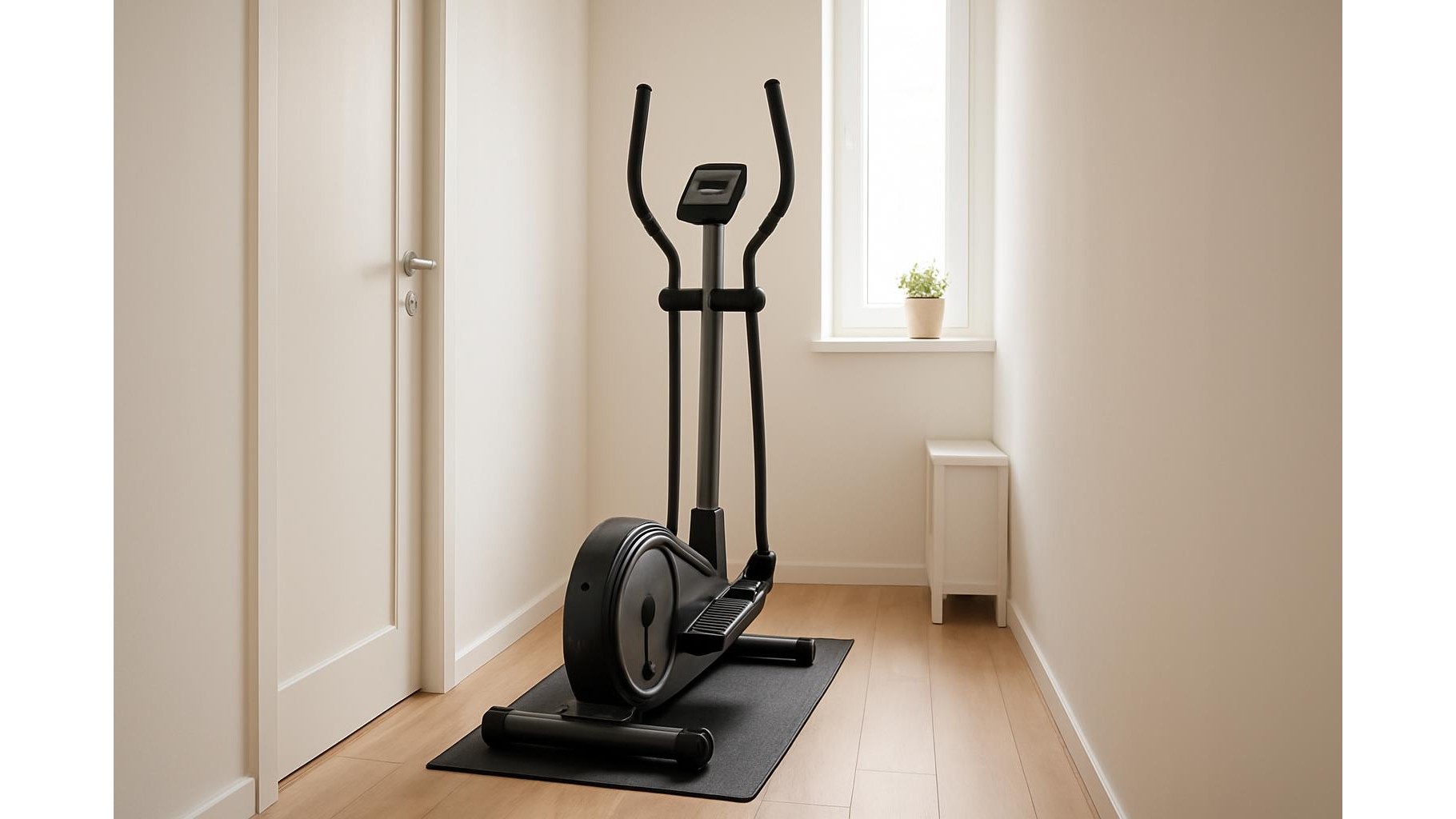
If you live in a flat or a small house, a full-size cardio machine can feel impossible to squeeze in. Narrow-space ellipticals are designed with a compact footprint and more upright frame so they can fit into hallways, studio corners and even beside the sofa. Choosing the right one means balancing size with comfort, noise and stability, and deciding whether an elliptical is actually a better choice than a folding bike or a walking pad for your body and your space.
Why narrow-space ellipticals are different
Standard ellipticals often feel huge because of their long rails and wide stance. Compact ellipticals shorten the frame, narrow the distance between the pedals and often stand more vertical, which lets them tuck into tight corners. Many models are designed to be used in hallways or between furniture, with a footprint closer to a small treadmill. However, this downsizing usually comes with trade-offs: slightly shorter stride length, less massive flywheels and sometimes lower maximum user weight. When reading product pages on Amazon, check measurements for length and width in centimetres, and look at user photos to understand how much clearance you need around the machine for safe mounting and dismounting.
Stride length, pedal spacing and who they suit
The most important comfort factor on a narrow-footprint elliptical is stride length – how far the pedals travel front-to-back. For many compact machines this falls between 30–40 cm, which works best for users under about 175 cm in height or for those doing gentle rehab or steady-state cardio. Taller users, or anyone wanting to simulate a running motion, may find very short strides choppy or uncomfortable over time. Also look at Q-factor (pedal spacing): if the pedals are too close together, hips and knees can feel pinched; too wide and it feels like you’re waddling. Reviews often mention knee or hip comfort, which is a good proxy when specs are vague. If multiple reviewers say it feels smooth and natural, that’s a good sign for longer workouts.
Handle height, ceiling clearance and ergonomics
In tight homes it’s easy to forget about vertical space. Narrow-space ellipticals often sit higher off the floor than bikes, and the moving handles can extend your reach by another 20–30 cm. Measure your ceiling height and subtract your own height plus the maximum pedal rise; you want at least a few centimetres spare so you’re not grazing light fittings. For shared hallways, check that the handles do not swing into walls or door frames. Adjustable or multiple grip positions help users of different heights find a comfortable posture, especially if several family members will share the machine. A slightly more upright stance can also be helpful for people with lower-back sensitivity compared with leaning forward on a bike.
Noise, stability and storage solutions
In flats with thin walls, noise level is critical. Look for ellipticals with magnetic resistance and belt drives, which are usually quieter than chain-driven systems. User reviews that mention using the machine early in the morning or while watching TV without turning the volume up are particularly useful. Because compact frames are lighter, pay attention to maximum user weight and comments about wobble or rocking at faster cadences. For storage, many narrow-space ellipticals include transport wheels so you can tilt and roll them into a corner after use; check product weights to make sure you can actually move them. If your chosen spot is a hallway, consider placing a mat underneath both to protect flooring and to reduce vibration transfer to neighbours below.
Ellipticals vs bikes and walkers in tiny spaces
Before committing to an elliptical, compare it honestly with a folding exercise bike or a walking pad treadmill. Bikes usually have the smallest footprint and fold vertically, making them easier to hide in cupboards or behind doors, and they can be quieter for very early or late workouts. Walking pads slide under beds or sofas but provide a different type of cardio, focused on steps rather than a low-impact, full-body motion. A narrow-space elliptical shines if you want to engage both upper and lower body, minimise joint impact and prefer to stand rather than sit while training. However, if your ceilings are low or your hallway is extremely narrow, a bike or walker might still be the more practical choice.
Choosing the right narrow-space elliptical for hallways and tiny home corners comes down to understanding your body, your home and your training goals. Check stride length, handle and pedal height, overall footprint and user reviews focusing on noise and stability. Compare these factors with alternatives like compact bikes and walking pads to see what really fits your daily routine. With a bit of measuring and expectation-setting, you can build an effective home cardio corner that keeps you moving without overwhelming your living space.