
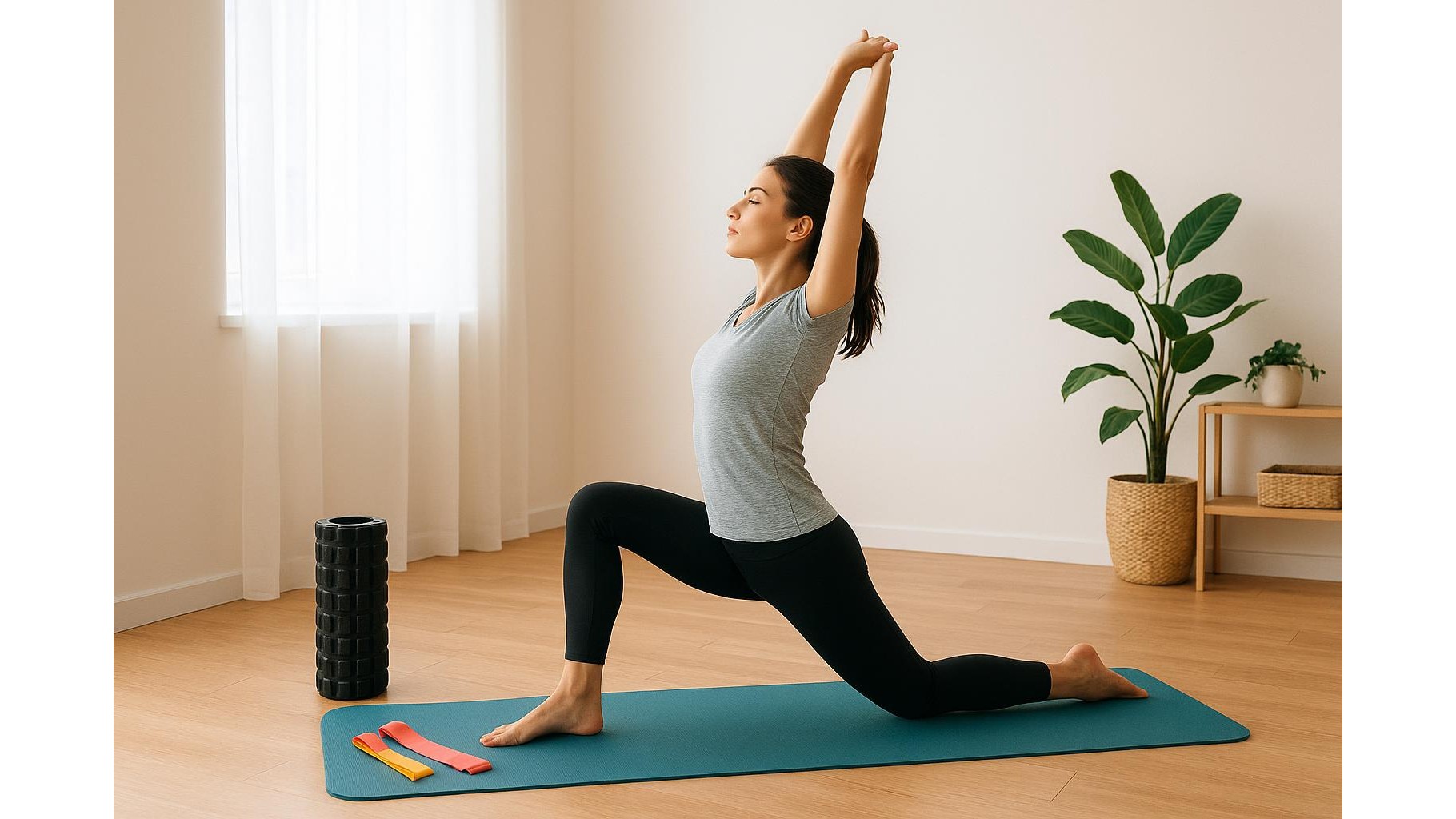
If your home workouts have left you feeling more stiff than strong, you’re not alone. Long hours at a desk plus heavy lifting can lock up your hips, round your shoulders and leave your spine feeling creaky. A simple 10-day mobility reset at home can help you restore range of motion, ease nagging tightness and make every future workout feel smoother and safer. You don’t need a full studio; just a small space, a mat, and a couple of basic tools like a foam roller and resistance bands.
Why a 10-day mobility reset works
Mobility improves when you combine consistent practice with gentle intensity. Ten days is long enough to feel a clear difference, yet short enough to stay focused. During this reset you’ll do 10–20 minutes a day, targeting hips, shoulders and spine with low-impact drills. Think of it as a structured active recovery plan: instead of random stretching, you follow a simple framework—Day 1–3 restore basic range of motion, Day 4–7 add light strength and control, Day 8–10 integrate everything into smooth, full-body flows. The goal is not to sweat hard, but to move better, reduce stiffness and step back into your normal training feeling refreshed.
Essential tools: mat, bands and self-massage
To get the most from your 10-day mobility reset, set up a small, dedicated home mobility corner. Start with a supportive, non-slip yoga mat to protect your knees and spine during floor work. Add a medium-density foam roller for gentle self-massage of your upper back, lats and glutes, and a pair of light to medium resistance bands for shoulder activation and hip strengthening. These tools let you scale intensity: a foam roller can release tight tissues before you stretch, while bands provide just enough resistance to build control at your new end ranges. Keep everything visible and ready; removing friction is key to staying consistent for all 10 days.
Days 1–3: Reset basics for hips, shoulders and spine
In the first three days, focus on slow, controlled mobility drills. For hips, include 90/90 hip switches, supported deep squats holding on to a doorframe, and gentle glute bridges. For shoulders, work on wall slides, band pull-aparts with a light band, and circles on all fours (thread-the-needle). For the spine, practice cat–cow, segmental rolling down and up, and supine twists. Spend 1–2 minutes per exercise, moving with relaxed breathing. The intention is to tell your nervous system that new positions are safe, not to force flexibility. If any movement feels pinchy or sharp, shorten the range and stay in the pain-free zone.
Days 4–7: Add strength and control to new ranges
Once your body accepts these new ranges, the middle phase builds strength at end range. For hips, add banded clamshells, slow reverse lunges with support, and hip airplanes holding a countertop. For shoulders, progress to banded face pulls, overhead band presses with a neutral grip, and scapular push-ups. For the spine, integrate half-kneeling windmills and controlled Jefferson curls with minimal load if you’re experienced and pain-free. Aim for 2–3 sets of 6–8 slow reps, resting as needed. Controlled tension teaches your body to own these positions, helping them carry over into squats, presses and daily tasks like lifting kids or groceries.
Days 8–10: Flow, breathe and integrate
In the final three days, you blend everything into full-body mobility flows. Combine hip openers like world’s greatest stretch, lunge-to-hamstring transitions and Cossack squats with dynamic shoulder moves such as arm circles, inchworms and quadruped reach-throughs. Layer in spinal waves, standing roll-downs and gentle rotations. Move for 10–15 minutes continuously, guided by your breath: inhale into new positions, exhale as you relax deeper. This integration phase teaches your body to coordinate hips, shoulders and spine together, so your everyday movements feel smoother and less restricted.
After 10 days of structured home mobility training, your hips should feel freer, your shoulders more open and your spine less tense. Keep the momentum by repeating your favourite drills 3–4 times per week as a warm-up or recovery session. The secret is consistency, not complexity: a few focused minutes on a mat with simple tools can transform how your whole body moves. Use this reset as a template you can return to whenever life, work or heavy training leaves you feeling stiff and stuck.









