
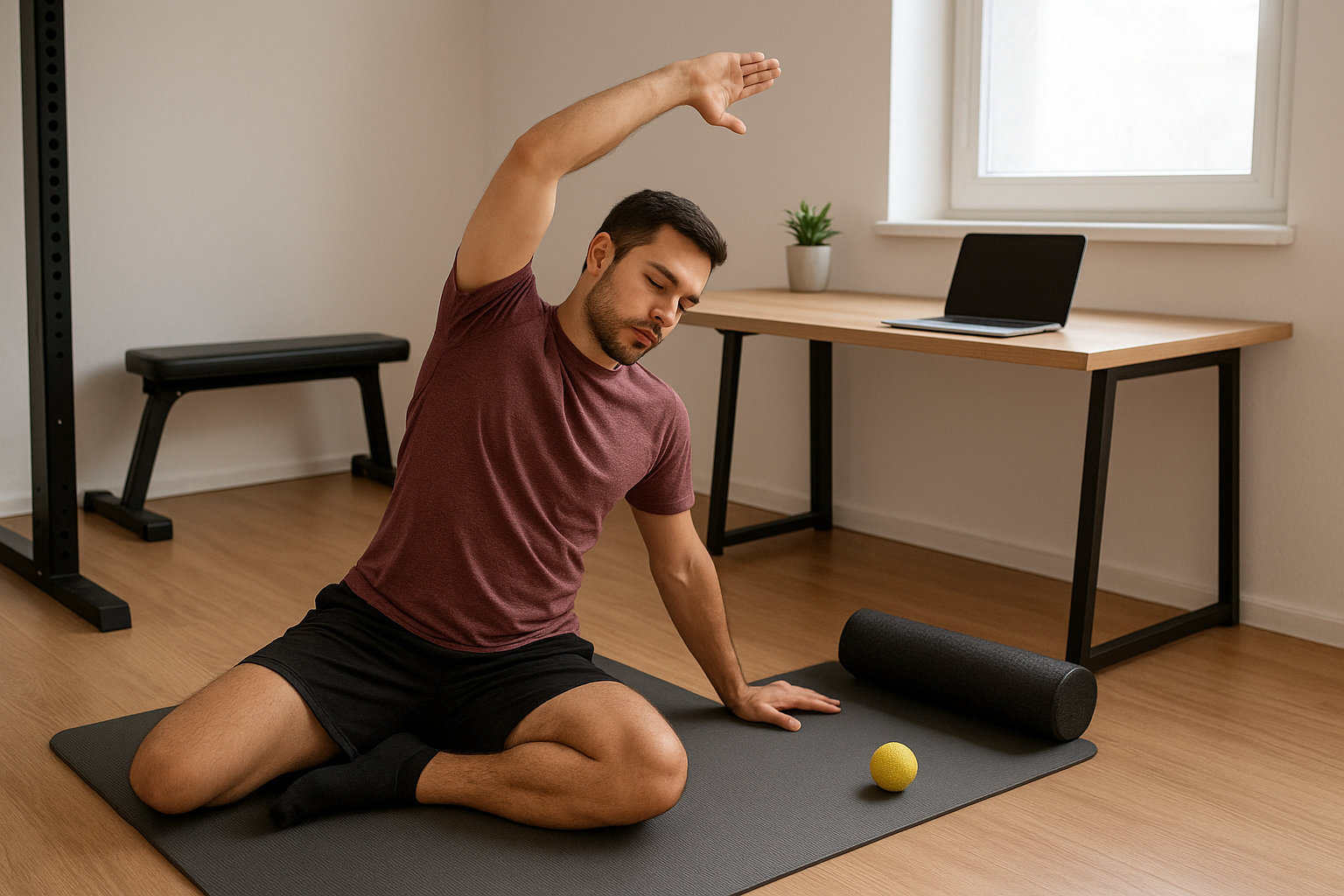
Spending the day hunched over a laptop leaves your hips stiff, your upper back rounded and your neck tight – the opposite of what you want going into a home workout. Before you grab the dumbbells, a short home recovery routine can undo posture stress, wake up sleepy muscles and reduce the risk of injury. In about 10–15 minutes, a mix of mobility drills, activation work and simple self-massage can reset your body from “desk mode” to “training mode”.
Why desk posture sabotages your home workouts
Hours of sitting create a predictable pattern: tight hip flexors, weak glutes, rounded shoulders and a stiff thoracic spine. This combination makes squats feel pinchy, overhead presses unstable and even push-ups uncomfortable. Before you blame your workout plan, look at your posture stress. A targeted pre-session routine helps restore joint range, improve muscle recruitment and sharpen your movement quality so each rep feels smoother and more controlled. Think of it as changing from worn-out office shoes into proper training footwear – you are preparing your body, not just warming it up.
Desk-to-gym mobility: 5-minute reset
Start with a fast mobility circuit to open the areas that get locked up at the desk. Begin with cat–camel movements on all fours to mobilise your spine, then flow into thoracic rotations, reaching one arm up to the ceiling and following it with your eyes. Next, use a deep lunge with rotation to open your hips and hip flexors, focusing on slow breathing and long exhalations to reduce tension. Finish with simple neck and wrist circles to undo screen strain. This short sequence restores basic joint motion so that your muscles can fire in better positions during your home workout.
Activation: waking up your glutes and core
After mobility, switch to activation exercises that target underused muscles, especially the glutes and core. Bodyweight glute bridges, side-lying clamshells and bird-dogs are ideal for home gyms and require little space. Move with intent, holding the top of each rep for one or two seconds to engrain better muscle recruitment. For an extra kick, add a light resistance band around your knees during bridges and clamshells to increase tension on your glutes and hip rotators. This helps correct the classic “desk worker” pattern of overactive hip flexors and underactive glutes before you load up squats, deadlifts or kettlebell swings.
Self-massage tools: simple ways to release tight spots
Self-massage can be a powerful addition to your home recovery toolkit, even if you only have a few minutes. A basic foam roller is excellent for sweeping over your upper back and lateral thighs, easing general tightness from sitting. A firm massage ball set allows more targeted work on stubborn hotspots like the glutes, hip rotators and chest muscles that tighten from keyboard use. Spend 30–60 seconds per area, adjusting pressure with your bodyweight and breathing slowly to avoid tensing up. Used before training, these tools help you move into better positions and make your activation and mobility drills more effective.
Breathing and micro-breaks: recovery that fits into your day
Undoing posture stress is not only about what you do before your workout, but also how you break up sitting time. Short micro-breaks throughout the day – standing up every 45–60 minutes for a quick stretch or walk – reduce the amount of stiffness you have to overcome later. Pair this with simple breathing exercises, like 3–5 slow diaphragmatic breaths while standing tall with your ribs stacked over your pelvis. Quality breathing calms your nervous system, supports better core function and gently reinforces a more neutral posture, so that your pre-workout routine builds on a better baseline.
Putting it all together: a 10-minute pre-workout plan
For busy desk workers training at home, the key is consistency, not complexity. Aim for a simple 10-minute sequence: 3–4 minutes of mobility, 3–4 minutes of glute and core activation, and 2–3 minutes of self-massage on your tightest areas. Over time, you will notice smoother movement, fewer niggles and better performance in your sessions. By treating home recovery for desk workers as a non-negotiable part of your workout, you turn your warm-up into an active antidote to long hours at the desk and build a stronger, more resilient base for every rep you perform.
This structured approach – mobility, activation, self-massage and smart micro-breaks – helps you consistently undo daily posture stress so that each home workout feels safer, more efficient and more enjoyable.









