When your knees, hips or lower back are complaining, traditional cardio like running or stepping can turn every session into a grind. That does not mean you have to give up heart-pumping training at home. By shifting the workload to your upper body with arm-driven cardio machines, you can maintain (or even improve) fitness while giving your legs a chance to recover. In a compact home gym, choosing the right arm-focused equipment and using it intelligently makes all the difference between a dusty gadget and a genuine training tool.
Why upper-body cardio belongs in your home gym
Most people think of cardio as a leg-dominated activity, but upper-body ergometers, arm bikes and arm-driven ellipticals can drive your heart rate just as effectively. Because these machines rely on the shoulders, chest, back and arms, they are ideal when you are managing knee pain, ankle injuries or delayed onset muscle soreness from heavy leg days. They are also useful for people who sit all day and need to open up the thoracic spine and strengthen postural muscles. In a home setting, an arm-focused machine offers low-impact conditioning you can do daily without pounding on the joints, while still burning meaningful calories and maintaining cardiovascular capacity.
Key types of arm-driven machines for home use
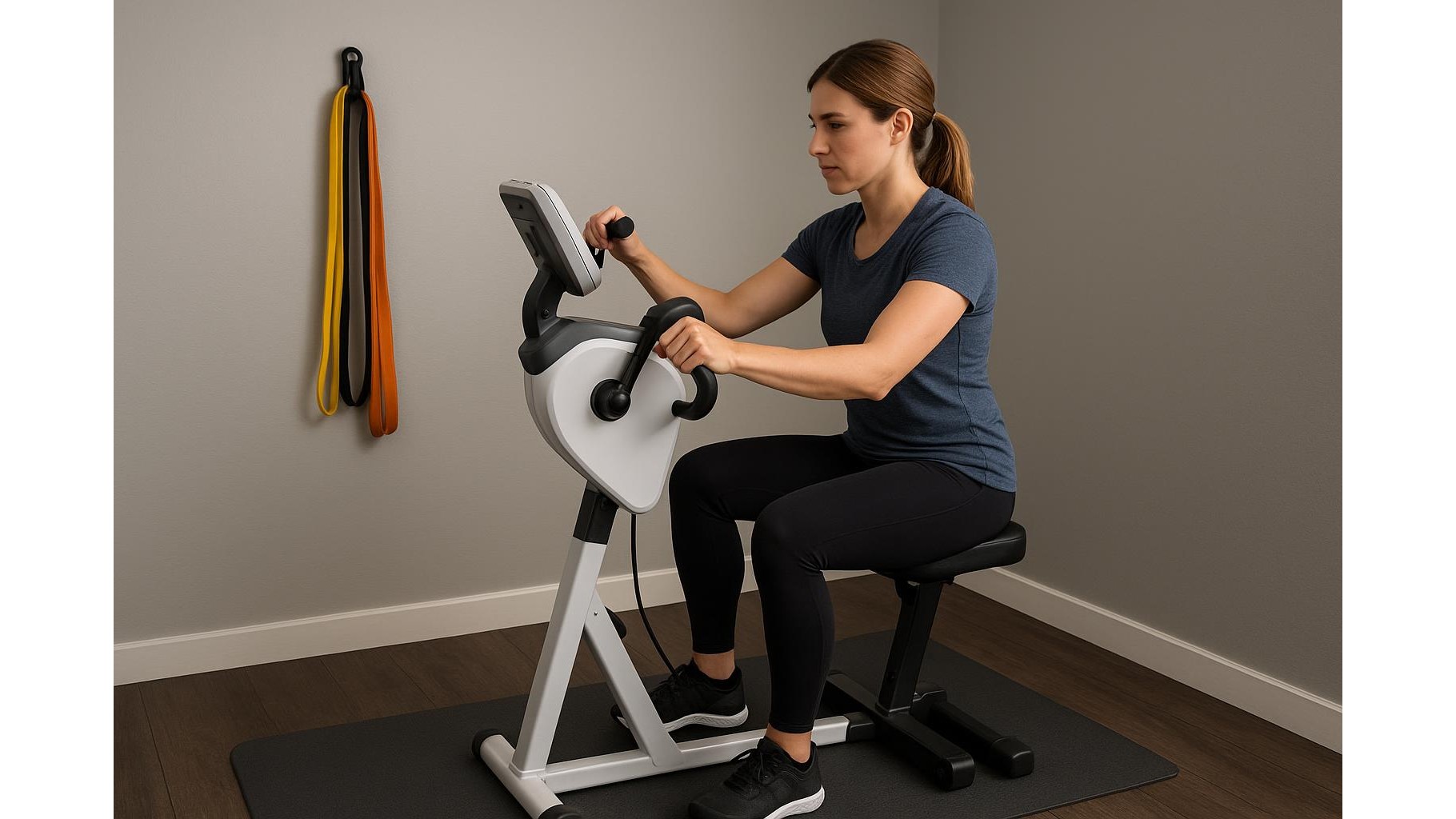
The most classic option is the upper-body ergometer (UBE), often called an arm bike. It looks like a compact bike with cranks for your hands instead of pedals, and you can usually use it seated or standing. Some versions sit on a tabletop for easy storage; others come with a dedicated frame. Another category is the arm-driven elliptical or cross trainer, which uses long handles connected to a magnetic resistance system. These let you perform smooth circular or oval movements with your arms, mimicking the feel of an elliptical without engaging the legs as much. Finally, there are hybrid foldable trainers that combine arm cranks with light leg support; for home users with limited space, these can double as a gentle full-body cardio option while still allowing arm-only sessions when needed.
Who benefits most from arm-focused cardio sessions
Arm-driven machines shine for anyone who needs a lower-body deload: runners dealing with overuse injuries, lifters in a heavy squat cycle, or beginners whose legs fatigue long before their lungs. They are also particularly helpful for people with mobility limitations that make standing or walking uncomfortable, provided the upper body is healthy. For strength athletes, upper-body cardio is an efficient way to increase work capacity without adding more leg volume. Desk workers can use short bouts throughout the day to improve circulation and reduce upper-back stiffness. However, those with shoulder instability or acute elbow and wrist issues should ease in carefully, keeping resistance low and focusing on smooth, pain-free ranges of motion.
How to structure effective upper-body cardio workouts
To get meaningful results from an arm-driven cardio machine, plan your sessions just as you would with a bike or treadmill. For general endurance, aim for 20–30 minutes at a steady, conversational pace, 3–5 times per week. Keep resistance moderate so your shoulders do not fatigue too quickly; your breathing and heart rate should be the main drivers of effort. For time-efficient conditioning, try intervals: 30 seconds of hard cranking followed by 60–90 seconds easy, repeated for 10–15 minutes. Focus on posture—neutral spine, relaxed neck, and elbows slightly bent—to avoid unnecessary strain. You can also pair short arm-ergometer bursts with light strength moves (such as band pull-aparts or wall slides) for a joint-friendly circuit that fits easily into a small home gym routine.
Space-saving tips and features that really matter
In a compact home gym, the best arm-driven machine is the one you can actually keep accessible. Prioritise footprint and storage options: tabletop or foldable arm bikes tuck away under a desk or in a cupboard, while slim arm-driven ellipticals can park against a wall. Look for adjustable resistance (preferably magnetic for quiet operation), a stable base that does not wobble when you crank hard, and handle ergonomics that suit your hand size and shoulder width. Basic consoles that track time, distance, RPM and calories are usually enough; Bluetooth or app connectivity is a nice-to-have but not essential if budget and space are tight. Above all, choose a machine that feels smooth and encourages regular, pain-free use—that is what keeps your upper-body cardio habit alive when your legs need a break.
Incorporating upper-body focused home cardio is one of the smartest ways to stay consistent when lower-body training is off the table. By understanding the different types of arm-driven machines, who they are best for, and how to structure simple sessions in a small space, you can keep your conditioning on track without compromising recovery. Think of an arm ergometer or arm-driven elliptical as a flexible tool in your home gym: ready to take over when your legs need time off, but still valuable for everyday, low-impact fitness whenever you want a change of pace.