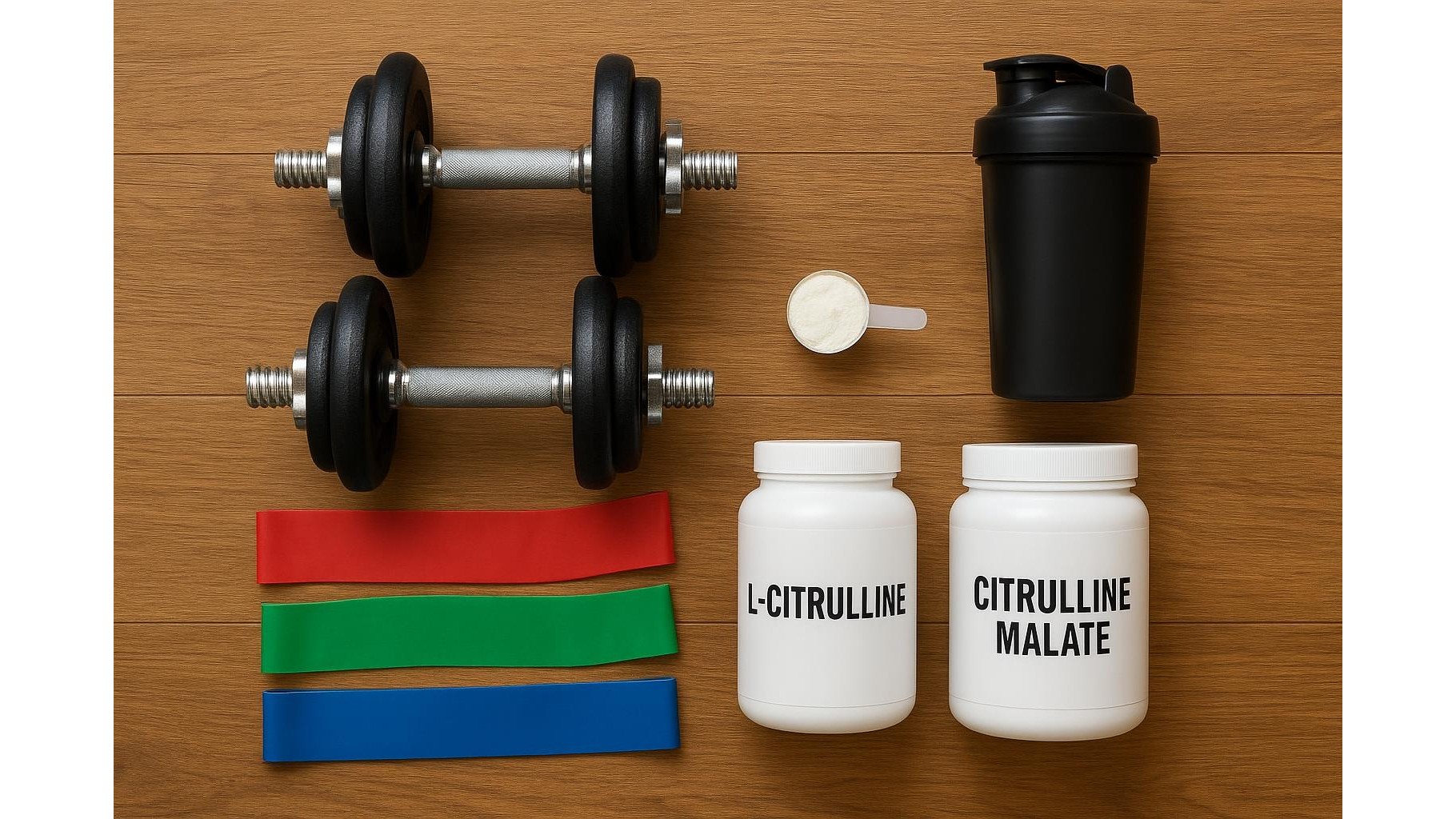
When you start taking your home workouts seriously, it’s natural to look for safe supplements that boost pump, endurance and recovery. Two of the most popular options are L-citrulline and citrulline malate. They sound almost identical, but they don’t work in exactly the same way. This guide breaks down what the science says, how to dose each form, and who actually needs these pre-workout ingredients in a home gym setting.
What L-citrulline actually does in your body
L-citrulline is a non-essential amino acid that your body converts into L-arginine and then into nitric oxide (NO). Higher nitric oxide levels help your blood vessels relax, improving blood flow to working muscles. For home lifters, that can mean better muscle pumps, potentially reduced fatigue and improved nutrient delivery. Research generally shows that pure L-citrulline increases plasma arginine more effectively than taking arginine itself, making it a preferred way to support NO production. Unlike caffeine-heavy pre-workouts, L-citrulline is non-stimulant, so it’s suitable for evening sessions and for lifters who want to avoid jitters or sleep disruption.
What makes citrulline malate different
Citrulline malate combines L-citrulline with malic acid (malate), usually in a 2:1 or 1:1 ratio. Malate is involved in the Krebs cycle, the process your body uses to generate energy (ATP). Because of this, citrulline malate is often marketed not only for pump, but also for increased muscular endurance and reduced DOMS (delayed onset muscle soreness). Some studies in resistance-trained athletes suggest citrulline malate can improve reps to failure and perceived fatigue. However, results are mixed, and product labels are not always clear about the actual citrulline content; a “6 g” scoop of 1:1 citrulline malate may deliver only 3 g of true L-citrulline. For evidence-based dosing, knowing the ratio is crucial.
Evidence-based dosing and timing at home
Most research-backed doses for L-citrulline sit around 6–8 g of pure L-citrulline, taken about 45–60 minutes before training. With citrulline malate, effective study doses cluster around 8 g, but again, that total weight includes malate. For typical 2:1 citrulline malate, 8 g provides roughly 5.3 g citrulline; with 1:1, it’s only 4 g. To approximate research doses at home, aim for at least 6 g of real citrulline, adjusting the scoop size if you know the ratio. Mix the powder in water or an intra-workout drink. Because both forms are non-stimulant, you have flexibility: you can split the dose (half pre-workout, half intra-workout) without losing benefits, which can also reduce digestive discomfort in sensitive users.
Which should you choose for your home pre-workout?
If your main goal is maximising pump and blood flow with clear, predictable dosing, pure L-citrulline is often the simpler choice: you know exactly how many grams you are getting, and you can titrate up from 6 g based on comfort and response. If you prioritise high-rep endurance, circuits or conditioning sessions in your home gym, citrulline malate may offer a small advantage thanks to the malate component, especially when workouts are longer and metabolically demanding. For people highly sensitive to digestive upset, some find L-citrulline slightly gentler at higher doses, while others tolerate citrulline malate better—so individual experimentation matters. Budget is also a factor: per effective gram of citrulline, plain L-citrulline powder is often more cost-effective.
Safety, who can skip it, and practical tips
Both L-citrulline and citrulline malate are generally well-tolerated at the doses studied, with mild digestive discomfort the most common side effect when people jump straight to high amounts. If you have cardiovascular issues, low blood pressure, or take medications that affect blood vessels (like nitrates or PDE5 inhibitors), speak to a healthcare professional before using any nitric-oxide–boosting supplement. Importantly, no one “needs” citrulline to progress in a home gym: consistent training, sufficient protein, calories and sleep will always drive most of your gains. Think of citrulline more as an optional, non-stim add-on when your basics are already dialled in. Start at 3–4 g, monitor pump, performance and any side effects for a week, and only then consider working toward the evidence-based 6–8 g range.
In summary, both L-citrulline and citrulline malate can support better pumps and potentially endurance in your home workouts, but they are not magic bullets. Pure L-citrulline makes dosing simpler and is ideal if you want predictable nitric oxide support without stimulants. Citrulline malate may offer extra help in longer, high-rep sessions, provided you account for the lower actual citrulline content. Choose the form that best fits your goals, budget and sensitivity, dose it intelligently, and remember that consistent training and recovery still matter far more than any pre-workout powder.