
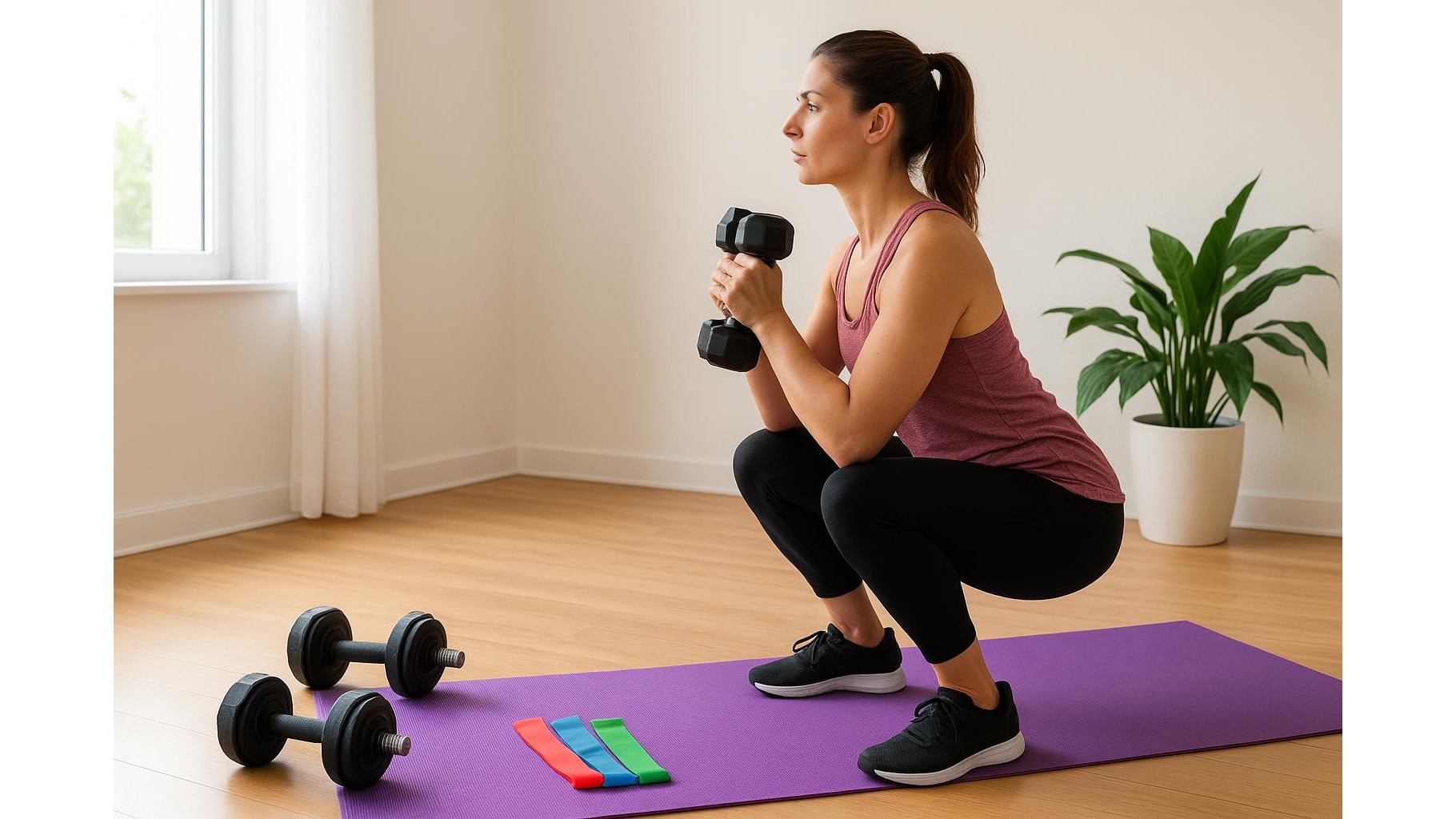
A well-planned home strength ladder workout is one of the most efficient ways to build full body strength, improve muscle control and develop real-world power in just 30 minutes. By combining slow eccentric reps (the lowering phase) with explosive concentric work (the lifting phase), you challenge both your muscles and nervous system, gaining better technique, more stability and a serious conditioning boost. All you need is a pair of dumbbells or a set of resistance bands and a small training space.
How the strength ladder and tempo method works
This 30-minute session uses a ladder structure: you perform 1 rep of each exercise, then 2, 3, 4 and 5, before coming back down if time allows. Instead of rushing through, you emphasise mixed tempos. For most moves, lower the weight in a 3–4 second eccentric, pause for control, then drive up with a fast, powerful concentric. This contrast trains your ability to absorb force and then express it quickly, a key component of athletic performance. Because volume ramps up gradually, beginners can stop at lower rungs, while experienced lifters can climb higher or add load.
[prompt_placeholder type=”cta” id=”telegram”/]
Equipment options: dumbbells or resistance bands
For this home ladder workout, the best choice is a pair of adjustable dumbbells or a solid resistance band set. Adjustable dumbbells let you quickly change load between upper and lower body moves, keeping rest periods short and intensity high. Resistance bands are ideal if you train in a small space or need something easy to store and travel with; they provide variable resistance, so tension increases as you reach the top of each movement, which pairs perfectly with slow eccentrics. Whichever option you choose, aim for a load that makes the final reps of each ladder rung challenging while still allowing technical, tempo-controlled execution.
Warm-up and movement prep (5 minutes)
Before you start the ladder, spend five minutes raising your heart rate and opening up key joints. Cycle through 30 seconds each of jumping jacks, bodyweight squats, arm circles and high knees, then repeat once. Follow with 5–8 slow hip hinge reps and world’s greatest stretch on each side. During this phase, already think about tempo control: move smoothly, own every position and avoid bouncing at end ranges. A good warm-up will help you feel more stable during the slow lowering phases and allow you to produce more safe power on the explosive portions of the workout.
The 30-minute full body ladder: structure and tempos
Set a timer for 20 minutes of work after your warm-up. You will rotate through 4 compound exercises: a goblet squat, a hinge or deadlift pattern, a horizontal press and a row. Perform 1 rep of each, then 2, 3, 4 and 5. Rest 30–45 seconds between rungs if needed, then continue climbing or repeat from 1 if you reach 5 quickly. Use a 3–4 second eccentric with a strong brace and a fast but controlled concentric. For example: squat down in 3 seconds, pause briefly at the bottom, then drive up hard; lower for rows in 3 seconds, pull explosively to the ribcage. Maintain crisp technique even as fatigue builds—tempo is only effective if you stay in control.
Exercise selection and progression ideas
Choose variations that fit your current ability and equipment. For squats, use a goblet squat with a dumbbell or banded front squat; for hinges, pick a Romanian deadlift with dumbbells or a banded pull-through. Pair these with a floor press or push-up for your press slot, and a single-arm row for your pull. If you are newer to tempo work, start with 2–3 second eccentrics and keep the ladder at 1–3 reps. As you build confidence, extend the eccentric to 4 seconds, add a 1-second pause in the hardest position and work up to 1–5-rep ladders. You can also progress by increasing load, shortening rest or adding an extra ladder round within the 20-minute window.
Cool-down, recovery and consistency
Finish with a brief cool-down to help your body shift out of high-intensity mode. Spend 3–5 minutes on deep breathing, long hip flexor stretches, hamstring stretches and gentle thoracic rotations. Because mixed-tempo ladder training creates a lot of muscular tension, prioritise hydration, protein intake and sleep on training days to maximise muscle growth and strength gains. Aim to repeat this 30-minute home ladder workout 2–3 times per week, tweaking exercises and loads as you progress. With consistent practice, you’ll feel greater control over every rep, more power out of the bottom of each movement and a clear boost in overall athleticism.









