
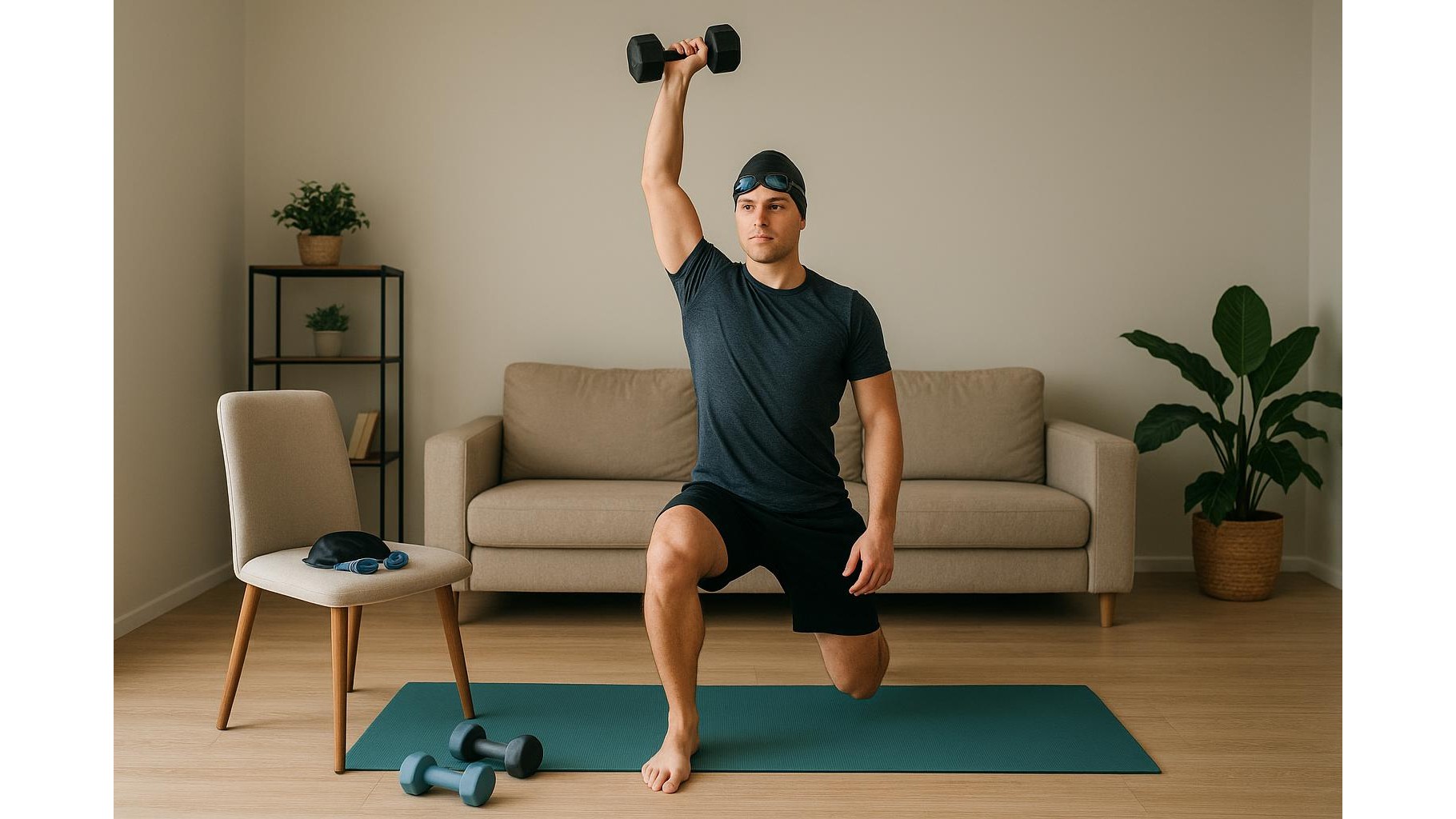
When the pool schedule slows down, many swimmers lose not only their feel for the water but also the strength and resilience that protect their shoulders. The good news: with just one dumbbell, a small space, and a smart plan, you can maintain power, core stability and endurance at home. This 35‑minute full body conditioning workout is designed specifically for swimmers in the off‑season, focusing on healthy shoulders, a rock‑solid core and sustainable conditioning that supports your next block of pool training.
Why a single-dumbbell workout works for swimmers
Using only one dumbbell mirrors the unilateral nature of swimming strokes, where each arm pulls independently through the water. Single‑arm loading challenges your core stability, forcing the trunk and hips to resist rotation and maintain alignment, much like a strong body line in freestyle or backstroke. A single implement also reduces setup time and complexity, so you can move quickly between exercises and keep the focus on time under tension and quality movement. For off‑season swimmers, this approach maintains strength in the shoulders, lats, hips and trunk without the fatigue and joint stress that often come from heavy barbell work.
Essential exercises for shoulder health
Swimmers’ shoulders take a beating during the season, so off‑season work should blend strength with stability. With one dumbbell you can build a simple circuit: single‑arm floor press to strengthen the anterior shoulder and chest while your core resists rolling; bent‑over rows to target the lats and mid‑back that drive your pull; and half‑kneeling overhead presses, which encourage proper rib‑cage positioning and scapular control. Perform 8–12 controlled reps per side, focusing on smooth movement and a strong lockout overhead without shrugging. This combination maintains shoulder capacity in the ranges you actually use in the pool and can help reduce imbalances between your dominant and non‑dominant arm.
Building a swimmer’s core and hip drive
A fast stroke comes from a stable trunk transferring power from the hips to the hands. Single‑dumbbell work is ideal for this. Include single‑arm front‑rack holds and overhead carries around your room to challenge anti‑rotation and anti‑lateral‑flexion strength. Pair these with Romanian deadlifts holding the dumbbell in one hand, hinging from the hips to load hamstrings and glutes while keeping the spine long. Add a set of Russian twists or dead bug presses holding the dumbbell to integrate rotation control, crucial for backstroke and freestyle. Aim for 30–40 seconds of continuous tension per set rather than chasing max reps; the goal is controlled, swim‑specific core endurance, not just burning out your abs.
Structuring a 35-minute conditioning session
To get the most from this off‑season home workout, organise your 35 minutes into focused blocks. Start with 5 minutes of dynamic warm‑up: arm circles, band pull‑aparts if available, hip hinges and light shoulder CARs. Then perform three 8‑minute EMOM (every minute on the minute) or circuit blocks. For example: Block 1 – single‑arm floor press and bent‑over row; Block 2 – half‑kneeling overhead press and Romanian deadlift; Block 3 – core carries and rotational work. Work for 35–40 seconds, rest for 20–25 seconds each minute. Finish with 4–5 minutes of gentle mobility for the pecs, lats and hip flexors. This structure keeps the heart rate elevated for conditioning while preserving crisp technique and shoulder‑friendly volume.
Progression, safety and getting ready for the next season
Because you only have one dumbbell, progression comes from tempo, range of motion and density rather than constant weight jumps. Slow the lowering phase to 3–4 seconds, pause briefly at the hardest point of the lift, or reduce rest periods as your fitness improves. Swimmers should prioritise pain‑free motion: no pinching at the front of the shoulder, no forced overhead range if you lack mobility. If your set‑up allows, combine this routine with light band work for external rotation and scapular control two to three times per week. Done consistently through the off‑season, this single‑dumbbell plan helps you return to the pool with stronger shoulders, better posture in the water and the endurance to handle early‑season yardage without feeling wrecked.
With a smart structure and just one piece of equipment, you can turn a small corner of your home into a targeted swim‑specific conditioning station. This 35‑minute routine keeps your shoulders robust, your core engaged and your engine ticking over between pool blocks, so when it’s time to dive back in, you’re not starting from zero but building on a solid, home‑grown foundation.









