Filming your home workouts with an action camera is a powerful way to track progress, fix technique and even share your training online. But shooting in a small living room or bedroom is very different from recording outdoor sports. You need a camera that handles tight spaces, artificial lighting and flexible mounting options without blowing your budget. This guide walks you through what to look for in a budget-friendly action camera for home workouts, from field of view to stabilization and app integration.
Choosing the right field of view for tight home spaces
In small rooms, the camera’s field of view (FOV) is crucial. A wide or ultra-wide lens helps you stay fully in frame even when you move from floor exercises to overhead presses. Look for cameras that offer multiple FOV modes (wide, linear, narrow) so you can avoid heavy distortion when you’re close to the lens. Ultra-wide can curve walls and make your form harder to judge, so a linear or de-warped mode is ideal for reviewing technique. If you mostly train in a narrow corridor or hallway, the ability to switch to a slightly tighter FOV can prevent background clutter and keep attention on your movement.
Stabilization and frame rate for smooth workout footage
Good image stabilization is non‑negotiable when you’re doing dynamic moves like burpees, jump squats or kettlebell swings. In a confined home gym, every small shake is exaggerated because the camera is so close to you. Look for electronic or gyro-based stabilization and check that it still works at your preferred resolution (often 1080p) and frame rate. A frame rate of 60fps at 1080p is a sweet spot: it keeps motion smooth and lets you slow down clips for form checks without choppiness. If your workouts are mostly low-impact strength sessions, you can prioritize higher resolution (2.7K or 4K) over ultra-high frame rates to capture more detail in joint positions.
Low-light performance and indoor image quality
Most home gyms rely on ceiling lights or a single window, which is challenging for small sensors. To get clear, usable footage, prioritize low-light performance. On spec sheets, this often shows up as a slightly larger sensor, faster lens (lower f-number) or dedicated low‑light modes. In practice, you want clean video without heavy noise when filming at dusk or in a basement. Even on a budget, choose an action camera that handles 1080p cleanly in auto mode rather than chasing cheap 4K that falls apart in dim rooms. Pair the camera with one or two inexpensive LED panels to reduce motion blur and keep your movements sharp for later review.
Mounting options and angles for home workouts
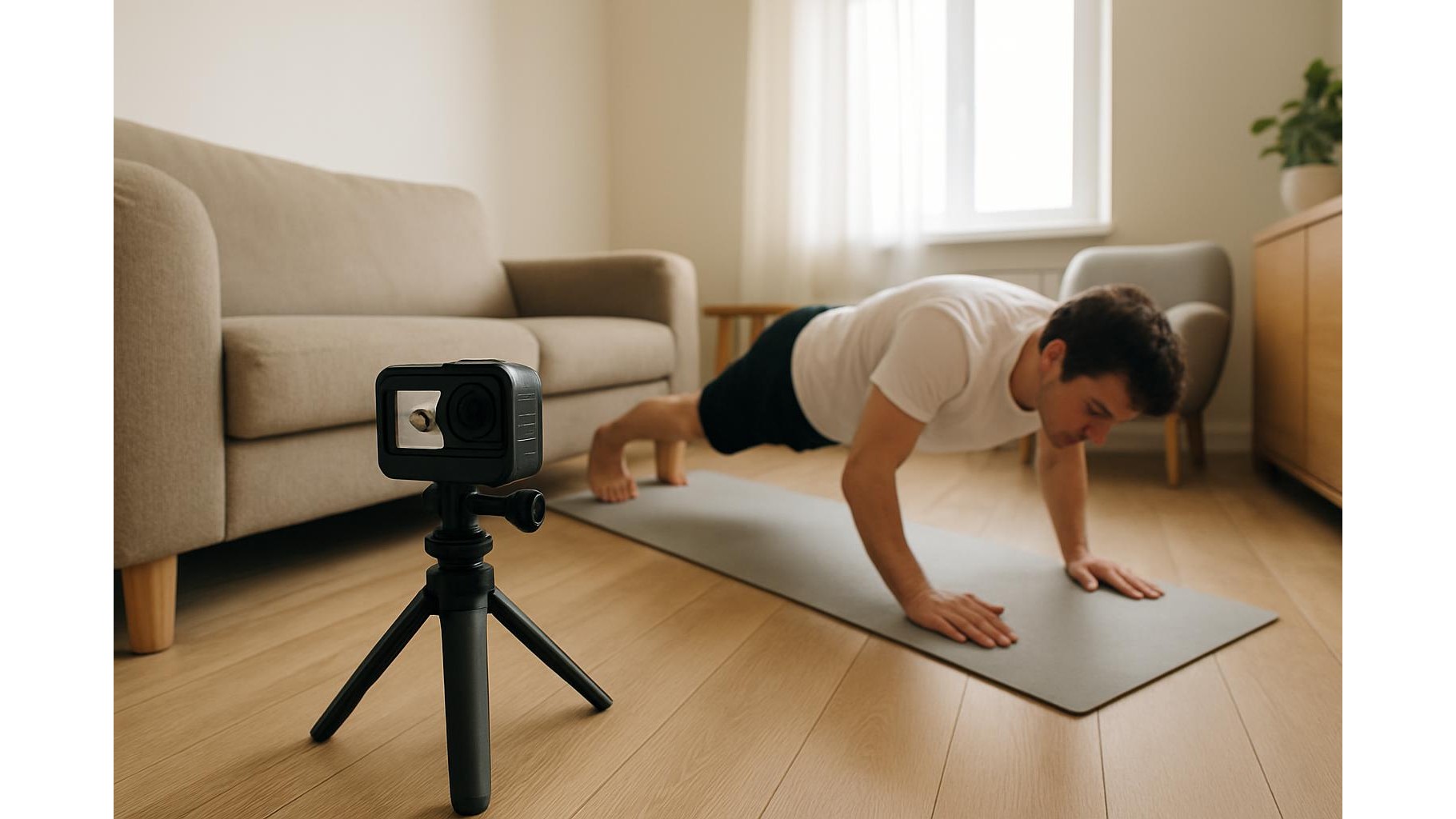
How you mount the camera matters as much as the camera itself. In small spaces, flexible mounting options let you experiment with angles that show your whole body. Prioritize cameras that include or support standard action camera mounts: sticky bases for walls, clamp mounts for shelves, and simple tripods. A wall or doorframe mount at hip or chest height works well for most strength moves; a higher angle from a bookshelf can capture full-body cardio. Make sure the camera has a standard 1/4-inch tripod thread or comes with an adapter so you can reuse affordable accessories. A flip screen is useful but not essential; many budget action cams let you preview the frame on your phone via Wi‑Fi, which is perfect when the camera is tucked into a corner.
Integration with coaching and workout apps
For modern home training, app connectivity can be a bigger win than pure specs. Look for a budget action camera that offers Wi‑Fi or Bluetooth and a stable companion app for your phone. This lets you start and stop recording between sets without walking across the room, and quickly review a lift or yoga pose. Some apps allow basic video trimming and adding overlays like time or date stamps, which can be useful for tracking training blocks. While full integration with specific coaching platforms is rare at low prices, the ability to export standard MP4 files and share them to coaching apps (Trainerize, TrueCoach, or simple cloud folders) is more than enough for most lifters and home athletes.
When you’re building a home gym filming setup, you don’t need a premium camera to get useful feedback on your training. Focus on a flexible field of view, reliable stabilization at 1080p/60fps, decent low-light performance, and mounting options that suit tight spaces. Add simple app control, and you’ll have a compact, budget‑friendly action camera that turns any corner of your home into a personal coaching studio without cluttering your room or your wallet.