
Creating a 30-minute Pilates ring home workout is an excellent way to build strength and mobility in a small space without disturbing your neighbours. With a single Pilates ring (also called a magic circle), you can challenge your core, legs and upper body through controlled, low-impact exercises that feel gentle on the joints but intense on the muscles. This routine is designed for your living room, bedroom or any corner where you can lie down on a mat.
Why the Pilates ring is perfect for small-space home workouts
The Pilates ring is a lightweight, versatile circle with padded sides that adds resistance to classic Pilates moves. Because it’s compact, it’s ideal if you train in a flat or small home gym: you only need a mat’s footprint and can easily store the ring in a drawer. Its springy tension helps you engage muscles you might usually miss, particularly the inner thighs, glutes and deep core. A ring also encourages mindful movement; you squeeze or press gently instead of relying on momentum, which keeps the workout quiet and joint-friendly. If you’re building a home gym on a budget, a good Pilates ring is one of the smartest investments you can make.
Warm-up and core activation (minutes 0–6)
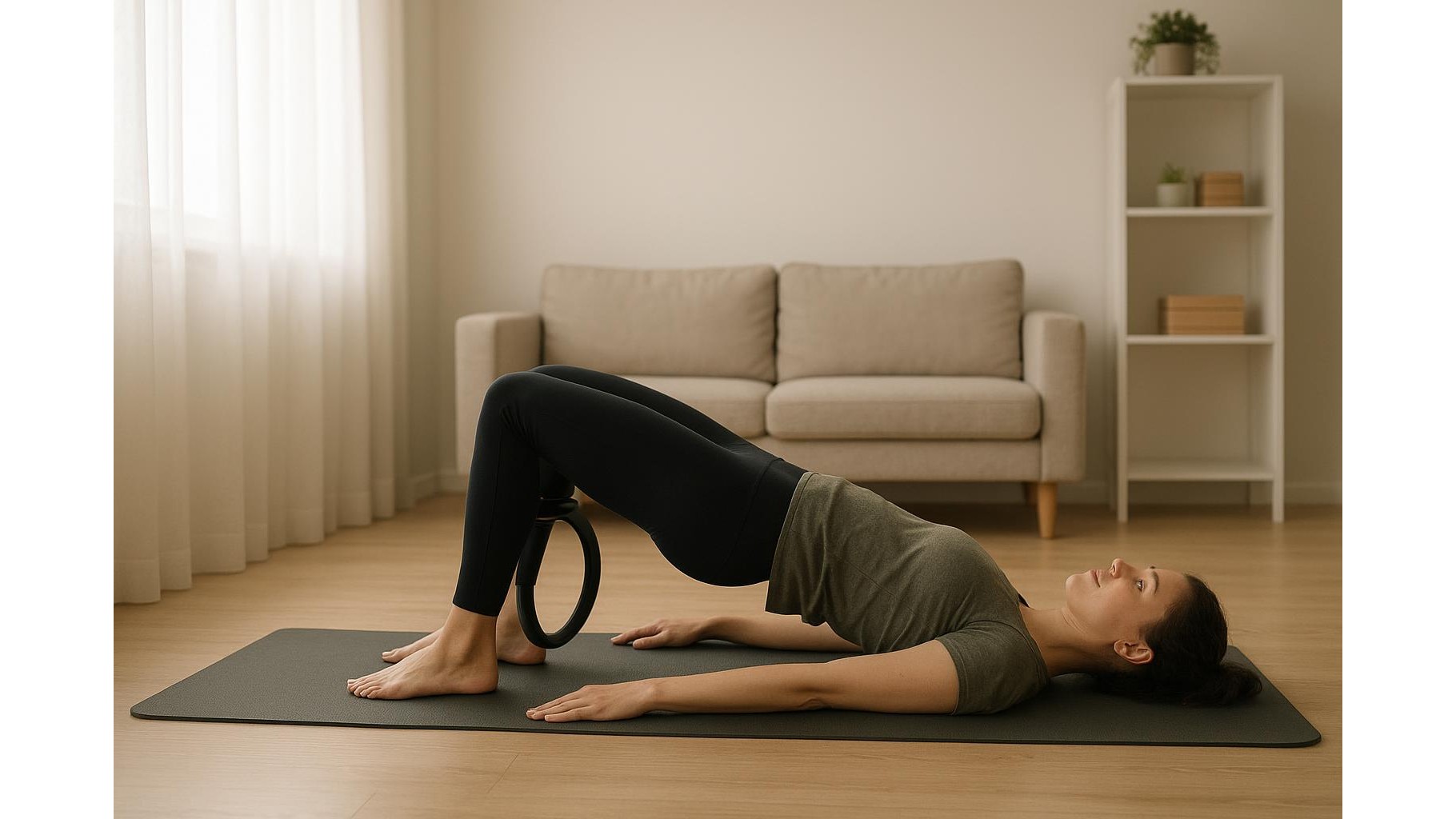
Start lying on your back on a mat, knees bent and feet hip-width apart. Place the Pilates ring between your hands, arms straight above your chest. Take slow breaths, gently pressing the ring on each exhale to wake up the shoulders and abdominals. Next, move into a simple pelvic curl: feet on the floor, ring between your thighs above the knees. As you roll your spine up into a bridge, lightly squeeze the ring to fire up the inner thighs and glutes. Roll down slowly, one vertebra at a time. Repeat for 8–10 reps. Finish this block with table top marches, the ring still between your thighs, lifting and lowering one leg at a time while keeping your pelvis stable and your core engaged.
Lower body focus: thighs and glutes (minutes 6–15)
For the main lower body sequence, stay on your back and keep the Pilates ring between your thighs, just above the knees. Perform another set of bridges, this time adding small pulses with the ring at the top of the movement for extra inner thigh activation. Aim for 12–15 reps. Then roll onto your side, placing the ring between your ankles. With your body in one long line, squeeze the ring as you lift the top leg slightly, then control the release. This targets the outer hips and glute medius, crucial muscles for hip stability and knee health. Switch sides after 10–12 reps. To finish, sit tall with the ring between your thighs and do tiny squeezes while maintaining an upright spine, warming up the hip adductors and posture muscles.
Upper body and posture work (minutes 15–22)
Transition to a seated position with legs crossed or extended in front of you. Hold the Pilates ring between your palms at chest height, elbows slightly bent. As you exhale, gently press the ring and feel your chest, shoulders and upper back activate. This helps combat the rounded posture many of us develop from working at a desk. Next, lie on your side again, one palm on the top pad of the ring and the other hand stabilising on the floor. Press down into the ring to work the triceps and side body. Repeat 10–12 times per side. Because the resistance is moderate and controlled, these upper body moves stay quiet and suitable for low-impact home training.
Core, balance and standing sequence (minutes 22–28)
Stand up with your feet hip-width apart, holding the Pilates ring between your hands at shoulder height. Press the ring lightly as you perform small mini-squats, sitting your hips back and keeping your knees tracking over your toes. This challenges your quads, glutes and core while training balance. Then place the ring just above one knee, against a wall or sturdy surface, and press into it as you balance on the opposite leg. This improves single-leg stability without needing much space. For a final core challenge, return to the mat in a seated “V” position, ring between your hands. Lean back slightly, press the ring and hold for 20–30 seconds, keeping your spine long and abdominals braced.
Cool-down and stretching (minutes 28–30)
Finish your 30-minute Pilates ring home workout with a gentle cool-down. Lying on your back, place one foot inside the Pilates ring and use it as a strap to guide your leg into a comfortable hamstring stretch. Switch legs after 20–30 seconds. Then sit up tall, place the ring in front of your chest and gently press as you round and lengthen your spine, alternating between flexion and extension to release the back muscles. A few deep breaths with light squeezes of the ring help calm your nervous system and signal the end of your session.
This 30-minute Pilates ring home routine gives you a complete full body workout in a tiny footprint, keeping impact low and movements controlled. With consistent practice two to three times per week, you’ll notice stronger core stability, better posture and more toned legs and arms, all without leaving your living room or needing bulky equipment.









