A Pilates-inspired resistance band workout is one of the most efficient ways to build strength, improve posture and increase joint-friendly mobility without leaving your living room. By combining controlled Pilates moves with the constant tension of resistance bands, you can target your core, glutes, shoulders and back in just 30 minutes, with minimal equipment and low impact on your joints.
Why Pilates and resistance bands are a perfect match
Pilates focuses on precise, slow and controlled movements that train deep stabilising muscles around your spine, hips and shoulders. When you add a simple elastic resistance band, every phase of the exercise becomes more challenging, especially the return phase, forcing you to stay engaged instead of just relaxing. This combination is ideal for anyone who wants better posture, core strength and mobility without heavy weights or high-impact jumps. You can easily adjust the difficulty by shortening the band or switching to a band with higher resistance, making this routine suitable for both beginners and more experienced home exercisers.
Essential equipment for a Pilates-style band session
To get the most from this 30-minute routine, you only need a non-slip mat and a set of resistance bands. Opt for a light-to-medium resistance long band that allows a full range of motion without compromising form. Look for options that include loop bands for glute work and longer bands for rows and presses, ideally with comfortable, non-irritating material so you can maintain a firm grip during slower Pilates-style repetitions. A supportive mat helps protect your spine and knees during floor-based core work and side-lying leg series, keeping your alignment precise and comfortable throughout the session.
10-minute warm-up for posture and mobility
Begin with 10 minutes of gentle mobility to prepare your joints and switch on your core. Start standing with band pull-aparts: hold the band at shoulder height, arms extended, and open your chest by pulling the band apart while keeping ribs down and neck long. Follow with shoulder circles and side bends, focusing on length through the spine. Move to the mat for cat–cow stretches, thread-the-needle rotations, and a basic Pilates imprint and release of the lower back to connect with your deep abdominal muscles. Finish with glute bridges, optionally with the band above your knees, driving the knees slightly outward to activate hips and glutes before the main strength block.
15-minute full-body strength and core block
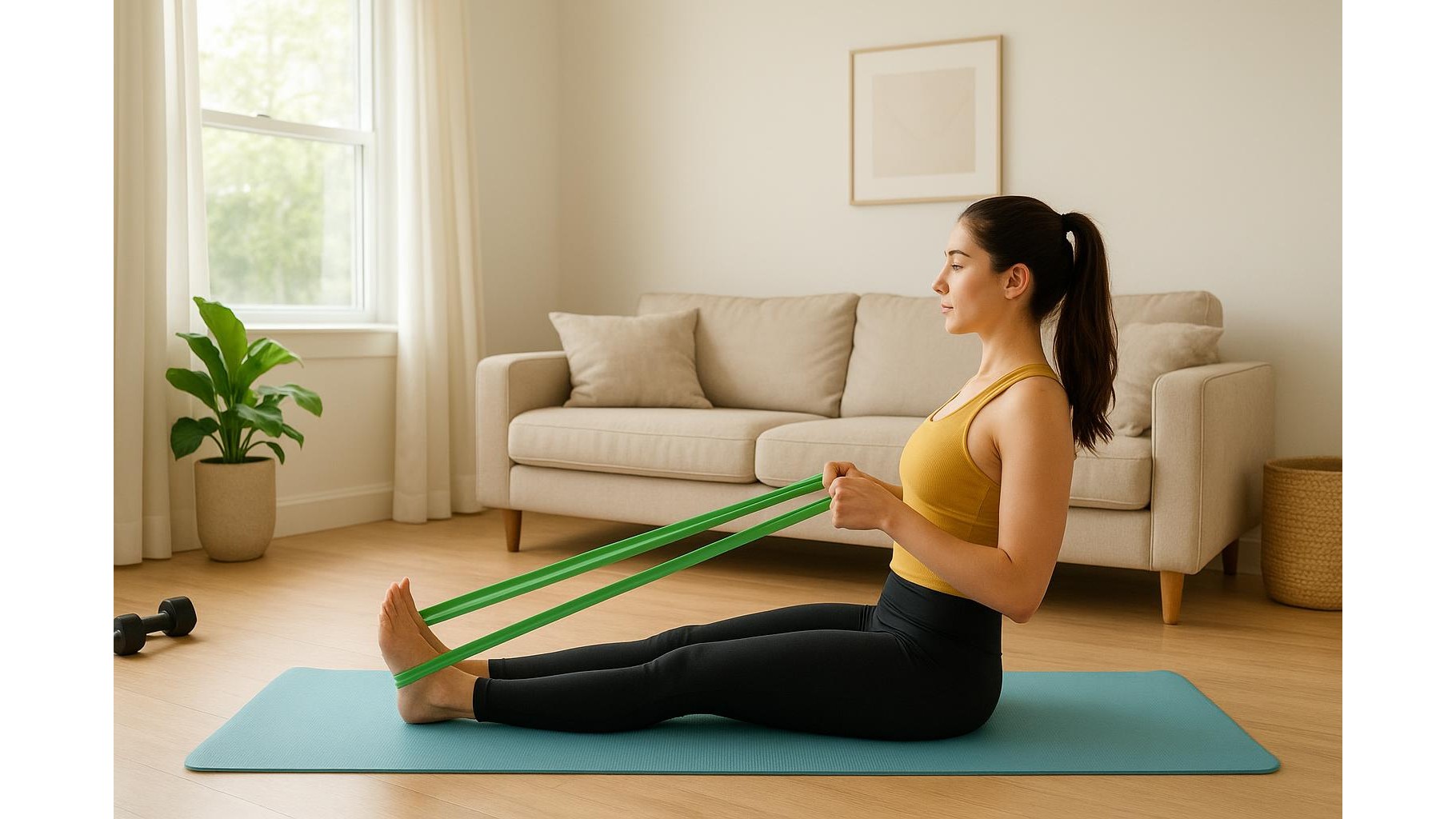
The heart of this home resistance band workout is a 15-minute circuit that hits your entire body. Perform 45 seconds of work and 15 seconds of transition for each move, repeating the circuit twice. Include a banded squat with overhead press to train legs and shoulders while maintaining a tall, Pilates-style posture. Add a seated row with the band looped around your feet to strengthen mid-back muscles that combat desk-related rounding. For core, use a band-resisted dead bug and a half-rollback with row, keeping your spine long and navel drawn gently to the spine. Finish with a side-lying clamshell or side-lying leg lift with band tension to sculpt glutes and improve pelvic stability.
5-minute Pilates-based cool down and reset
End your 30-minute routine with a short cool down to cement your posture gains. Lie on your back and gently hug your knees into your chest, then extend one leg at a time using the band as light assistance for a hamstring stretch. Roll to your side and come to a tall kneeling or standing position for chest-opening stretches, interlacing your fingers behind your back or lightly pulling the band apart to open the front of your shoulders. Finish with a Pilates-style standing roll-down: articulate through each vertebra as you fold forward and then slowly stack your spine, visualising a long, aligned posture that you will carry into the rest of your day.
Practising this Pilates-inspired resistance band workout at home two to four times per week can significantly improve your posture, core strength and mobility in just half an hour per session. The low-impact nature makes it sustainable, while the adjustable resistance keeps it challenging as you progress. With a simple band and focused, mindful movement, you can turn your home into an effective, joint-friendly training space and build a stronger, more upright body over time.