
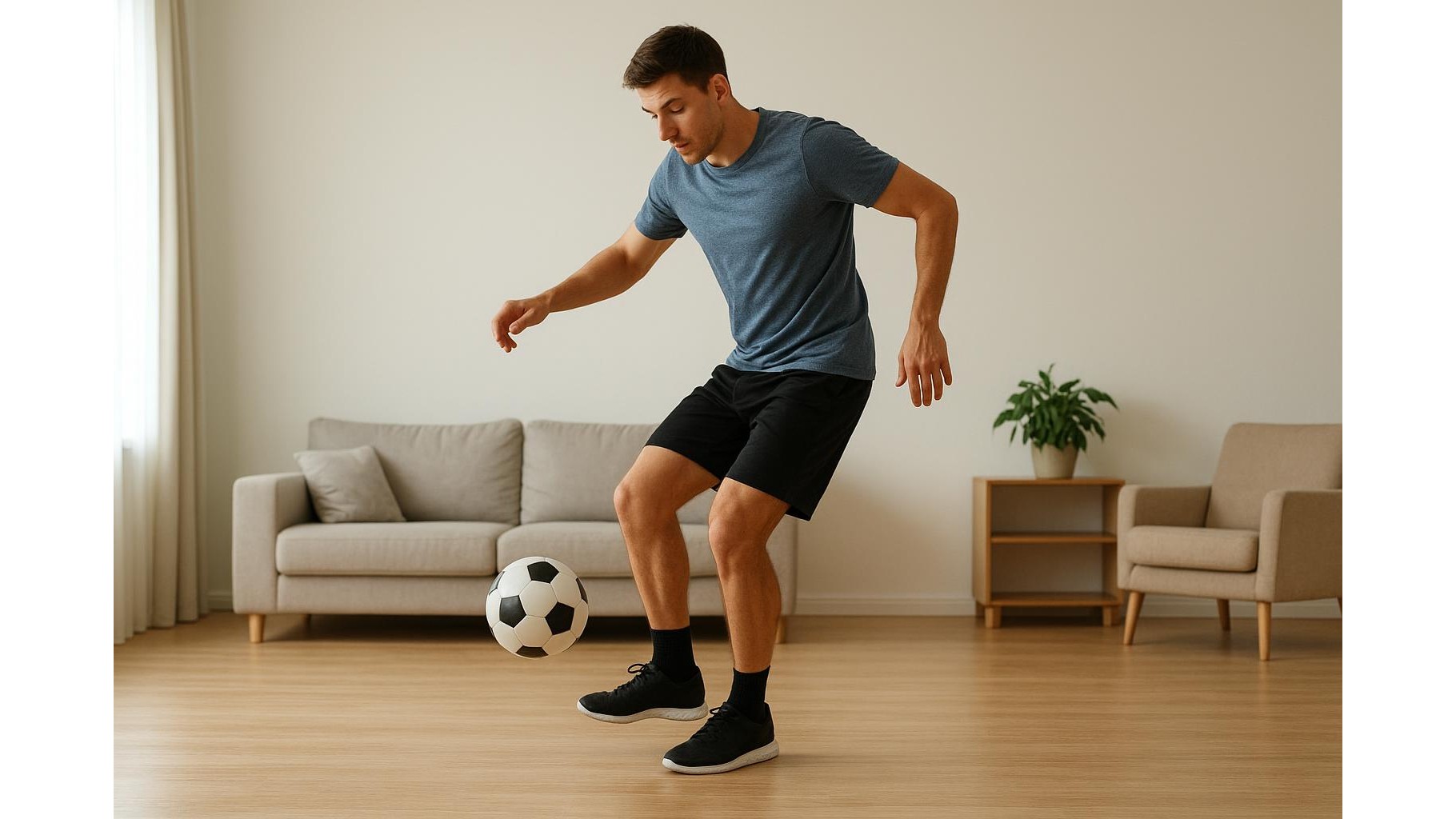
If you think you need a full garage gym to sharpen coordination, agility and cardio, this 30‑minute soccer ball workout will change your mind. With nothing more than a ball and a bit of floor space in your living room, you can train footwork, reaction speed, balance and light conditioning. Below you’ll find a structured routine with options for beginners and advanced athletes, plus tips to keep the session fun and joint‑friendly.
Why a soccer ball is a powerful training tool
A simple size 5 soccer ball turns your living room into a compact agility lab. Unlike static gym machines, a ball is unpredictable: it rolls, bounces and demands constant micro‑adjustments from your feet, ankles and core. This forces your body to develop better proprioception (body awareness) and dynamic balance. Working with a ball also keeps training mentally engaging, which is ideal if you struggle with motivation on traditional cardio machines. Focus on soft touches, staying light on your feet and keeping your eyes up, just like in a real game situation.
Warm‑up: waking up feet, hips and core (5 minutes)
Start with a simple 5‑minute warm‑up to prepare joints and muscles. March in place, then switch to light jogging, adding arm circles and hip rotations. Next, place the soccer ball under one foot and gently roll it forward‑backward and side‑to‑side to mobilise the arch and ankle, then repeat on the other side. Finish with 30–60 seconds of fast feet around the ball: tap the floor quickly, staying on your toes. Beginners can slow the pace and hold a wall for balance; advanced users can add small lateral shuffles around the ball while keeping the torso tall and the core braced.
Foot taps and toe rolls: mastering control and rhythm (8 minutes)
This block targets footwork, coordination and light cardio. Stand behind the ball and perform alternating toe taps on top of it: right foot on, switch in the air, left foot on. Aim for 20–30 seconds of work followed by 20 seconds of rest, repeated for 4 rounds. Focus on small, precise touches and quiet landings. Then move to toe rolls: place one foot on the ball and gently roll it forward and back while keeping your balance, switching legs every 30 seconds. Beginners can hold onto a chair or wall; advanced athletes can increase speed or add a gentle hop with the supporting leg to raise heart rate and challenge stability.
Lateral shifts and single‑leg balance drills (8 minutes)
Now we challenge lateral agility and balance. Stand with the ball in front of you and perform quick side‑to‑side steps around it, always facing forward. Imagine you are defending an opponent: stay low, chest up, knees soft. Do 30 seconds on, 20 seconds off, for 3–4 sets. Then move into single‑leg balance work: stand on one leg and lightly tap the ball forward, sideways and backward with the free foot, drawing a small triangle pattern. This fires up hip stabilisers and ankle strength. To progress, try not to let the tapping foot touch the floor between taps; to regress, allow a light toe touch on the ground for extra support.
Reaction and coordination games (6 minutes)
To train reaction speed and coordination, add short, playful drills. One option is the random touch drill: gently pass the ball against a wall (or sofa if it is sturdy and safe), then react to the rebound with a quick trap and pass again. Try 3 sets of 45 seconds with 15 seconds rest. If you do not have a suitable wall, lightly toss the ball upward and control it with your feet or thighs when it lands. You can also use simple call‑outs: decide that right‑foot touches send the ball to your right and left‑foot touches send it left, forcing your brain and body to stay in sync. Keep movements controlled to protect furniture and avoid powerful strikes indoors.
Core and cool‑down with the ball (3–5 minutes)
Finish by using the soccer ball as a light core trainer. Sit on the floor, knees bent, and hold the ball with both hands. Perform gentle Russian twists, moving the ball from side to side while keeping the spine long and the feet either on the floor (easier) or slightly lifted (harder). Then lie on your back, squeeze the ball between your knees and perform 8–12 small hip bridges to activate glutes and hamstrings. Conclude with a cool‑down: seated hamstring stretch with one heel on the ball, calf stretch by gently pulling the toes towards you with the ball underfoot, and slow breathing to bring your heart rate down.
This 30‑minute home coordination booster proves you can build balance, agility and cardio capacity with just a soccer ball and a bit of creativity. By mixing warm‑up, footwork, lateral drills, reaction games and core work, you train your whole body and nervous system without heavy equipment. Adjust the tempo, work intervals and support (wall or chair) to match your level, and repeat this routine 2–3 times per week to notice smoother movement, quicker reactions and more confidence in any sport or daily activity.









