Building a home gym doesn’t always mean installing a huge power cage. If you train in a spare room, hallway or garage already full of storage, a compact home gym rack can give you safe squats, presses and pull-ups without dominating the space. This guide explains what to look for in slim, wall‑mounted and foldable racks, with practical safety tips for lifters who don’t need a full cage but still want solid, confidence‑inspiring equipment.
Understanding your space and training style
Before picking any compact rack, measure the area where it will live. Check ceiling height for overhead press and pull‑ups, the floor footprint for your stance on squats and deadlifts, and how far a rack can extend from the wall without blocking doors or storage. Think about your main lifts: if you focus on squats, bench and overhead press, a minimal rack with adjustable J‑cups and safety arms can be enough. If you also want pull‑ups or ring work, make sure the rack includes or accepts a pull‑up bar and has clearance for your head and legs. Planning these details first will narrow your choices and prevent expensive mistakes.
Key safety features in a compact rack
Even without a full cage, safety should come first. Look for a rack built from heavy‑gauge steel with a clearly stated load rating that comfortably exceeds your current and future lifts. Adjustable safety spotter arms are essential if you train alone; they should lock firmly into the uprights and have enough length to catch the bar without feeling flimsy. Stable wall‑mounting brackets or a wide, braced base help prevent wobble. Check that bolt hardware is substantial and ideally zinc‑coated to resist corrosion in garages. Finally, clear installation instructions and suitable fixings for your wall type (brick, block, concrete) are vital to keep the rack secure under load.
Slim wall‑mounted racks for permanent setups
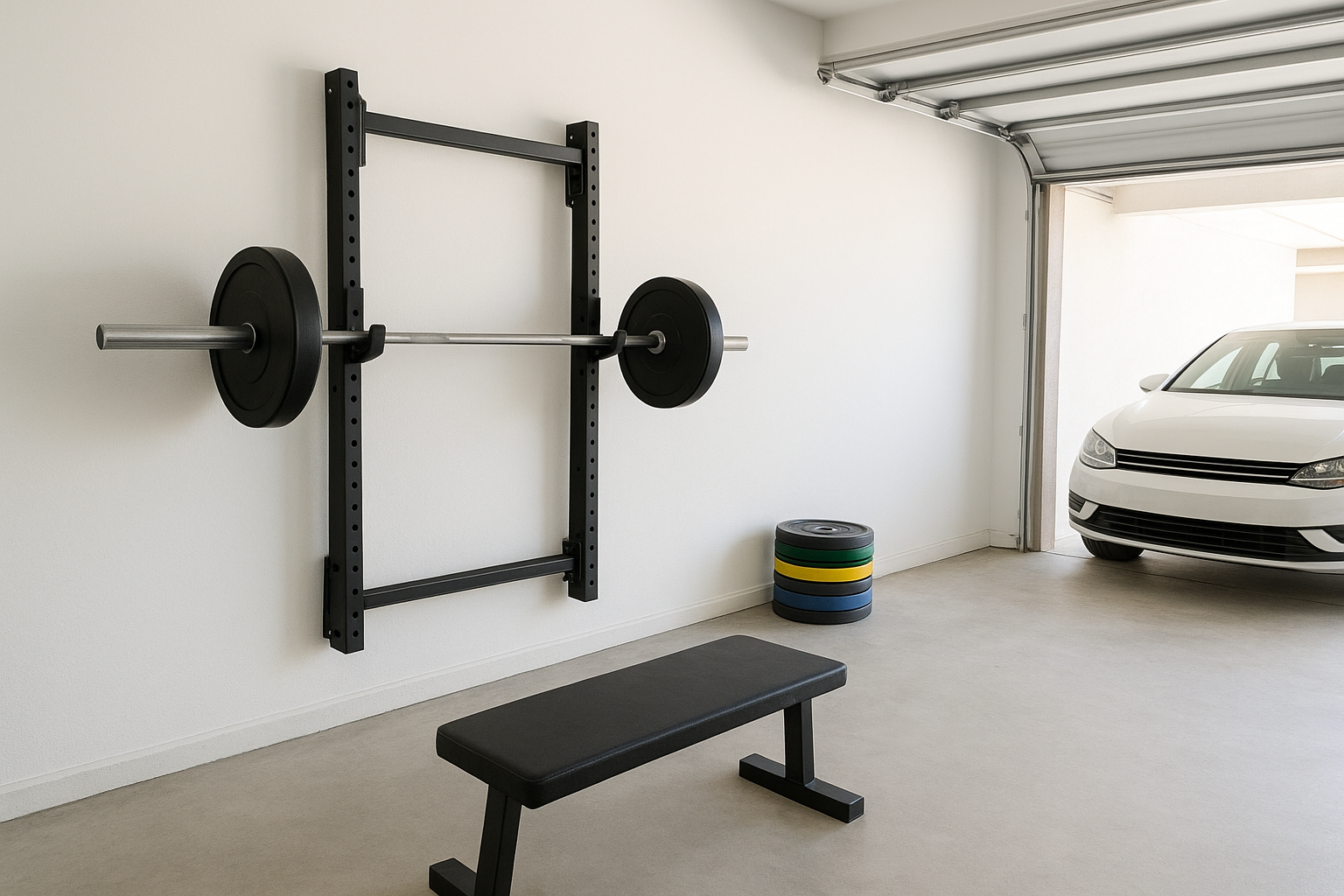
If your rack can stay in place all the time, a slim wall‑mounted rack is one of the most space‑efficient options. Fixed wall racks keep the uprights close to the wall, leaving floor open for lifting and other exercises. When choosing this style, prioritise multiple height adjustment holes for precise J‑cup and safety arm placement, plus an integrated pull‑up bar for added versatility. Many lifters pair a wall‑mounted rack with a flat or adjustable weight bench and a set of bumper plates to create a complete but compact strength station. Because these racks rely heavily on the wall for stability, ensure your wall construction is suitable and that you are comfortable drilling into it or hiring a professional installer.
Foldable racks for shared and multi‑use rooms
When your gym shares space with a car, bikes or living area, a foldable wall rack is often the smartest compromise. These designs swing out from the wall for training, then fold back to reclaim most of the floor, making them ideal for single‑car garages, studios or spare bedrooms. Look for strong hinge mechanisms, secure locking pins and an easy folding process that one person can manage. A quality foldable rack should feel solid under a heavy barbell, not like a temporary gadget. Combine it with compact storage for plates and a collapsible bench so you can set up and clear away your gym in minutes. This balance of stability and convenience can make consistent training much easier in tight homes.
Practical buying tips and accessories
Beyond the rack itself, factor in the total system you need. Check compatibility with standard or Olympic barbells, and make sure the rack width allows a comfortable grip and safe re‑racking. Consider upgrading to UHMW‑lined J‑cups to protect your barbell knurling, and adding dip handles, landmine attachments or band pegs if your rack supports them. A sturdy lifting platform or rubber flooring will protect both your equipment and your home, especially in upstairs or flat situations. Finally, read user reviews that mention installation difficulty, stability under heavy loads and long‑term durability; these real‑world experiences are often more revealing than specs alone and will help you choose a compact rack you can trust for years of safe lifting.
Choosing a compact home gym rack when you do not want a full power cage is all about matching safety, stability and versatility to the space you actually have. By measuring carefully, prioritising strong construction and reliable safety features, and deciding whether a fixed wall‑mounted or foldable design suits your lifestyle, you can build a highly effective strength setup in even the smallest room. With the right rack, barbell and accessories, your home gym can stay tidy and unobtrusive while still supporting serious, progressive training.