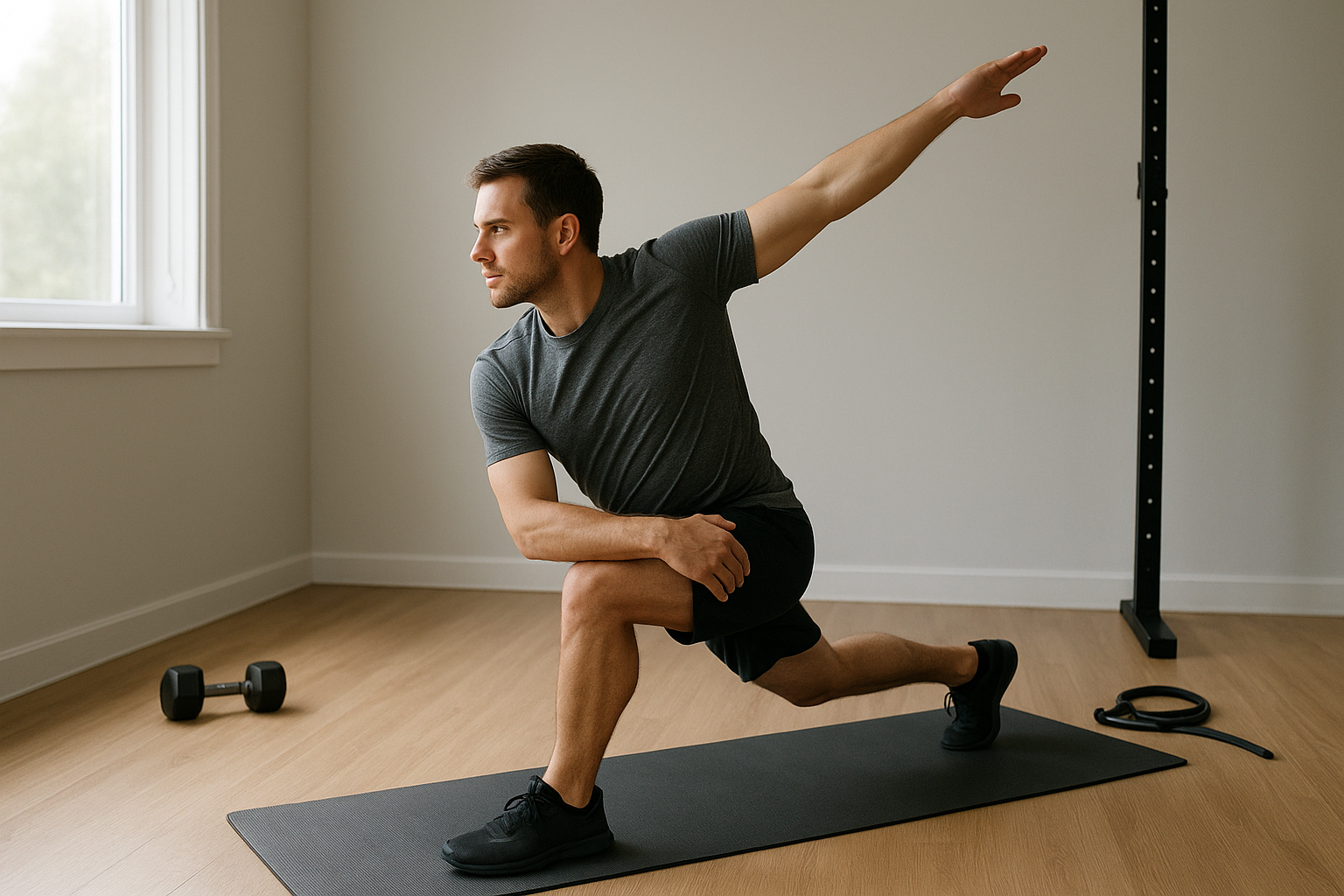
A consistent 10-minute mobility routine can be the missing link between feeling stiff and moving with ease in your home workouts. Mobility training keeps your joints healthy, reduces aches from both strength training and desk work, and helps you get more from every squat, press and hinge. This guide gives you a simple, repeatable framework to design a short daily sequence you can stick to, even on the busiest days.
Why mobility matters for home lifters
Most people train hard but move in a very limited way throughout the day: long hours of sitting, then intense home workouts. That gap often leads to stiff hips, tight shoulders and a cranky lower back. A focused mobility routine works like joint hygiene: you gently take your body through full ranges of motion, lubricate the joints and relax overworked muscles. This improves movement quality, makes it easier to hit depth in squats or keep a neutral spine in deadlifts, and may help reduce the risk of overuse injuries. Think of mobility as maintaining the hardware so your strength and conditioning software can run smoothly.
Choose your 3–4 priority areas
To keep your routine to about 10 minutes, you need to be selective. Start by identifying the joints that limit your training or feel stiff from office work. Common problem areas are the ankles (affecting squats and lunges), hips (for hinging and sitting comfort), thoracic spine or upper back (for pressing and posture) and shoulders (for overhead work). Pick 3–4 focus areas and commit to them for at least four weeks. For example: ankles + hips + T‑spine for a lower‑body strength phase, or shoulders + T‑spine + wrists if you do a lot of push‑ups and presses. This prevents overwhelm and makes the habit easy to maintain.
Build a simple 10-minute sequence
Now turn those focus areas into a repeatable circuit. A practical template is: 2–3 exercises, 1–2 sets each, 40–60 seconds per move. For hips and spine, you might use: deep hip circles in a lunge position, 90/90 hip rotations on the floor, and slow cat–cow or thread-the-needle for the upper back. For ankles: knee-over-toe ankle rocks against a wall. For shoulders: arm circles and scapular wall slides. Move slowly, breathe through your nose and avoid forcing range; aim for gentle discomfort, not pain. Set a timer for 10 minutes and cycle through your chosen moves, rather than counting reps. This time-based approach keeps the routine efficient and focused.
When to do your mobility routine
The best time is the one you can stick to consistently. Many home lifters like using mobility as a warm-up before training, focusing on the joints they will load that day, then adding a few slower, longer holds after the workout. If you sit for most of the day, you can also use your 10-minute mobility routine as a mid‑day movement break to undo desk posture. What matters most is frequency: performing this routine daily or at least 4–5 times per week. Keeping it short removes friction, so it feels achievable even when energy is low. Over time, those minutes add up to noticeably better flexibility, posture and control.
Tracking progress and adjusting over time
Mobility gains can be subtle, so it helps to track them. Every few weeks, test a simple benchmark: your overhead reach against a wall, your deep squat position, or how far your knees can travel over your toes without the heel lifting. Note how each position feels before and after your 10-minute routine. As your range improves, you can progress from basic joint circles to more loaded mobility using light weights or bodyweight holds, or shift focus to new areas that feel restricted. The goal is not endless stretching, but moving with more freedom and control in the patterns you use for training and daily life.
By identifying your key problem areas, building a simple 10-minute mobility routine and performing it consistently, you create a powerful support system for your home workouts. Those few minutes of joint care help reduce stiffness from both training and desk work, deepen your positions in strength exercises and make movement feel smoother overall. Treat mobility as a non‑negotiable part of your home gym practice, and your body will repay you with better performance and more comfortable everyday motion.