Programming your home rowing machine properly can turn random sweating into structured, effective cardio training. Most home rowers share similar console features: time, distance, strokes per minute, and sometimes heart rate. By learning how to set up intervals, distance targets and heart-rate-based workouts, you can use the same machine for gentle recovery, fat loss and serious conditioning. This guide walks you through the main console modes and gives you sample programs for beginners and intermediate rowers.
Understanding your rower console basics
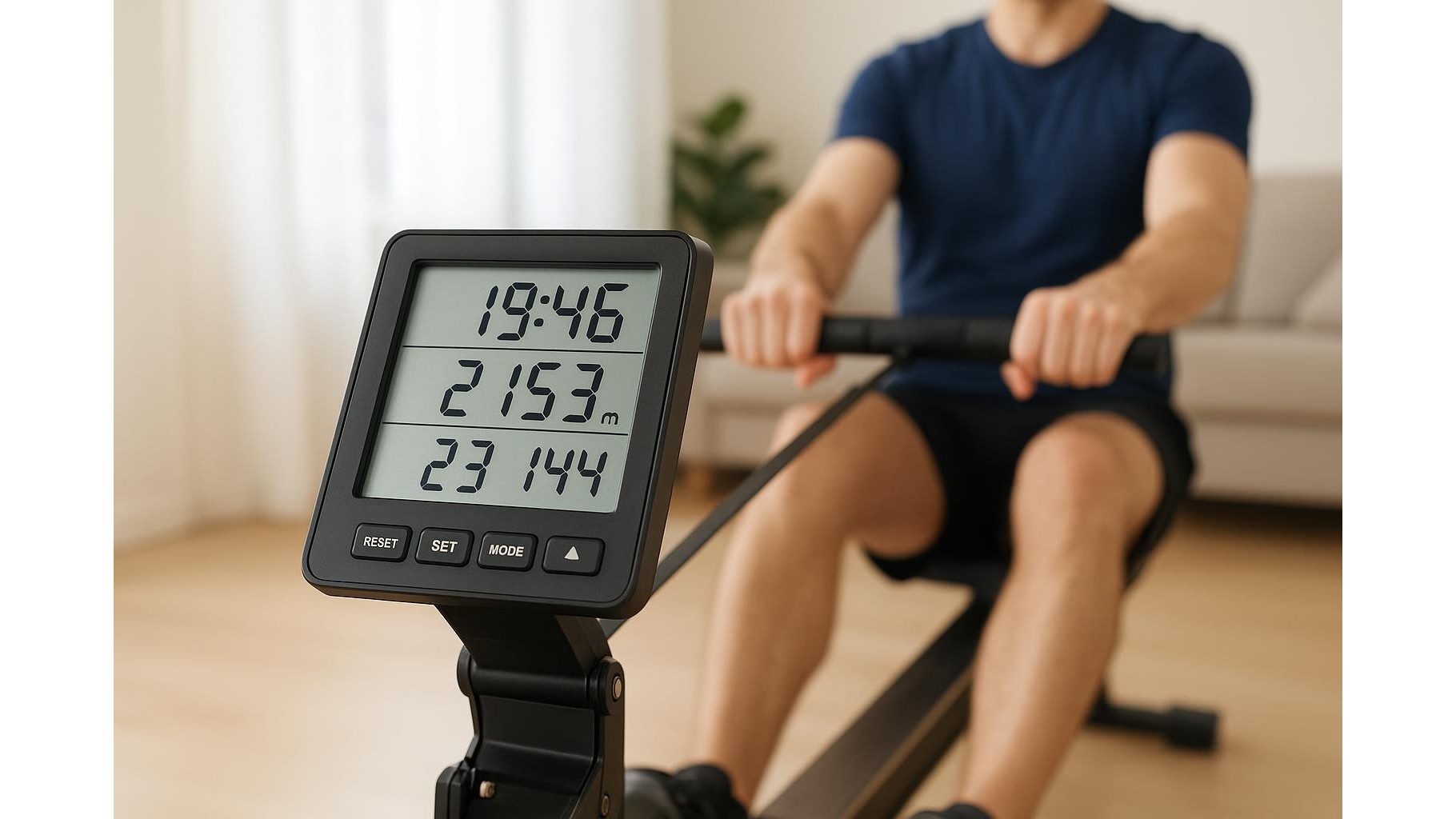
The first step is to get familiar with what your home rowing console can display and control. Most home rowers show time, distance, stroke rate (SPM) and calories; some also display split time per 500 m and connect to a heart rate monitor via Bluetooth or chest strap. Start by finding the basic modes: usually there is a Quick Start or Manual mode, a Distance or Target mode, and an Interval or Program mode. In Manual, just row and watch your numbers; this is ideal for learning your natural pace and how different damper or resistance settings feel. Once you are comfortable reading time, distance and SPM without thinking, you are ready to dial in structured workouts.
Setting up distance and time targets for steady cardio
For steady-state cardio, you will mainly use time and distance targets. On most consoles, you can press a button labeled Time or Distance and then use arrows or a dial to select your goal, such as 20:00 minutes or 3000 m. For beginners, a simple session could be 15–20 minutes at an easy pace where you can still talk, aiming for 20–24 SPM. An alternative is to set 1000–2000 m and row smoothly until you hit the target, focusing on technique: powerful leg drive, relaxed shoulders, and controlled recovery. Intermediates can extend sessions to 25–30 minutes or 4000–6000 m at a moderate intensity. Use the live feedback—split time per 500 m and stroke rate—to stay consistent and avoid starting too hard.
Programming simple interval workouts on the console
Interval training is where the console truly shines. Look for buttons labeled Interval, HIIT, Work/Rest or Custom. A common setup flow is: choose Interval mode, enter work time or distance, then rest time, and select the number of rounds. For beginners, start with 30 seconds of work and 60 seconds of rest, 8–10 rounds. On a basic console without a dedicated interval mode, you can still do this by using the main timer: row hard for 30 seconds, then row very lightly or stop for 60 seconds, tracking intervals on a watch. Intermediates can progress to 40 s on / 20 s off or 500 m hard with 2 minutes light rowing between efforts. Use the console’s beeps or countdown to stay honest with both your pushes and your recovery.
Using heart rate and perceived effort to guide your sessions
If your rower connects to a heart rate sensor, the console can help you stay in specific training zones. First, estimate your max heart rate as roughly 220 minus your age, then define zones such as 60–70% (easy aerobic), 70–80% (moderate) and 80–90% (hard). Many consoles allow you to select a target HR or fat-burn program; you enter your age, sometimes weight, and the machine will suggest a target. For a beginner session, set a 20-minute workout and keep your heart rate around 65–75% of max, adjusting stroke power rather than stroke rate when you drift too high. Intermediates can use HR to control intervals: for example, row hard until you reach 85% of max, then ease off until you drop back below 70%, repeating for 15–20 minutes.
Sample beginner and intermediate rowing programs
To put it all together, here are two sample structures you can program on most home rower consoles. Beginner plan: Day 1—20 minutes time target at easy pace (60–70% max HR); Day 2—8 × 30 s work / 60 s rest intervals using Interval mode; Day 3—1500–2000 m distance target at comfortable pace focusing on technique. Intermediate plan: Day 1—30 minutes steady at moderate effort (70–80% max HR) using time target; Day 2—6 × 500 m intervals with 2 minutes light rowing between reps using distance intervals; Day 3—heart-rate-guided fartlek: 20 minutes switching between 1 minute hard at 80–85% and 2 minutes easy at 65–70%. Rotate these across weeks, increasing either time, distance or the number of intervals gradually.
By learning how to use your rower’s console for structured workouts, you turn a simple cardio machine into a versatile training partner. Master the basic displays, practice programming time, distance and intervals, and, if available, make use of heart-rate feedback to guide intensity. With a few well-designed beginner and intermediate programs saved in your routine, every session becomes purposeful, measurable and easier to progress over time.