
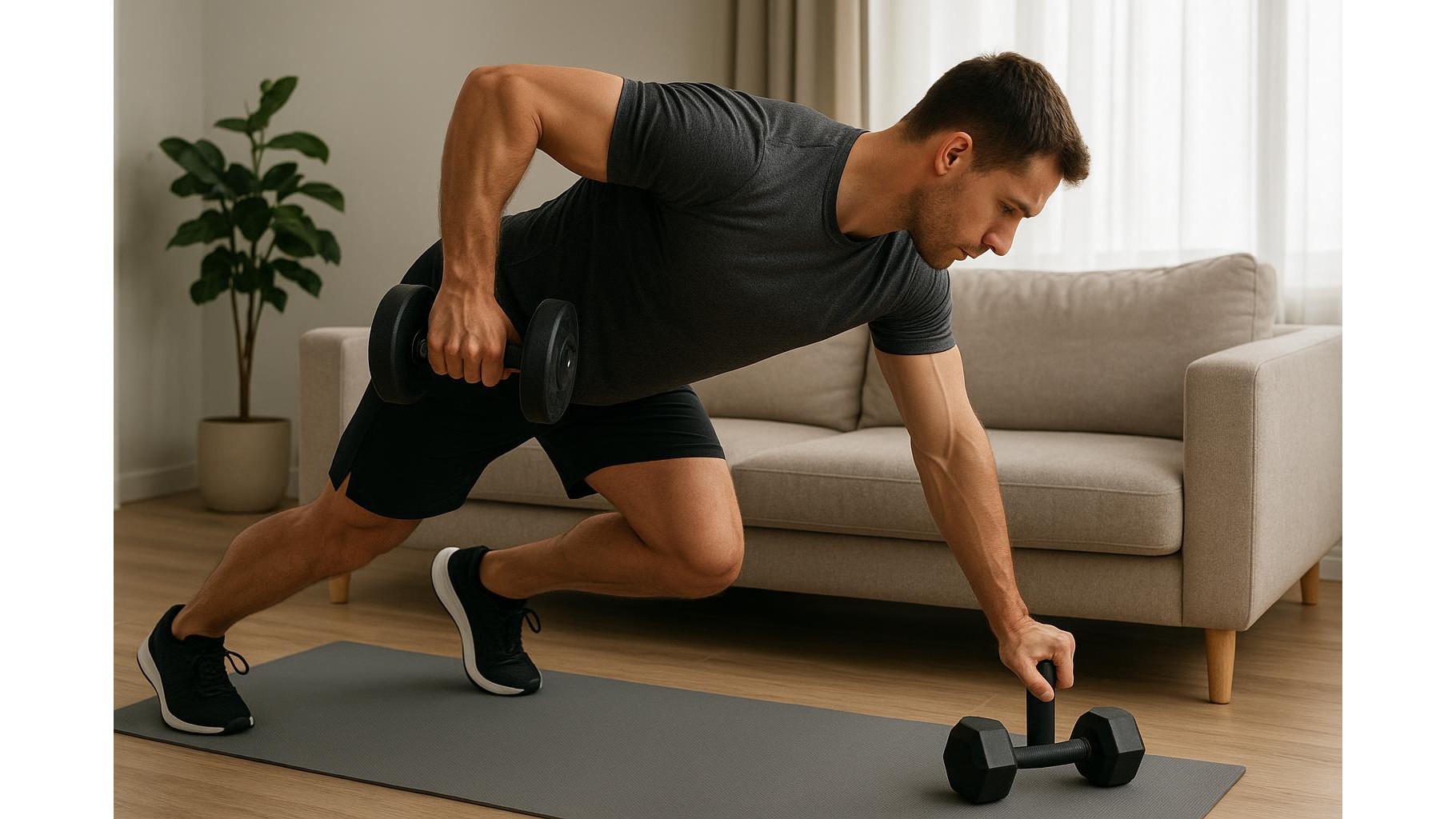
If you spend long hours at a desk or on the sofa, a focused home back and biceps workout can be a game changer for your posture. This 45-minute dumbbell pull routine is built around simple moves you can do in a small space with just a pair of dumbbells and stable household furniture. You’ll hit your lats, upper back and biceps while learning how to protect your lower back with smart setup, tempo and breathing. Whether you’re a beginner or more advanced, you’ll find easy swaps to adjust load and difficulty without needing a full gym.
Why a pull-focused day boosts posture
Most people’s days are dominated by pushing and slouching: typing, driving, scrolling. A dedicated pull day reverses that by strengthening the muscles that open your chest and stabilise your shoulder blades, especially the lats, rhomboids and rear delts. Training these with dumbbells improves shoulder alignment and helps your spine stack naturally, reducing neck and lower-back strain. In this 45-minute session, you’ll cycle through rowing and curling patterns that challenge both your big back muscles and the smaller stabilisers. Focus on smooth control and full range of motion instead of chasing heavy weight. If you only have light dumbbells, increase reps or slow the tempo to keep the sets challenging.
Warm-up and setup for a safe lower back
Before you start loading up with dumbbell rows, spend 5–7 minutes waking up your spine and shoulders. Perform 2 rounds of: 10 cat–cow reps, 10 bodyweight hip hinges and 10 band or towel pull-aparts. This primes your posterior chain and teaches you to hinge from the hips instead of rounding the lower back. For support, use a sturdy chair, bench or sofa arm you can lightly brace on. Keep your feet about hip-width, soften the knees and brace your core as if preparing for a light punch. Throughout the workout, think “chest proud, ribs down” and keep your neck in line with your spine. If any movement pinches in your lower back, reduce the range of motion or perform the exercise supported with one hand on furniture.
The 45-minute dumbbell pull workout structure
This at-home back and biceps workout is organised into three blocks. Work in a controlled tempo of about 2 seconds up, 2 seconds down, resting 45–60 seconds between sets as needed.
- Block 1 – Horizontal Pull (15 minutes): 3 sets of 10–12 reps per side of one-arm dumbbell rows, then 3 sets of 8–10 reps of renegade rows (hands on dumbbells or floor). Beginners can drop to all-fours rows instead of renegade rows.
- Block 2 – Vertical-ish Pull (15 minutes): 3 sets of 12–15 dumbbell pullovers lying on the floor or sofa, followed by 3 sets of 10–12 incline dumbbell rows, chest supported on a bench or cushions on a low table.
- Block 3 – Biceps Finisher (10–12 minutes): Alternate 3 sets of 10–12 standing hammer curls with 3 sets of 10–12 concentration curls, focusing on squeezing the biceps at the top.
Spend the final few minutes on light stretching for the lats, chest and forearms.
Exercise swaps for every fitness level
If you’re a beginner, make your base position more stable and the movement simpler. Swap renegade rows for chest-supported rows with your torso on a bench or stack of cushions to avoid straining the lower back. Use lighter dumbbells and aim for higher reps (12–15) to practise technique. Intermediate lifters can increase load, use a slightly slower lowering phase and shorten rest periods. Advanced trainees can add pauses at peak contraction, or use unilateral sets (one arm at a time) to challenge core stability. If you don’t have multiple dumbbell weights, manipulate variables you can control: tempo, range of motion, isometric holds and total volume. The goal is to finish the session feeling worked but not wrecked.
Cues to protect your lower back and maximise gains
Lower-back safety starts with consistent setup. In all rowing exercises, hinge at the hips with a neutral spine, brace your abs and imagine zipping up tight jeans to stabilise your midsection. Pull the dumbbell towards your hip, not your ribs, to really engage the lats instead of shrugging through the upper traps. Exhale as you pull, inhale as you lower under control. Avoid jerking the weights or letting them yank your shoulders forward at the bottom. In curls, keep elbows close to your ribs and avoid swinging your torso. If you feel compression in the lower back, reduce the hip hinge angle or perform the movement lying or chest-supported. Quality reps and consistent weekly practice will build strength faster than pushing into pain.
With just a pair of dumbbells, some basic furniture and 45 focused minutes, you can train your back and biceps at home, support healthier posture and protect your lower back. Use this pull-focused routine 1–2 times per week, aiming to add a little more volume or control over time. Combine it with a push and leg session across the week for a balanced, sustainable home programme. Stay consistent, listen to your body and treat good form as your heaviest weight—you’ll feel the difference in how you stand, move and carry yourself every day.









