If you have a pair of dumbbells and 25 spare minutes, you can build a stronger upper body without leaving your living room. This follow-along, dumbbell-only upper body workout targets your chest, back, shoulders and arms using simple moves, smart sequencing and minimal equipment. Whether you are a beginner or an intermediate lifter, you will find clear progressions to match your current level and a structure you can repeat two or three times per week for steady gains.
What you need for this 25-minute upper body session
For this routine, all you need is a pair of moderately heavy dumbbells and a bit of floor space. If you own different pairs, pick one lighter set for shoulders and isolation work and a heavier set for presses and rows. Ideally, you want a weight that feels challenging for the last two reps of each set, while still allowing you to keep good form. An exercise mat or a folded towel can make the floor presses and rows more comfortable, and if you have a stable bench or sturdy coffee table, you can use it for supported rows. No bench? No problem: every move can be done on the floor or standing.
Warm-up and structure: how the 25 minutes are organised
Start with a 3–4 minute warm-up to prepare your joints and raise your heart rate. Perform arm circles, shoulder rolls, cat–cow stretches and a set of light bodyweight push-ups against a wall or counter. The main workout uses a circuit format: you will rotate through five exercises—two for chest, two for back and shoulders, and one for arms—keeping rest short to save time. Work for 40 seconds and rest for 20 seconds, then move to the next exercise. Complete three total rounds. Beginners can work for 30 seconds and rest for 30 seconds, while intermediates can push to 45 seconds of work with only 15 seconds of rest.
Chest focus: dumbbell floor press and deficit push-up
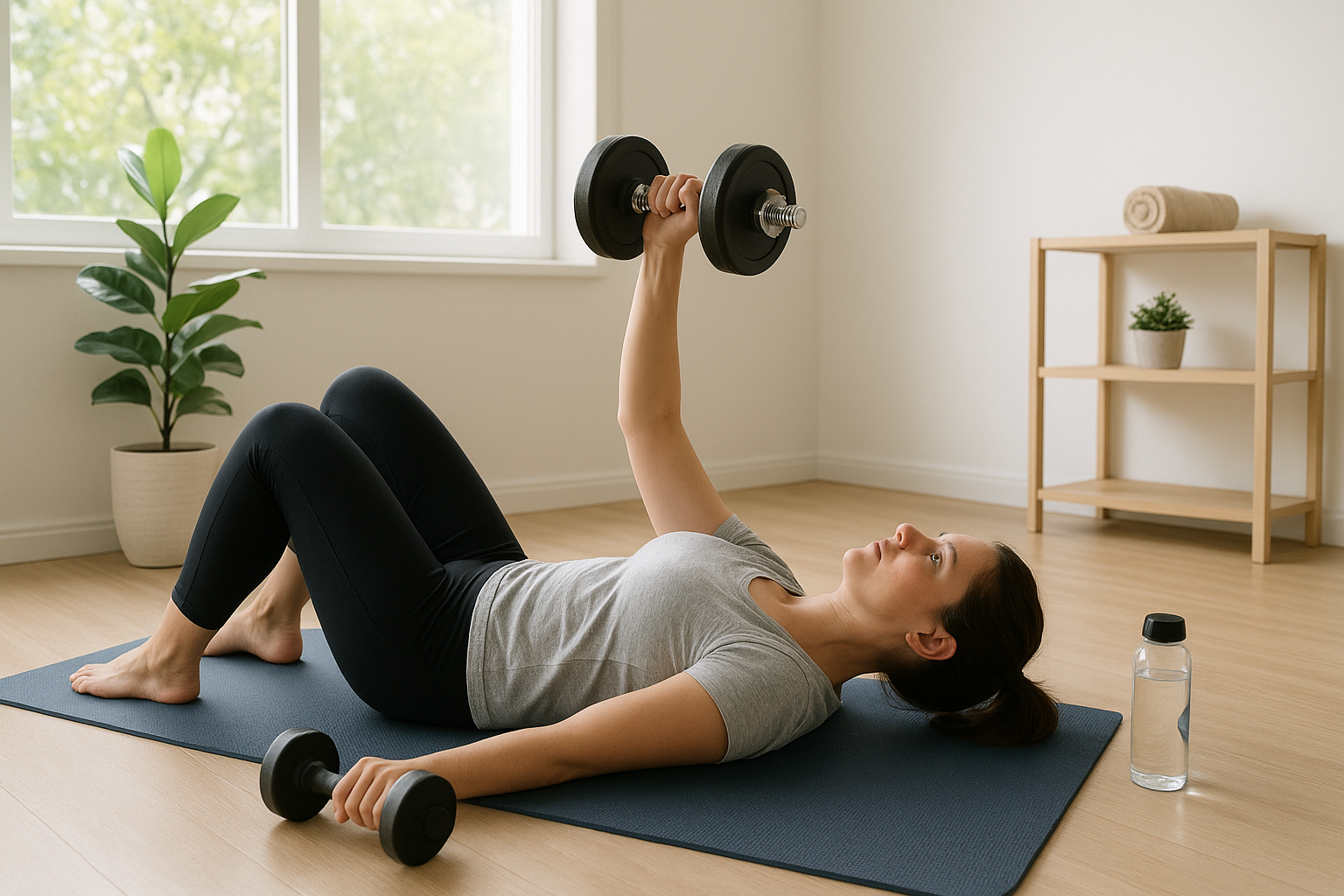
The first move is the dumbbell floor press, a bench-press alternative perfect for home gyms. Lie on your back on the floor, dumbbells above your chest with palms facing forward. Lower your elbows until your upper arms lightly touch the floor, pause for a beat, then press back up while squeezing your chest and keeping your shoulders packed down. This limited range protects your shoulders while still loading the pecs and triceps. Pair this with a bodyweight or light dumbbell deficit push-up: hands on the dumbbells to increase depth, body in a straight line, chest lowering between the handles. Beginners can do this elevated on a countertop or sofa, while intermediates can add a slow tempo or pause at the bottom for more intensity.
Back and shoulders: rows and overhead presses
To balance all the pressing, add a bent-over dumbbell row. Stand with a slight knee bend, hinge at the hips while keeping your spine neutral, and let the dumbbells hang under your shoulders. Pull them towards your lower ribs, leading with your elbows and squeezing your shoulder blades together at the top. Avoid rounding your back and use a controlled tempo. Follow this with a standing dumbbell overhead press. With the dumbbells at shoulder height and palms facing forward or slightly inwards, brace your core and press them straight overhead without leaning back. Lower under control. Beginners can do this seated to remove momentum; intermediates can try an alternating press, keeping one arm locked overhead for extra shoulder stability.
Arms finisher: curls and triceps extensions
Finish the circuit with a focused arms block that hits biceps and triceps. For curls, stand tall with the dumbbells by your sides, palms facing forward, and curl the weights up without swinging or letting your elbows drift behind your body. Squeeze at the top, then lower slowly. Immediately move into overhead triceps extensions: hold one or two dumbbells above your head with arms straight, then bend your elbows to lower the weight behind your head, keeping your upper arms still. Extend back up while squeezing the back of your arms. Beginners can perform these lying on the floor with one dumbbell held in both hands; intermediates can use a slow, three-second lowering phase to increase time under tension.
Progressions, frequency and recovery
To keep progressing with this dumbbell-only upper body workout, aim to add small improvements each week: one or two extra reps per interval, a slightly heavier pair of dumbbells when the current load feels easy, or fewer seconds of rest between moves. Train this routine two or three times a week, with at least one rest day between sessions to allow your muscles to recover and grow. Focus on controlled technique rather than rushing: the quality of each rep matters more than the total number. Combine the workout with a balanced diet, enough sleep and regular walking or light cardio, and your home gym will become all you need to build a stronger, more defined upper body in just 25 minutes a day.
This entire session is designed to be efficient, scalable and repeatable, making it ideal if you have limited time, space and equipment but still want meaningful progress. Stick with it consistently for four to six weeks, track your reps and weights, and you will see and feel the difference in your chest, back, shoulders and arms.