Building strong arms at home does not require a full gym. With just a pair of dumbbells and some resistance bands you can train biceps, triceps and forearms effectively in only 30 minutes. This structured routine is split into simple blocks with clear timing, plus suggestions to scale the workout for both beginners and intermediate lifters. Focus on good form, controlled tempo and progressive overload to keep your arms growing over time.
Essential equipment for your 30-minute arm workout
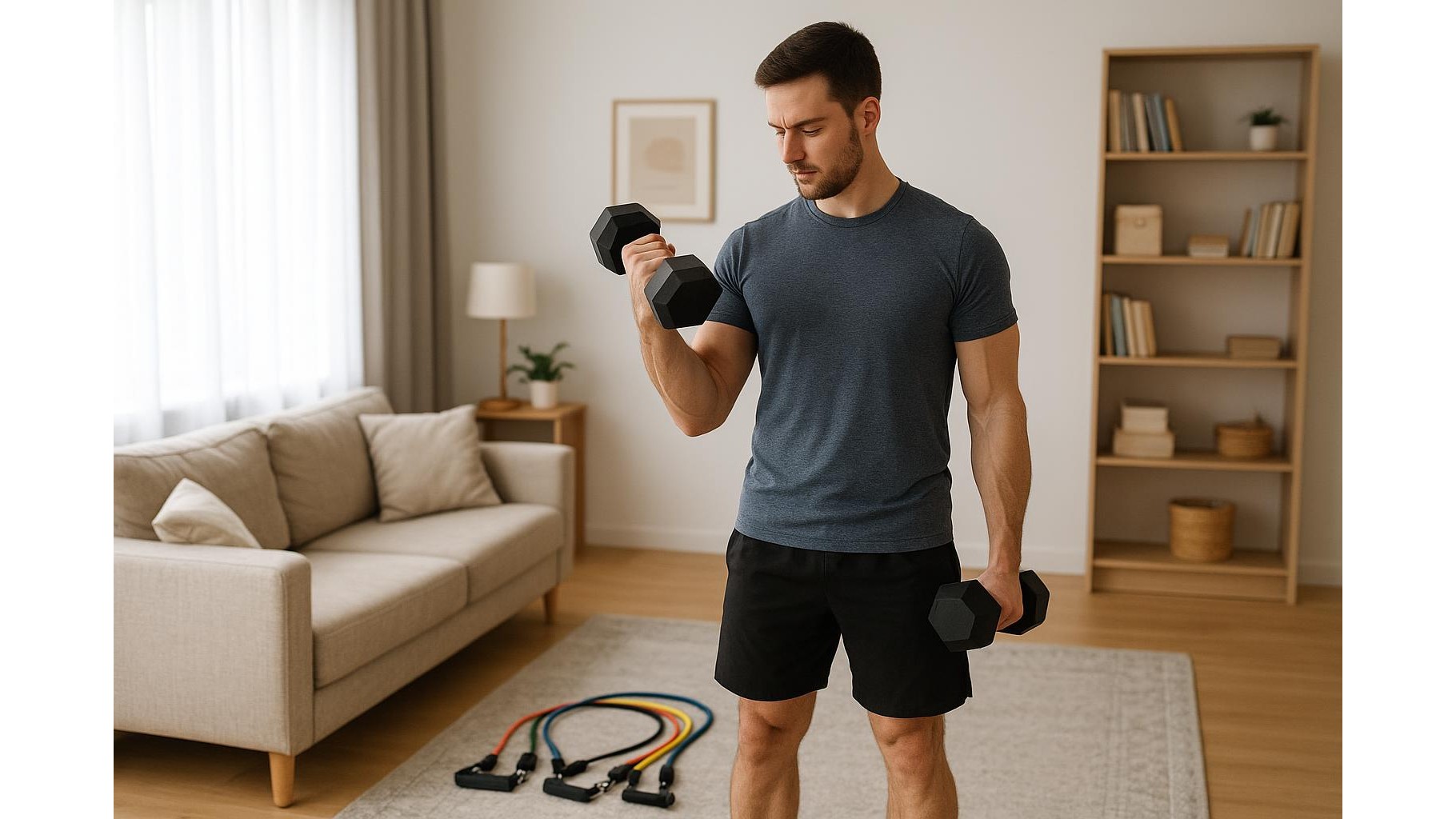
For this session you just need two tools: a pair of dumbbells and a set of resistance bands with different levels of tension. Ideally, choose dumbbells that challenge you in the 8–15 rep range while maintaining strict form. Resistance bands should include at least light, medium and heavy bands so you can adapt each exercise to your strength level. Bands with handles are excellent for curls and triceps extensions, while loop bands can add extra tension to forearm and grip work. A non-slip mat and a stable chair or bench can increase comfort and safety but are optional. Prioritise equipment that feels comfortable in your hands and allows smooth, controlled motion without jerks.
Warm-up and structure of the 30-minute session
Start with a 5-minute warm-up to prepare your joints and raise your heart rate. Perform 30–45 seconds each of arm circles, band pull-aparts with a light band, wall push-ups and light dumbbell hammer curls. The main workout is divided into three 7–8 minute blocks: one focused on biceps, one on triceps and one on forearms and grip. Work with a simple pattern: 40 seconds of effort followed by 20 seconds of rest, repeated for 3–4 rounds per block. Beginners can shorten work intervals to 30 seconds and extend rest to 30–40 seconds, while intermediates can push up to 45 seconds of work and keep rest at 15–20 seconds to raise intensity.
Biceps block: dumbbells and bands for front-of-arm strength
The first block targets the biceps and the front of your upper arm. Alternate between dumbbell biceps curls (standing or seated), hammer curls for the brachialis and banded curls to increase time under tension. For dumbbell curls, keep your elbows tucked near your torso, avoid swinging your body and focus on squeezing the biceps at the top of each rep. With banded curls, stand on the band with feet shoulder-width apart and adjust your stance to increase or decrease tension. Beginners can use lighter dumbbells and a thinner band, aiming for 10–12 controlled reps per interval, while intermediates may choose heavier weights and slow eccentrics, lowering the weight for 3–4 seconds to maximise muscle stimulus.
Triceps block: building back-of-arm power
The second block emphasises the triceps, which are crucial for overall arm size and pushing strength. Combine overhead dumbbell triceps extensions, dumbbell kickbacks and band pushdowns anchored to a sturdy point such as a door anchor or rail. During overhead extensions keep your core braced, elbows pointing forward and avoid arching your lower back. For kickbacks, hinge slightly at the hips, fix your upper arm parallel to the floor and extend the elbow fully to feel the lockout. With band pushdowns, choose a band that lets you complete your intervals without shrugging your shoulders up. Beginners can reduce range of motion slightly and use slower reps to learn control, while intermediates can increase tension and add a brief pause at full extension to intensify the contraction.
Forearms, grip and cool-down
The final block combines forearm and grip training with a short cool-down. Perform dumbbell wrist curls and reverse wrist curls for 40 seconds each, followed by farmer carries around your room holding dumbbells at your sides with a tight grip and tall posture. If you have a light loop band, add band finger extensions by looping the band around your fingers and opening your hand against the resistance to balance flexor and extensor strength. Finish with 3–5 minutes of stretching for biceps, triceps and forearms, holding each stretch for 20–30 seconds. This combination helps reduce stiffness, supports elbow health and prepares your arms for your next training session.
By structuring your training into focused arm blocks and using both dumbbells and resistance bands, you can achieve an efficient 30-minute arm workout at home that scales from beginner to intermediate level. Consistency is key: aim to repeat this routine two or three times per week, gradually increasing band tension or dumbbell load as the exercises become easier. With disciplined effort, careful form and progressive overload, you will see noticeable gains in biceps, triceps and forearm strength without leaving your living room.