
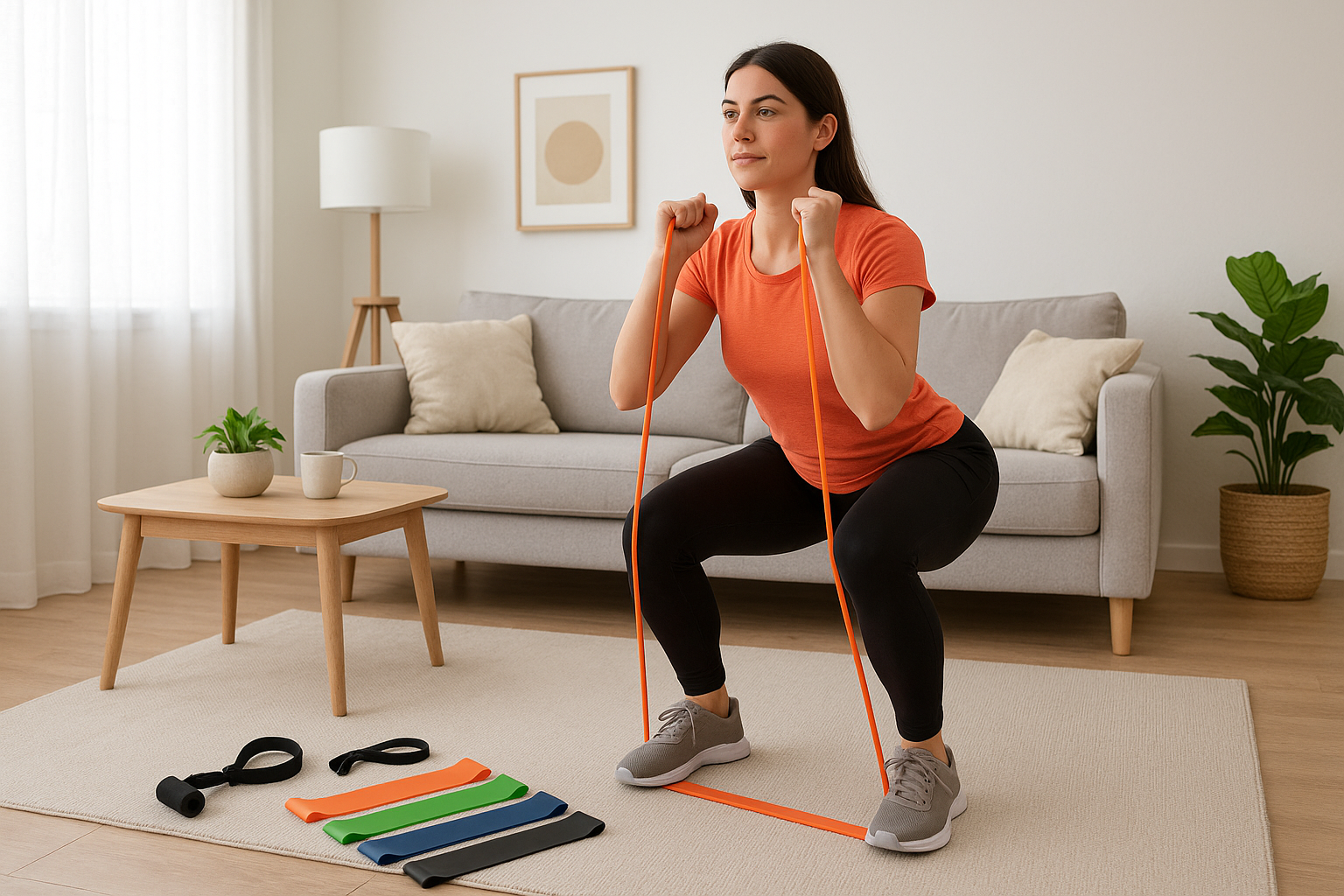
A total body resistance band workout is one of the most efficient ways to train your entire body in a small space with minimal equipment. With just one or two resistance bands, you can hit every major muscle group, improve stability and mobility, and scale the intensity from beginner to intermediate without leaving your living room. Below you will find a structured routine with exercise list, sets, reps and simple progressions, so you can build strength at home using only bands.
Essential gear: choosing the right resistance band
For this workout, all you need is a versatile long loop band or a tube band with handles. A popular option that fits most home setups is the resistance band with handles and door anchor, such as a typical full-body set you would find on Amazon (for example: resistance bands set with handles and door anchor). Look for a set that includes multiple resistance levels so you can progress from easier to harder bands as you get stronger. Beginners should start with a light or medium band, while intermediates can mix medium and heavy bands for different body parts (lighter for shoulders, heavier for legs and glutes). A door anchor is very useful to create pulling angles for back and chest work without needing any extra equipment.
Full body warm-up and activation
Before the main workout, spend 5–7 minutes on a simple band warm-up to activate key muscles and reduce injury risk. Start with band pull-aparts (2 sets of 15 reps) to wake up your upper back and shoulders, then do banded good mornings (2 sets of 12 reps) to prime your hamstrings and glutes. Finish with lateral band walks around your living room (2 x 10 steps each direction) to fire up your hip stabilisers. Use a light resistance band here; the goal is blood flow and muscle activation, not fatigue. Keep movements controlled, breathe steadily and focus on full range of motion to prepare your joints for the main total body resistance band workout.
Main workout: upper body push and pull
The core of this home resistance band workout starts with upper body push and pull exercises. For chest and shoulders, perform standing chest presses by looping a band around a sturdy anchor (or using a door anchor) and pressing forward, 3 sets of 10–15 reps. Follow with overhead shoulder presses standing on the band, 3 sets of 10–12 reps. For your back and biceps, add standing rows (anchor the band at chest height and pull towards you) for 3 sets of 12–15 reps, and band biceps curls for 3 sets of 10–15 reps. Beginners should use one light band and stop 2–3 reps before failure; intermediates can step further away from the anchor or use a thicker band to increase tension and work closer to muscular fatigue.
Lower body focus: legs and glutes at home
To make this a true total body band workout, your legs and glutes need dedicated work. Start with banded squats: stand on the band with feet shoulder-width apart, hold the ends at shoulder level, and squat for 3 sets of 12–15 reps. Next, perform banded Romanian deadlifts by standing on the band and hinging at the hips to target hamstrings and glutes, 3 sets of 10–12 reps. Add reverse lunges with the band under the front foot and held at your sides for 2–3 sets of 8–10 reps per leg. Beginners can reduce the depth of the squat and lunge, while intermediates increase resistance or tempo (3 seconds down, 1 second up) to make the same exercises more challenging without extra equipment.
Core and stability with resistance bands
A resistance band full body routine is incomplete without core training and stability work. Wrap the band around a fixed point at chest height for band Paloff presses, holding the band in front of your chest and resisting rotation, 3 sets of 10–12 seconds per side. Add band-resisted dead bugs lying on the floor to connect your abs and hip flexors, 2–3 sets of 8–10 reps per leg. Finish with banded plank rows: assume a high plank with the band anchored in front of you, row one hand at a time for 2–3 sets of 8–10 rows per side. These moves challenge your core while engaging shoulders and hips, making them ideal for a compact living room functional training session.
Progressions, frequency and safety tips
To progress this living room resistance band workout, you can increase band tension, add sets, slow down the eccentric phase, or shorten rest periods between exercises. Beginners should perform this routine 2–3 times per week on non-consecutive days, using lighter bands and focusing on technique. Intermediates can train 3–4 times per week or split the routine into upper and lower body days. Always check your bands for wear and tear before each session, secure door anchors correctly, and maintain control—no jerky movements. Over time, you can add a second band set with higher resistance, such as a premium long loop set from Amazon (for example, a long loop pull up assistance band set), to keep challenging your muscles safely at home.
With a structured total body resistance band workout like this, your living room becomes a fully functional training space. By combining a brief warm-up, targeted upper and lower body exercises, and focused core work, you can build strength, endurance and stability using just one or two bands. Adjust resistance, volume and tempo to match your level, and you will have a scalable routine that grows with you—no bulky machines or crowded gyms required.









