If you are short on time but still want a stronger, more stable midsection, this 15-minute core workout is designed for you. It is beginner-friendly, requires no equipment, and fits easily into a busy day. You can do every move in your living room using just your bodyweight. Focus on slow, controlled repetitions and steady breathing to get the most from this quick routine.
Why a 15-minute no-equipment core workout works
A short core routine can be surprisingly effective when you minimise rest and choose exercises that challenge multiple muscles at once. This home core workout targets your abs, obliques and lower back, helping improve posture and reduce the risk of back pain. Because you do not need equipment, there is no set-up time: you can simply clear a small space on the floor and start. Consistency is more important than duration, so a focused 15 minutes done several times per week will beat a longer workout you rarely complete.
Warm-up and how to structure your 15 minutes
Begin with a quick 2–3 minute warm-up to wake up your muscles and joints. March on the spot, circle your arms and perform gentle torso rotations. Then move into a circuit format: perform each exercise for 30 seconds, rest 15 seconds, and move to the next. Once you finish all moves, rest 60 seconds and repeat the circuit 2–3 times depending on your fitness level. This keeps your heart rate slightly elevated while giving your core enough recovery to maintain good technique.
The five core exercises you can do in your living room
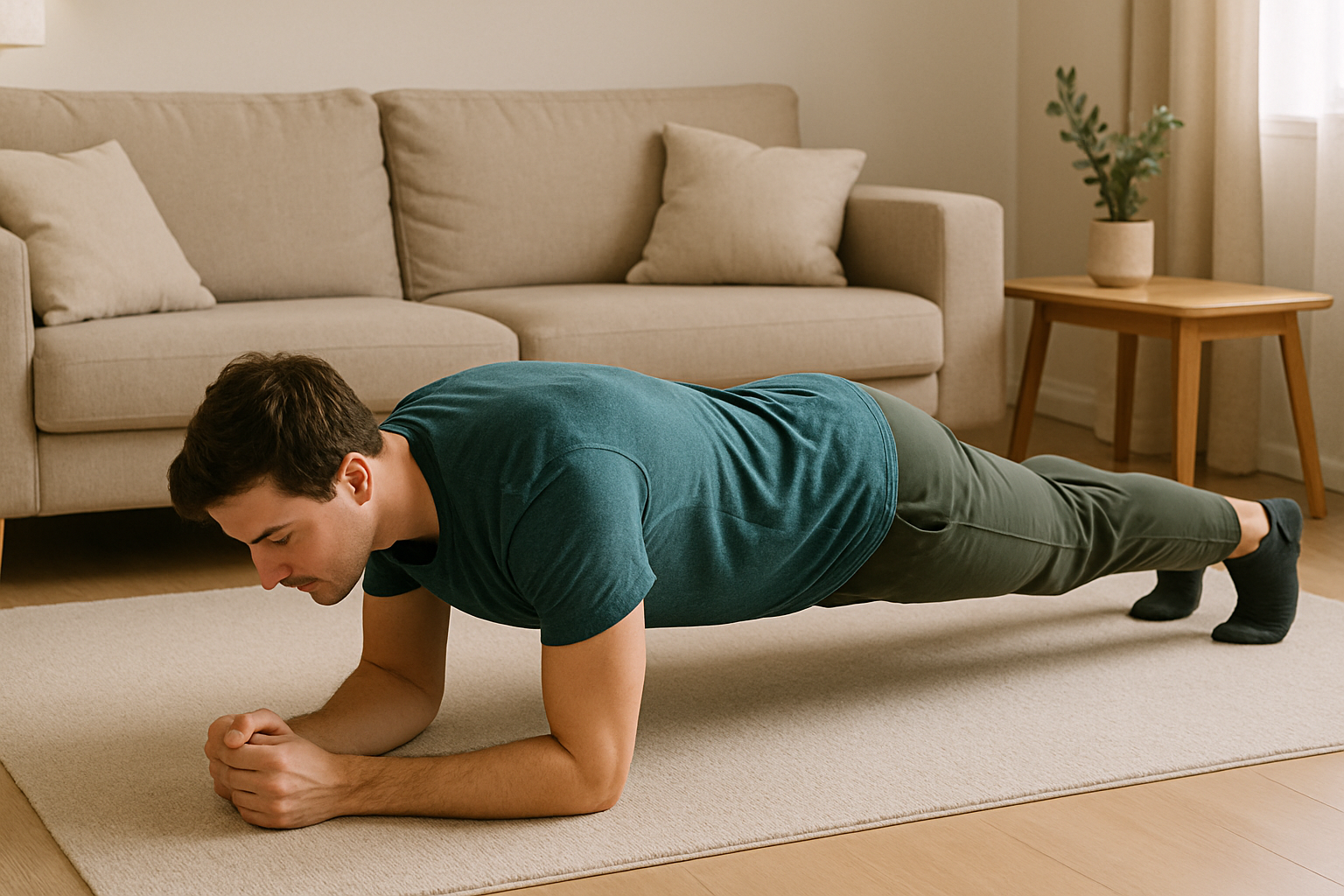
Exercise 1: Dead bug. Lie on your back with arms straight above your chest and knees bent at 90 degrees. Brace your core and slowly lower opposite arm and leg towards the floor without arching your back, then return and switch sides. Exercise 2: Glute bridge. Lie on your back, knees bent, feet hip-width. Squeeze your glutes and lift your hips until your body forms a straight line from shoulders to knees, then lower with control. Exercise 3: Forearm plank. Rest on forearms and toes, keep your body in a straight line and avoid letting your hips sag. Exercise 4: Side plank (right then left). Lie on your side, support yourself on one forearm, stack your feet and lift your hips. Exercise 5: Dead bug holds. Return to dead bug position but hold the extended arm and leg out for the full time, then switch side next round.
Progressions, regressions and form tips
If you are a true beginner, shorten work intervals to 20 seconds and extend rest to 20–30 seconds. You can also drop your knees to the floor for a modified plank and support your top leg in side planks by placing the top foot in front of the bottom leg. To progress, increase work intervals to 40–45 seconds, add gentle plank shoulder taps from a high plank position, or try raising one leg during glute bridges. Always lead with form: keep your lower back gently pressed towards the floor in dead bugs, avoid holding your breath and stop if you feel sharp pain rather than muscular fatigue.
How to fit this core routine into a busy week
For best results, aim to perform this 15-minute core workout 3–4 times per week on non-consecutive days. You can tack it onto the end of a walk, a run or a short strength session, or use it as a standalone routine on days when time and energy are low. If you already train regularly, place this workout after your main lifts or cardio so your core muscles are not overly fatigued beforehand. Track your progress by noting how long you can hold planks with solid form and how stable you feel during dead bugs; as these improve, you will notice better posture and more control in everyday movements.
In summary, this no-equipment core workout offers a simple, time-efficient way to build strength and stability from home. With just 15 minutes, a small living room space and your own bodyweight, you can challenge your abs, obliques and lower back safely. Follow the circuit structure, focus on technique, and use the suggested progressions to keep improving. Make it a consistent habit and your core will become stronger, more resilient and ready to support every other aspect of your training and daily life.