
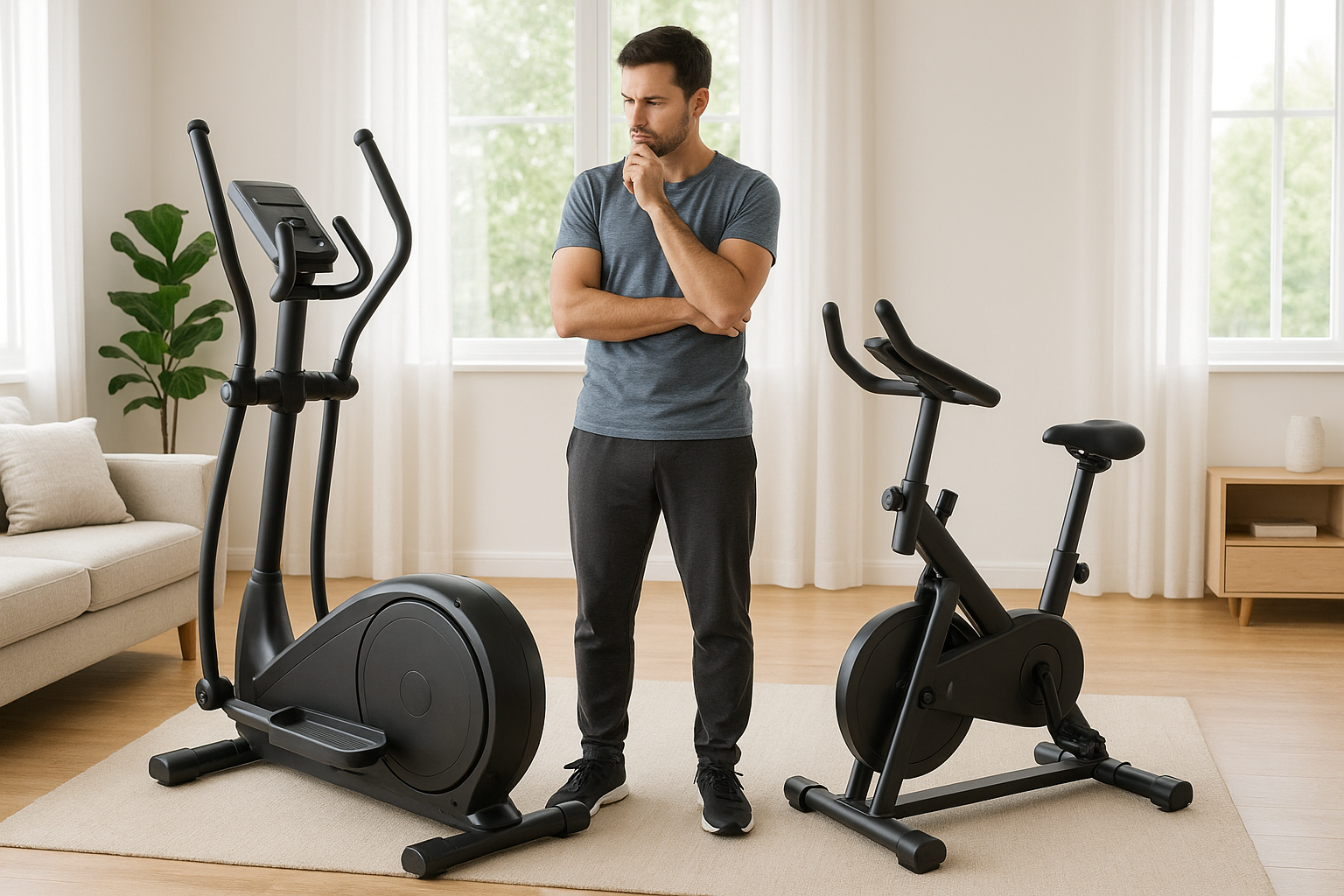
Choosing between an elliptical and an indoor bike is one of the biggest decisions when building a home gym cardio corner. Both machines can boost heart health, burn calories and support weight loss, but they feel very different on your joints, muscles and daily routine. Understanding how each option loads your body, fits your space and matches your goals will help you invest once and train for years with confidence.
How ellipticals and indoor bikes load your joints
Both machines are considered low‑impact cardio, but they stress your body in different ways. The elliptical mimics a running or stair‑climbing motion without the harsh impact of pounding the ground. Your feet stay on the pedals, which is kind to knees and ankles, yet your hips and lower back still work through a larger range of motion. An indoor bike keeps you fully supported on the saddle, so impact is minimal and the circular pedal path is very forgiving for sensitive knees. However, long rides in a bent‑over position can irritate the lower back or neck if the bike is not adjusted. If you have a history of knee surgery or osteoarthritis but tolerate cycling, a bike often feels smoother; if back pain is your main concern, an upright elliptical posture may be better.
Muscles worked and calorie burn: full‑body vs lower‑body focus
An elliptical trainer with moving handles offers a genuine full‑body workout: your glutes, quads, hamstrings and calves work with every stride while your chest, back and arms contribute as you push and pull. This can raise your heart rate quickly and may help you burn more calories in less time, especially if you use interval sessions. An indoor bike is mostly a lower‑body workout, concentrating on quads and glutes, with some core engagement to stabilise your torso. For cyclists or runners, this can closely match sport‑specific demands. If your prime goal is maximum calorie burn and time efficiency, an elliptical has a slight edge; if you want to develop powerful legs or complement outdoor cycling, a bike is hard to beat.
Space, noise and home‑friendly practicality
In a small home gym, footprint matters as much as features. Ellipticals tend to be longer and taller, often requiring clear ceiling height for users to stand upright at the highest pedal point. They are harder to move once assembled and rarely fold away. Indoor bikes, particularly compact magnetic models, have a smaller footprint and are easier to roll into a corner after training. They are also generally quieter, which is crucial in flats or shared homes. Maintenance is usually simpler on a bike, with fewer moving linkages than an elliptical. If you live in an apartment, need to train early or late, or share your space, a quiet magnetic bike will typically cause fewer disturbances than a heavy front‑drive elliptical.
Comfort, motivation and daily usability
The best home cardio machine is the one you enjoy enough to use consistently. Ellipticals feel more like walking in the air and allow you to stand upright, which can be more comfortable for those who dislike sitting on a saddle. Many people find the gliding motion intuitive, though some notice foot numbness on long sessions if they do not vary posture. Indoor bikes require careful saddle and handlebar adjustment to avoid discomfort, but once dialled in they are excellent for longer, steady rides while watching TV or following virtual classes. Modern bikes also integrate particularly well with apps and online workouts, which can keep motivation high. Consider your temperament: if you like immersive studio‑style rides, a bike shines; if you prefer upright, more natural movement resembling walking or hiking, you may stick with an elliptical longer.
Matching machine to your goals and budget
For weight loss and general fitness, both machines can deliver, so your decision should blend budget, joint history and space. Mid‑range indoor bikes are often more affordable than equally sturdy ellipticals, making them attractive for tighter budgets. If your primary goal is joint‑friendly, whole‑body conditioning and you have enough room, an elliptical offers excellent value over time. If you want focused leg training, prefer seated workouts, or have limited space and money, an indoor bike is typically the smarter first buy. Whichever you choose, set clear weekly targets for frequency and duration, and consider simple accessories like a heart‑rate monitor, mat and fan to turn your corner into a sustainable home cardio station.
In summary, ellipticals and indoor bikes are both smart choices for a home gym, but they are not interchangeable. Ellipticals favour full‑body engagement and upright, low‑impact movement, while bikes excel in compact size, simplicity and lower‑body focus. Match the machine to your joints, goals, space and budget, then commit to using it consistently. With the right choice and steady habits, your home cardio setup can support better health, energy and performance for years.









