
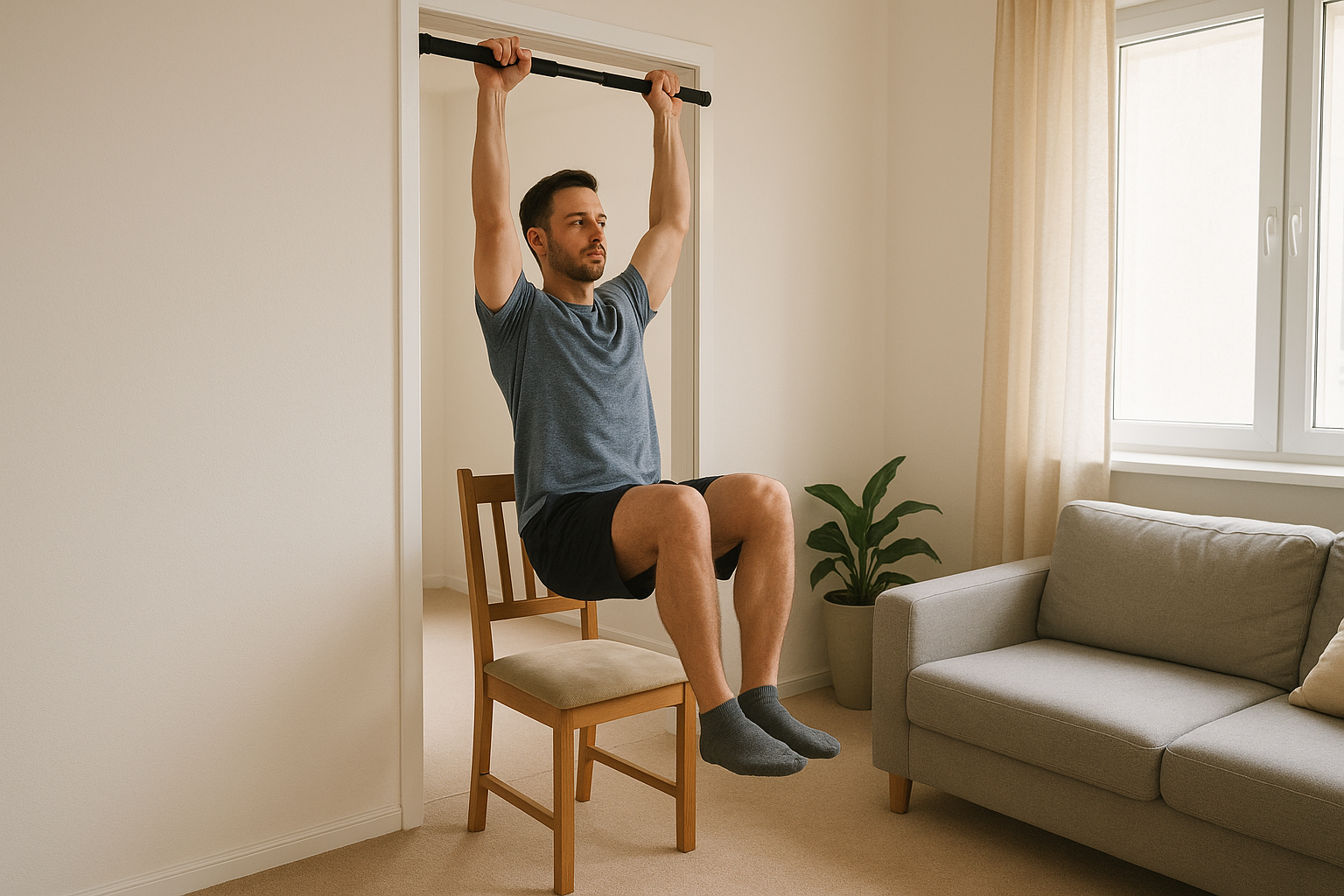
Building serious strength at home does not require a room full of machines. With a simple doorway, a sturdy chair and your own bodyweight, you can train every major muscle group and steadily progress from beginner to intermediate level. This 3-day blueprint focuses on full body bodyweight workouts you can perform in a small space, adding simple tools like a doorway pull-up bar and resistance bands if you want extra challenge.
Essential home setup: doorway, chair and minimal gear
Your basic home gym for this plan is incredibly simple: a solid door frame, a stable chair and some clear floor space. If you want to unlock more pulling and core variations, consider adding a doorway pull-up bar and a resistance band set. A typical doorway bar allows chin-ups, neutral-grip pulls and even hanging leg raises, massively expanding your upper body options. A mixed-resistance band kit adds scalable tension for rows, biceps curls, triceps extensions and assistance on difficult movements like pull-ups or single-leg squats. These compact tools sit perfectly in a small apartment and support years of progressive overload without bulky machines.
Day 1: Push focus – chest, shoulders and triceps
The first day targets your pushing muscles. After a brief dynamic warm-up (arm circles, wall slides, easy squats), perform 3–4 rounds of: incline push-ups with hands on the chair (beginners) or decline push-ups with feet on the chair (intermediates), 8–15 reps; pike push-ups with feet on the floor or chair to emphasise shoulders, 6–10 reps; and bench dips using the chair, 8–12 reps. Keep 60–90 seconds rest between sets. Beginners can reduce range of motion or use the wall for easier push-ups, while intermediates can slow the tempo, add a pause at the bottom, or elevate feet higher to increase difficulty. Aim to add reps or harder variations each week.
Day 2: Pull and core – back, biceps and abs
The second day focuses on pulling strength and a strong core. Use your doorway and chair creatively. For pulling, you can perform door frame rows by gripping the sides of the frame and leaning back, or, if you own a doorway bar, strict pull-ups and chin-ups. Beginners can use a resistance band looped over the bar for assistance, while intermediates work towards slower eccentrics (5-second descents). Pair this with inverted rows under a sturdy table or by bracing your heels against the chair. For core, rotate through planks (forearms on the floor), chair-supported leg raises while holding the sides of the seat, and controlled dead bugs. Perform 3 circuits, 8–12 reps for pulls and 20–30 seconds per core move, progressing by adding time or range.
Day 3: Legs and conditioning – lower body power
The third day is all about leg strength and light conditioning. Start with sit-to-stand squats using the chair as a depth guide (beginners) or Bulgarian split squats with your back foot on the chair (intermediates), 8–12 reps per leg. Add reverse lunges using the doorway for balance and calf raises off a step or thick book. To boost conditioning, finish with a short circuit: 30 seconds of chair step-ups, 30 seconds of fast bodyweight squats, and 30 seconds of mountain climbers, followed by 60 seconds rest; repeat 3–4 times. Beginners can slow the pacing and reduce the work intervals, while intermediates increase speed or add an extra round for a tougher challenge.
Programming, progression and weekly schedule
For best results, follow this 3-day bodyweight program on non-consecutive days, such as Monday (push), Wednesday (pull & core) and Friday (legs & conditioning). On rest days, low-intensity walking or mobility work keeps you recovering well. Progression is key: track your reps and variations in a notebook. Once you can complete the top end of the rep range with good form, move to a tougher variation (for example from incline to standard push-ups, or from chair-assisted to full Bulgarian split squats). You can also progress by increasing time under tension, such as using 3–4 second negatives and 1–2 second pauses at the hardest point of the lift.
Safety, recovery and staying consistent
Even with simple home workouts, safety and consistency matter. Make sure your chair is stable and placed on a non-slippery surface, and that your door frame is solid before performing rows or pulls. Focus on smooth, controlled reps rather than rushing to hit numbers; joint-friendly form will keep you training long-term. Finish each session with a few minutes of light stretching for hips, chest and shoulders, and try to sleep 7–9 hours per night to support recovery. Most importantly, commit to the schedule for at least 6–8 weeks. With a doorway, a chair and smart progression, you will build impressive functional strength entirely at home.









