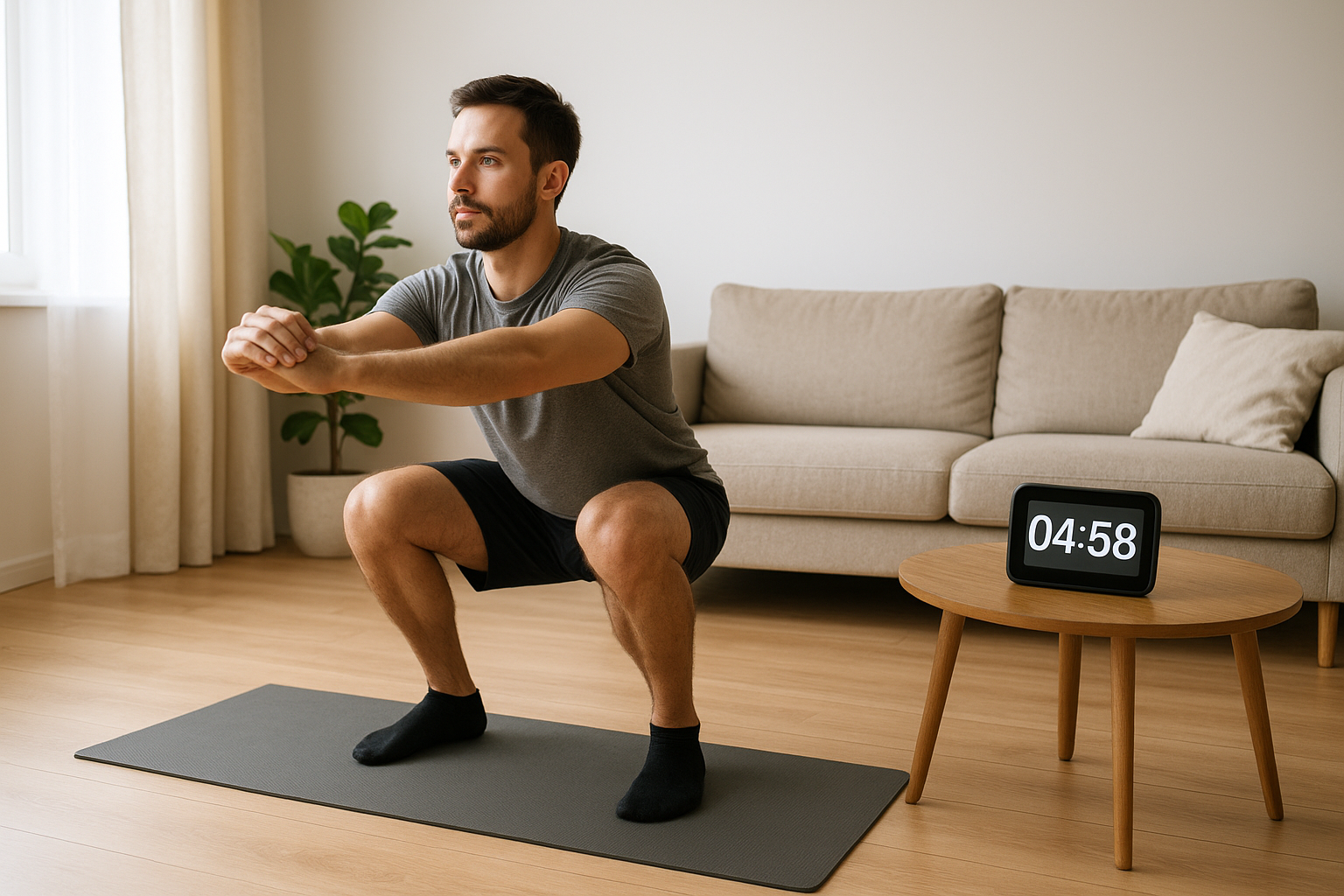
If you want a fast, efficient way to build full body strength and boost your cardio at home, a 20-minute ladder workout is a powerful option. This style of training uses only your bodyweight, so you don’t need any equipment or much space. By gradually “climbing” and then “descending” reps, you get a smooth blend of strength, conditioning and mental focus that works for beginners and advanced trainees alike.
Why ladder workouts are so effective at home
A ladder workout is simple: you pick a few exercises and increase the reps each round (1–2–3–4…) or go up and down the ladder (1–2–3–2–1). This structure keeps rest short and intensity high, giving you both strength and cardio benefits in a tight 20-minute window. Because you only work with bodyweight, transitions are quick and there’s no time wasted changing loads. Ladders also let you auto-regulate: beginners stop at lower rungs, while fitter athletes can climb higher. The result is a scalable, time-efficient workout you can do in your living room, hotel room or any small space.
Warm-up and movement prep in 3 minutes
Before you hit the ladder, spend 3 minutes waking up joints and muscles to move safely and powerfully. Cycle through:
- 30 seconds of marching or jogging in place to raise heart rate.
- 30 seconds of arm circles and shoulder rolls to loosen the upper body.
- 30 seconds of hip circles and bodyweight good mornings for hips and hamstrings.
- 30 seconds of World’s Greatest Stretch (lunge with rotation) alternating sides.
- 30 seconds of inchworms to prime core and shoulders.
- 30 seconds of easy air squats, gradually going deeper.
Move smoothly and avoid pushing to fatigue in the warm-up. The goal is to feel warmer, looser and mentally ready for the focused work of the ladder, not to get tired before the main session begins.
The 20-minute full body ladder: main workout
Set a timer for 20 minutes. Perform this circuit as a continuous ladder, adding 1 rep to each movement every round:
- Push-ups
- Bodyweight squats
- Reverse lunges (each leg)
- Dead bugs or another core move
Round 1: 2 reps of each. Round 2: 3 reps. Round 3: 4 reps, and so on. Rest only as needed to maintain good form. If you reach a round where your form breaks down, drop back one rung and stay there until the timer ends. This structure challenges your full body strength, elevates your heart rate and builds muscular endurance without any equipment. Keep the movements controlled and focus on solid technique over speed.
Beginner and advanced progressions for every move
To make this no-equipment workout work for every level, adjust each exercise:
- Push-ups: Beginners can use incline push-ups with hands on a sturdy table or wall; advanced lifters use full push-ups or decline push-ups by elevating the feet.
- Bodyweight squats: Beginners use a box or chair tap to guide depth; advanced trainees add a pause at the bottom or perform jump squats for extra power.
- Reverse lunges: Hold on to a support if you’re new; advanced athletes use sprinter-style lunges or add a knee drive at the top for balance and core work.
- Core: Start with dead bugs or plank on knees; progress to a full high plank, shoulder taps or hollow body holds as your core strength improves.
By choosing the right progression for each move, you ensure the ladder remains challenging but sustainable, allowing you to complete the full 20-minute session with quality reps.
How to pace, breathe and recover
A common mistake with ladder workouts is starting too fast and burning out early. Aim for a steady pace where you can control your breathing and maintain clean technique. Inhale on the easier part of each movement and exhale on the effort (for example, exhale as you push up from the floor or stand from a squat). If your form slips, take 10–20 seconds of rest, then resume at the same rung or drop one level. After the timer ends, walk around for a minute, then perform a short cool-down with gentle stretches for hips, chest and shoulders. This approach helps you recover faster and makes it easier to repeat the workout two or three times per week.
Putting the ladder into your weekly routine
Use this 20-minute no-equipment ladder workout two or three times a week on non-consecutive days to build strength, cardio capacity and work capacity. You can alternate it with low-intensity walks or mobility sessions to stay active without overtraining. As you adapt, you can experiment with different exercises—such as adding burpees, glute bridges or side planks—while keeping the same ladder structure. Over time, track how high you climb within the 20 minutes to measure progress. With consistency and smart pacing, you’ll develop stronger muscles, better conditioning and greater confidence training at home, all without a single piece of equipment.
This ladder-style home workout proves that you don’t need a gym or gear to train effectively. With just your bodyweight, a timer and a bit of floor space, you can get a comprehensive full body session that fits into even the busiest day.