
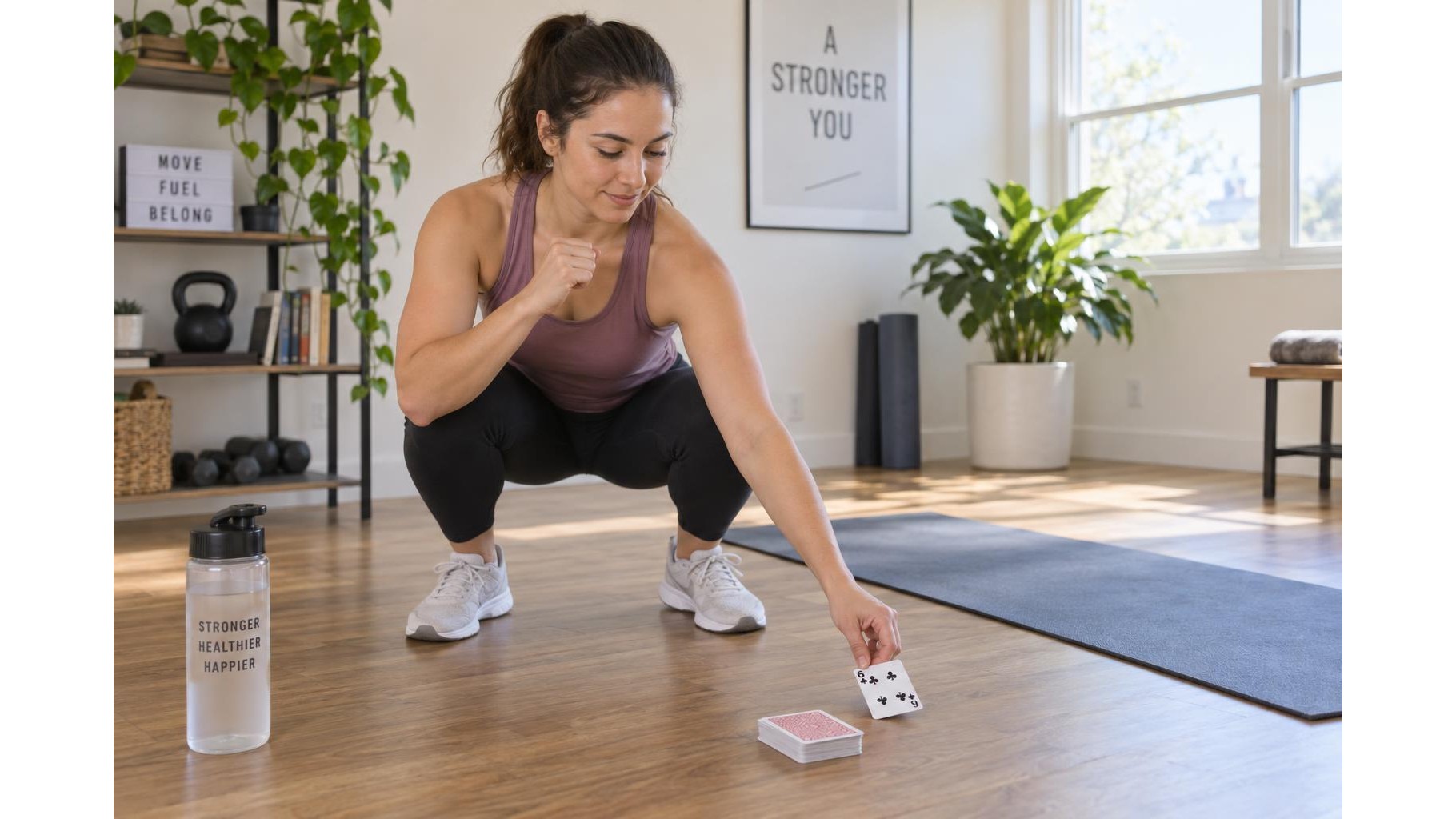
Turn a standard deck of cards into a simple, unpredictable 30-minute home workout. Each suit represents a movement pattern, while the card value determines your reps or work time. You need no gym equipment—just a little floor space, water and a deck of cards. Adjust the rules to suit your fitness level, and keep every movement controlled rather than racing to finish.
Warm up before the first card
Spend five minutes preparing your body before you shuffle. March in place for one minute, then move through arm circles, hip hinges, alternating reverse lunges and easy bodyweight squats. Finish with a few slow incline or wall push-ups. Keep the pace comfortable and use a smaller range of motion if you feel stiff. A warm-up should raise your temperature and help you practise the patterns you will use in the workout, not leave you tired before it begins.
Give every suit a movement
Choose four exercises and assign one to each suit. For example, hearts mean squats, diamonds mean push-ups, clubs mean reverse lunges and spades mean glute bridges. These cover lower-body strength, pushing, single-leg work and the hips. If an exercise does not feel comfortable, swap it for a suitable alternative before you start and keep that choice for the whole session. You can also use standing calf raises instead of bridges if getting down to the floor is difficult.
Let card values set the challenge
Number cards set repetitions: a 2 means two reps and a 10 means ten. Treat an ace as 11, a jack as 12, a queen as 13 and a king as 14—or choose smaller face-card numbers if you are new to training. For an easier timed option, use each card’s number as seconds of work, with face cards capped at 20 seconds. For lunges, count the listed reps across both legs, splitting them evenly. Keep your technique steady, and stop a set early if you cannot maintain good form.
Play through a 30-minute session
After your warm-up, shuffle the deck and place it face down. Set a timer for 20 minutes, draw one card at a time and complete the assigned exercise for its reps or interval. Then take the next card. Rest for 30–60 seconds between cards as needed; take longer if your breathing has not settled. When the timer ends, stop drawing, even if cards remain. Use the final five minutes for an easy walk around the room and gentle stretches. The complete plan is five minutes of warm-up, 20 minutes of card-based work and five minutes of cool-down.
Scale effort with smart adjustments
Beginners can remove some cards, use a 10-minute workout block, cap every card at eight reps or work for 10 seconds per card. Make push-ups easier by placing your hands on a sturdy wall or counter, and hold a chair for balance during lunges. If you are more experienced, use a slower lowering phase, choose a lower push-up variation or draw cards continuously while keeping rests short. Do not add speed at the expense of control. Stop if you feel sharp pain, dizziness or unusual shortness of breath.
A deck of cards makes a flexible way to add variety to bodyweight training, but the goal is not to clear the deck at any cost. Pick movements you can perform safely, adjust the repetitions and rest when needed. With a warm-up, a timed workout block and an easy cool-down, this playful routine can fit into a busy day and be repeated with fresh suit assignments whenever you want a new challenge.









