
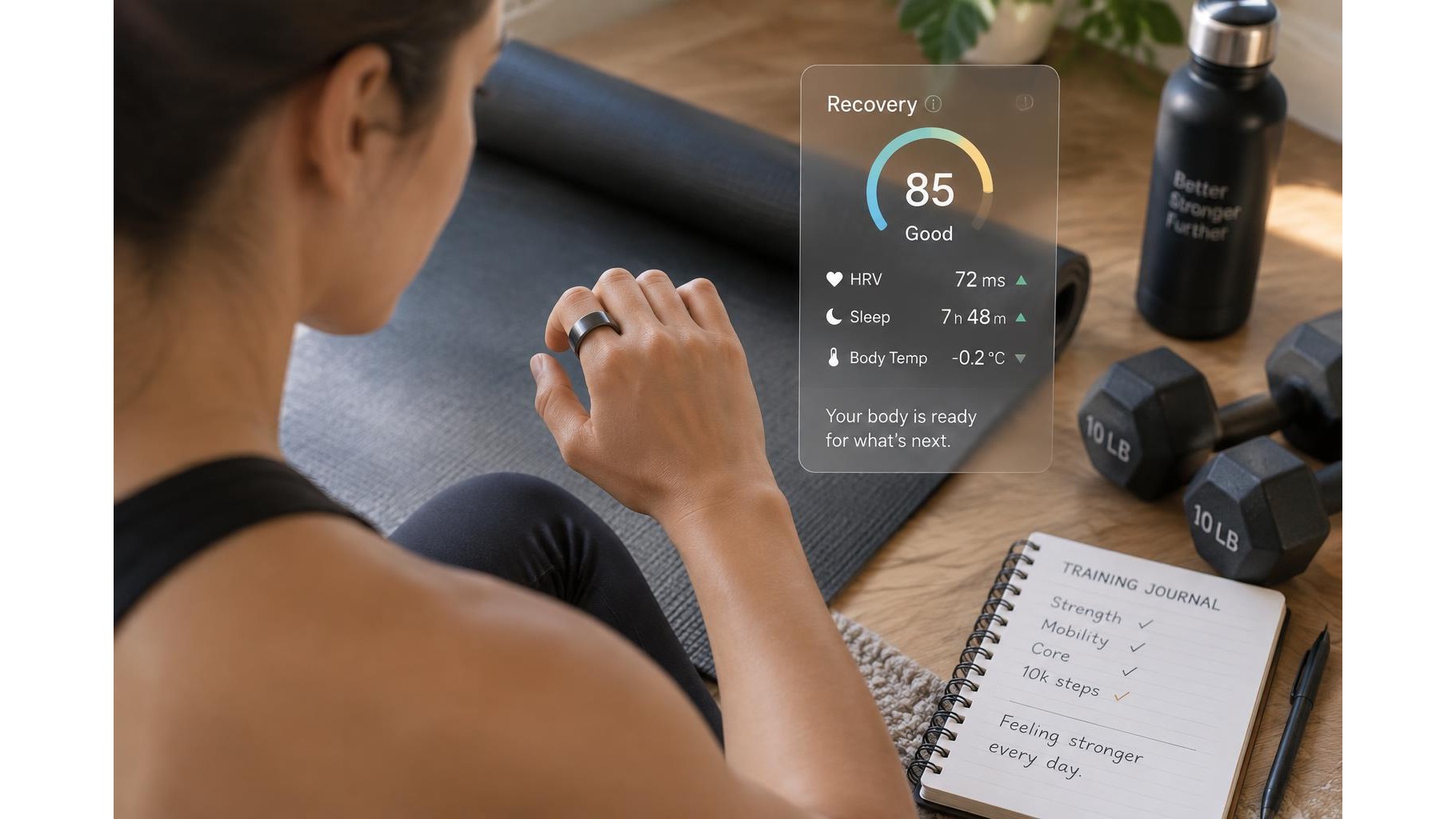
Smart rings can make daily stress and recovery patterns easier to notice, but their scores are not instructions to skip a workout—or proof that something is medically wrong. For home training, the most useful approach is to treat ring data as one imperfect signal alongside sleep, energy and how exercise feels. Look for patterns over time, then make small, reversible adjustments rather than reacting to a single number.
Understand what the indicators represent
Depending on the device, a ring may estimate trends using measures such as heart rate variability (HRV), resting heart rate, skin temperature, movement and sleep. These are indirect signals, not a direct measurement of psychological stress or a complete picture of recovery. A lower-than-usual HRV or higher resting heart rate can occur for many reasons, including a hard session, poor sleep, alcohol, travel or the start of an illness. Check how your ring defines its scores and remember that readings can be affected by fit, sensor contact and ordinary day-to-day variation.
Build a personal baseline before changing plans
Individual baselines matter more than generic “ideal” scores. Wear the ring consistently, follow its guidance on fit, and allow time for the app to establish your normal range. Compare recent readings with your own usual pattern rather than with another person’s results. A single unusual night may be noise; several days moving in the same direction may be more informative. Keep in mind that a baseline can shift with schedule changes, training blocks or seasonal routines, so it is a reference point—not a permanent verdict on your fitness.
Pair trends with sleep, energy and training notes
A short daily log adds context that a wearable cannot capture. Note sleep quality, perceived energy, soreness, mood, illness symptoms and what you trained, including approximate effort. If a ring shows a recovery dip after a demanding home workout and you also feel unusually tired, that combination is more useful than either signal alone. If the score looks low but you feel well and your performance is normal, avoid assuming you are unfit to train. Look for repeated agreement between data and lived experience.
Adjust the session, not your whole routine
When several signals point to reduced readiness, consider a modest change: reduce sets, choose lighter resistance, lengthen rest periods or swap intervals for easy mobility or walking. You can also begin with a gentle warm-up and decide how to proceed based on how you feel. If your energy improves, continue at a comfortable effort; if fatigue persists, keep the session easy or rest. This flexible approach preserves consistency without treating a wearable score as a command. Resume normal training gradually when your usual energy and performance return.
Know the limits and respect symptoms
Smart-ring stress and recovery features are designed to show patterns, not diagnose medical conditions, determine the cause of a symptom or guarantee that exercise is safe. They can also miss relevant context and produce unusual readings. Do not use a reassuring score to dismiss persistent symptoms, and do not use a low score alone to make medical conclusions. If you feel unwell, have concerning symptoms, or notice a persistent change in how you feel, pause hard training and seek appropriate advice from a qualified healthcare professional.
Use ring trends as a prompt to check in with yourself, not as a pass-or-fail grade. A sensible home-training decision combines multi-day patterns with sleep, energy, symptoms and recent workload. Make small adjustments when several signals agree, keep notes to learn what is normal for you, and let your actual wellbeing take priority over any app score.









